this post was submitted on 04 Dec 2025
68 points (97.2% liked)
Linguistics Humor
1592 readers
14 users here now
Do you like languages and linguistics ? Here is for having fun about it
For serious linguistics content: !linguistics@mander.xyz
Rules:
- 1- Stay on Topic
Post about linguistics or language humor & memes - 2- No Racism/Violence
- 3- No Public Shaming No shaming someone that could be identifiable or recognizable
- 4- Avoid spam and duplicates
founded 2 years ago
MODERATORS
you are viewing a single comment's thread
view the rest of the comments
view the rest of the comments
Not necessarily a synonymous (same meaning), but a cognate (same origin). For example:
Meaning went all over the place, but they're still cognates.
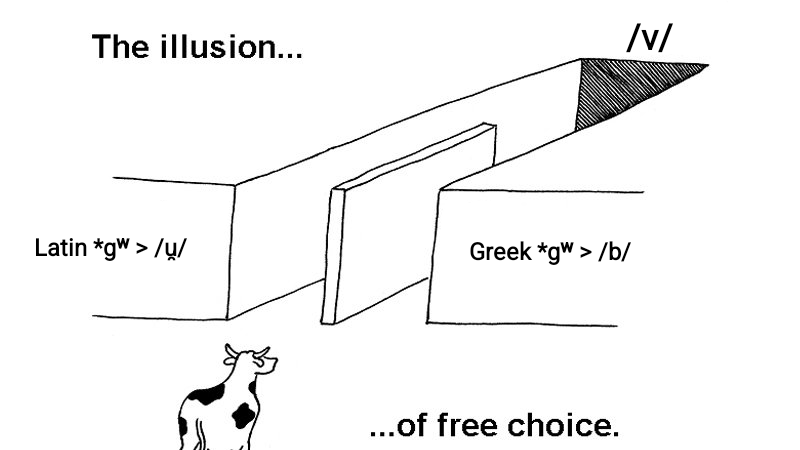
Or, in case you're referring to (*gʷṓws "cattle" - because of the cow): it should have been "vos" /w/ in Latin, but for some reason it ended as "bos" /b/ instead. If Latin didn't misbehave then it would be another example; compare with Greek βοῦς /bu:s/ "cattle, ox" → βόδι /'voði/ "ox"
But you used /w/ for Latin while the meme said /ụ/ (I know I used the wrong diacritic).
I would also use /w/ but I know that the difference between half consonants and half vowels isn't always clear cut and I was curious about the reasoning why to use one over the other.
For phonemes, in some language-specific cases one might be preferable over the other, but for most part they're interchangeable. You could even use something weird, like /Ⅎ/; or do it like Mark Hale did for Marshallese vowels and use emojis. Either way, Latin has such a simple phonemic inventory that you won't see any confusion from using either.
For "raw" sounds it matters a tiny bit, because [w] implies more constriction than [u], while [u̯] implies it's the same as [u] except non-syllabic. Even then, personal preferences matter a lot, so different linguists might transcribe the same stuff differently.
The reason I used "w" in this case is simply convenience — it demands me a single keystroke, "u̯" requires four (after tweaking my .XCompose file for that; otherwise I'd need to copypaste it).
I would argue that in the case of Latin, it's in consonant position, historically the stages before and after are unambiguously consonants and I see no reason to analyze it as a vowel (not saying there is none but I'm not aware of any).
In English "raw" is more ambiguous. Historically it comes from vowels but it doesn't function as one today since it doesn't trigger strategies to avoid hiatuses for example.
Honesty, one motivation for writing the comments is that I'm glad there is activity in this community and I want to push it. I could use more linguistics in my life so thanks for engaging with me!
At least in Classical Latin, as used in late Republican / early Imperial times, it is a consonant. And quite distinct from the vowel. In fact, that "Ⅎ" I mentioned was an attempt of some emperor to spell /w/ [w~β] apart from /u u:/ [ʊ u:]; that wouldn't happen if at least some speakers didn't catch "hey, /w/ doesn't look like a vowel".
But before that, it's way more complicated. The Etruscan alphabet had a letter for /w/, it's ⟨F⟩; but when the Latin alphabet popped up, instead of using it for /w/ they repurposed the letter to /f/ [ɸ~f], and decided to spell /w/ with the same ⟨V⟩ as /u u:/.
Going further back in time the things get even messier, as PIE *u is clearly a syllabic allophone of *w, not its own phoneme. So... "is /w/ a consonant or a vowel?" "yes".
After that (the Romance languages) it depends a bit on the language, but I feel like the mess is back on the menu. That Latin /w/→/v/ is a consonant, sure, but other instances of [w] popped up; either as part of a vowel or as /u/ forced into a syllabic position. For example, in Spanish I'm pretty sure it's being handled as a vowel, because:
It's less ambiguous than your English example with "raw", where the absence of linking-R you mentioned hints it's already a consonant.
You're welcome!
at a casual glance, it looks like a significant difference is that the Latin ellided from a palatal consonant and the Greek from a bilabial to end up at the same phoneme.
Latin [w] is labiovelar, just like [gʷ]; no palatal in this case. The difference is mostly order of operations:
then [β] evolving into [v] in both.
apologies I meant velar, my brain short circuited over "soft palate".