this post was submitted on 04 Dec 2025
68 points (97.2% liked)
Linguistics Humor
1594 readers
20 users here now
Do you like languages and linguistics ? Here is for having fun about it
For serious linguistics content: !linguistics@mander.xyz
Rules:
- 1- Stay on Topic
Post about linguistics or language humor & memes - 2- No Racism/Violence
- 3- No Public Shaming No shaming someone that could be identifiable or recognizable
- 4- Avoid spam and duplicates
founded 2 years ago
MODERATORS
you are viewing a single comment's thread
view the rest of the comments
view the rest of the comments
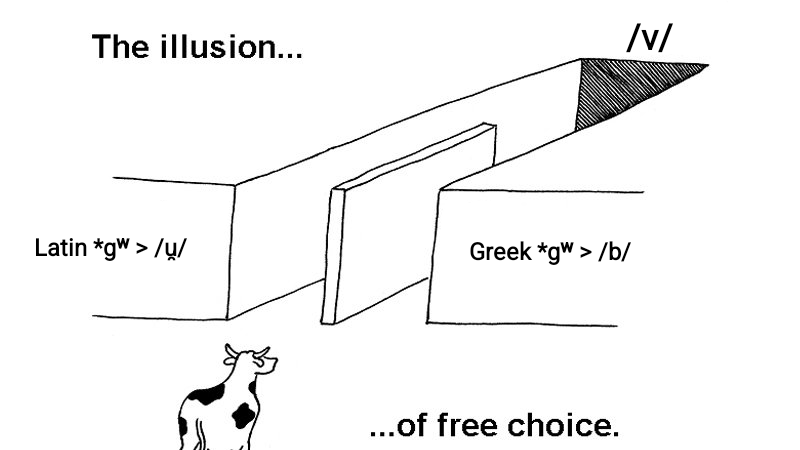
At least in Classical Latin, as used in late Republican / early Imperial times, it is a consonant. And quite distinct from the vowel. In fact, that "Ⅎ" I mentioned was an attempt of some emperor to spell /w/ [w~β] apart from /u u:/ [ʊ u:]; that wouldn't happen if at least some speakers didn't catch "hey, /w/ doesn't look like a vowel".
But before that, it's way more complicated. The Etruscan alphabet had a letter for /w/, it's ⟨F⟩; but when the Latin alphabet popped up, instead of using it for /w/ they repurposed the letter to /f/ [ɸ~f], and decided to spell /w/ with the same ⟨V⟩ as /u u:/.
Going further back in time the things get even messier, as PIE *u is clearly a syllabic allophone of *w, not its own phoneme. So... "is /w/ a consonant or a vowel?" "yes".
After that (the Romance languages) it depends a bit on the language, but I feel like the mess is back on the menu. That Latin /w/→/v/ is a consonant, sure, but other instances of [w] popped up; either as part of a vowel or as /u/ forced into a syllabic position. For example, in Spanish I'm pretty sure it's being handled as a vowel, because:
It's less ambiguous than your English example with "raw", where the absence of linking-R you mentioned hints it's already a consonant.
You're welcome!