kchr

joined 2 years ago
[–] kchr@lemmy.sdf.org 2 points 1 month ago* (last edited 1 month ago)

There is no such thing as the Whisper protocol, AFAIK.

Signal uses the Signal protocol, formerly known as TextSecure due to Signal being a merge of the earlier (proprietary) projects TextSecure for encrypted messaging and RedPhone for encrypted voice calls.

The two projects were initially started by Whisper Systems, co-founded by Moxie Marlinspike and Stuart Anderson. The name of this company may be the cause of confusion, but the protocol has to my knowledge never been called anything else than TextSecure and subsequently Signal.

Whisper Systems was acqui-hired by Twitter who then open-sourced both projects under the GPL license, after which the Open Whisper Systems organization was created by Moxie to continue development on what later got merged into the Signal project as we see it today.

The protocol uses the Double Ratchet algorithm (a.k.a. Axolotl Ratchet) for cryptographic key exchange, invented specifically for secure messaging and use in Signal (although naturally open source and applicable for oher use cases too).

Wikipedia (understandably) has a nice timeline over the various projects:

https://en.wikipedia.org/wiki/File%3ASignal_timeline.svg

End of nerd snipe transmission, over and out. :-)

[–] kchr@lemmy.sdf.org 1 points 1 month ago* (last edited 1 month ago)

In Sweden there were computer magazines that came with a CD-ROM that had at least one new Linux distro on it with every issue. I had so much fun trying them all out on my computer and noting down what I liked the best with each of them.

Sometimes when I was home alone for an extended period of time, I used to install a distro on the shared family computer as well, to use as a router and have the feeling of running a real server (so far I had only experienced UNIX/Linux servers via restricted shells on public services over dialup, but never as root...).

Before the family returned home I would reinstall Windows 95 and they would be none the wiser. At least I think so...
[–] kchr@lemmy.sdf.org 2 points 1 month ago

In case you haven't already explored existing browser alternatives, Qutebrowser is a keyboard-driven browser that can be infinitely extended as it is written in Python and you have full access to the browser API (including the low-level internals) in your configuration file. You can import any Python modules you need, and it has native support for ad blocker lists + userscripts (Greasemonkey et al).

[–] kchr@lemmy.sdf.org 1 points 1 month ago

This is actually a great idea, especially if it also supported recurring payments. I've terminated all my subscriptions to various streaming services and am planning to instead use that money for monthly donations to FOSS projects I use - such a service would help, both for payment and possibly discovering other projects I haven't thought about that offer ways to donate!

[–] kchr@lemmy.sdf.org 3 points 1 month ago (1 children)

The United States Packet Service will see to that TCP/IP packet of yours.

[–] kchr@lemmy.sdf.org 3 points 2 months ago* (last edited 2 months ago) (2 children)

And then you can pull out ServiceNow out of your sleeve the next year, and do thing all over again!

[–] kchr@lemmy.sdf.org 4 points 4 months ago

I'm sure the Antifa Corporation Ltd is involved with this operation at some level...

[–] kchr@lemmy.sdf.org 3 points 4 months ago (1 children)

I know what you mean, but it's not what you said. :-)

Just wanted to point out that they still have monopoly on the enterprise side of organization infrastructure, which is huge - the number of companies running production systems on self-hosted Linux infrastructure are orders of magnitude fewer than those that don't, even if the number of Windows servers in total might be fewer.

Microsoft gets paid per employee, per application suite and per cloud service (if Azure is involved for the AD) - not only per server. They were very early on the recurring subscription model almost every SaaS provider is leaning into nowadays, even for on-prem stuff.

[–] kchr@lemmy.sdf.org 4 points 4 months ago* (last edited 4 months ago) (3 children)

Not really. Almost every Windows-based organization over a certain number of employees will use some shape or form of Active Directory (whether on-prem or in Azure) and most likely also Office 365, which is corporate/enterprise infrastrucure that is really hard to migrate away from once you built your IT and processes around it.

All the license fees for just retaining access to and being able to onboard new employees in that infrastructure is a huge portion of the budget for these organizations.

They just gave up the war on competing with UNIX/Linux on the non-enterprise production infrastructure side, since there were no money to be made there.

[–] kchr@lemmy.sdf.org 1 points 7 months ago* (last edited 7 months ago) (1 children)

You forget the other side of the coin with using a rolling distro like Arch - you more or less have to keep updating the system a couple of times per week, especially if you want to be able to install new packages with a lot of dependencies.

Not saying I personally have any problems with it, but it's worth mentioning when talking about how quick and easy it is to update the system (which it truly is)... ;-)

[–] kchr@lemmy.sdf.org 23 points 7 months ago

Lisan al Gaib!

[–] kchr@lemmy.sdf.org 5 points 7 months ago

No, it was explicitly called out as a flaw:

You would have to do it between the camera and the data centre, so yes, still possible, but doing it at a later date would be very hard.


cross-posted from: https://lemmy.sdf.org/post/27058788

The 38th Chaos Communication Congress (38C3) takes place in Hamburg, 27.-30.12.2024, and is the 2024 edition of the annual four-day conference on technology, society and utopia organised by the Chaos Computer Club (CCC) and volunteers.

Scheduled talks: https://fahrplan.events.ccc.de/congress/2024/fahrplan/schedule/

Streaming and recordings: https://media.ccc.de/c/38c3

Congress offers lectures and workshops and various events on a multitude of topics including (but not limited to) information technology and generally a critical-creative attitude towards technology and the discussion about the effects of technological advances on society.

Starting in 1984, Congress has been organized by the community and appreciates all kinds of participation. You are encouraged to contribute by volunteering, setting up and hosting hands-on and self-organized events with the other components of your assembly or presenting your own projects to fellow hackers.

53
submitted 1 year ago* (last edited 1 year ago) by kchr@lemmy.sdf.org to c/technology@lemmy.world
 

The 38th Chaos Communication Congress (38C3) takes place in Hamburg, 27.-30.12.2024, and is the 2024 edition of the annual four-day conference on technology, society and utopia organised by the Chaos Computer Club (CCC) and volunteers.

Scheduled talks: https://fahrplan.events.ccc.de/congress/2024/fahrplan/schedule/

Streaming and recordings: https://media.ccc.de/c/38c3

Congress offers lectures and workshops and various events on a multitude of topics including (but not limited to) information technology and generally a critical-creative attitude towards technology and the discussion about the effects of technological advances on society.

Starting in 1984, Congress has been organized by the community and appreciates all kinds of participation. You are encouraged to contribute by volunteering, setting up and hosting hands-on and self-organized events with the other components of your assembly or presenting your own projects to fellow hackers.


For those that are looking to install GrapheneOS and want to ensure that their banking apps work as intended, here is a curated list with app compability status per country.

Each entry also lists required settings, profile and whether they need access to Google Play services, among other details.

Update on 2024-12-23: The following site is a great resource as well, it provides details on MFA support for various services grouped by country (not only banking): https://2fa.directory/

Thank you @jagged_circle@feddit.nl for the suggestion!

125
submitted 1 year ago* (last edited 1 year ago) by kchr@lemmy.sdf.org to c/sysadmin@lemmy.world
 

cross-posted from: https://lemmy.world/post/22872422

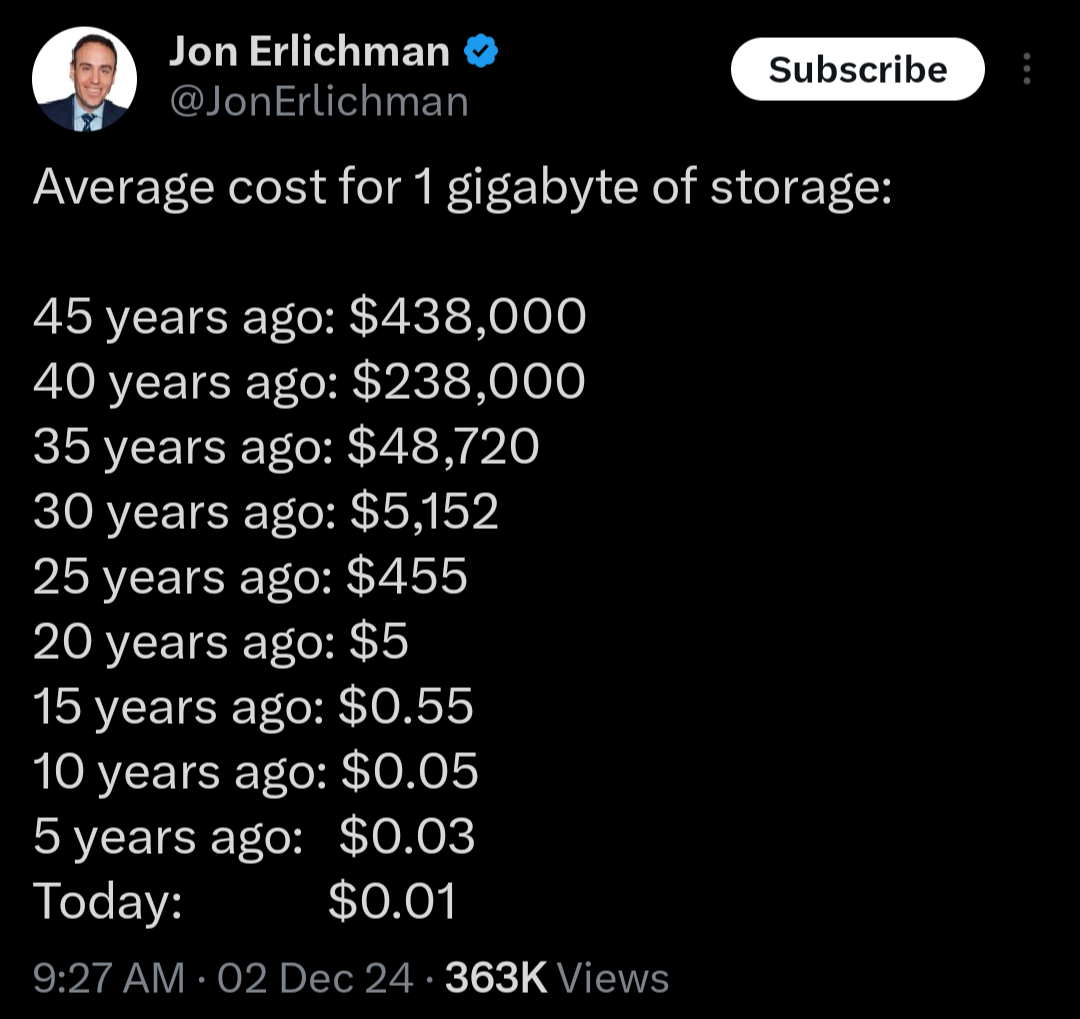
Screenshot of a Twitter post by user JonErlichman

Average cost for 1 gigabyte of storage:

45 years ago: $438,000 40 years ago: $238,000 35 years ago: $48,720 30 years ago: $5,152 25 years ago: $455 20 years ago: $5 15 years ago: $0.55 10 years ago: $0.05 5 years ago: $0.03 Today: $0.01

 
view more: next ›