ProbablyKaffe

joined 4 years ago
[–] ProbablyKaffe@lemmygrad.ml 21 points 5 months ago (2 children)

tupac was a new afrikan communist

[–] ProbablyKaffe@lemmygrad.ml 12 points 9 months ago* (last edited 9 months ago) (1 children)

https://ssnp.online/%d9%85%d8%a8%d8%a7%d8%af%d9%89%d8%a1-%d8%a7%d9%84%d8%ad%d8%b2%d8%a8-%d8%a7%d9%84%d8%b3%d9%88%d8%b1%d9%8a-%d8%a7%d9%84%d9%82%d9%88%d9%85%d9%8a-%d8%a7%d9%84%d8%a7%d8%ac%d8%aa%d9%85%d8%a7%d8%b9%d9%8a/

https://ssnp.online/%d8%ba%d8%a7%d9%8a%d8%a9-%d8%a7%d9%84%d8%ad%d8%b2%d8%a8-%d9%88%d8%ae%d8%b7%d8%aa%d9%87/

They have a website (link is in arabic it might look funny without rendering).

I don't have a good collected source but some bullet points about them:

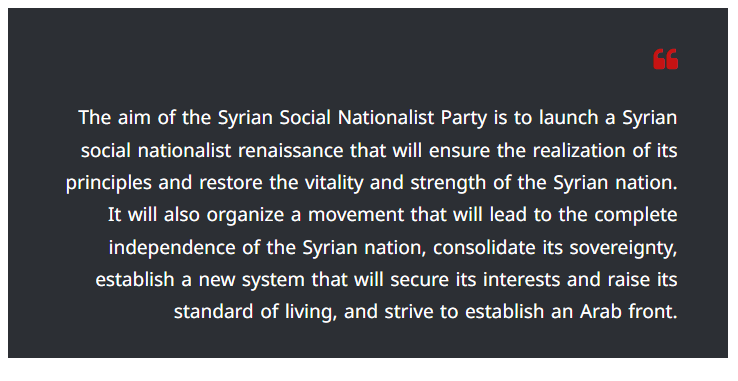
  • The symbol is a merger of the Christian Cross and the Islamic Crescent, creating a pinwheel iconography, has nothing to do with the Nazis. The party is secular but these are the two largest faiths of Syria and Lebanon and wanted to bridge religious sectarianism and antagonize the partition of governments by faith.
  • They were founded during French-ruled Lebanon I believe, one of their main points is that they want to bring Syria and Lebanon back together under one state. They were partitioned into Christian dominated and Muslim dominated states from effectively one historic country/region. The Social National party is secularist and views the division on religious grounds as unnecessary (for instance, the president of Lebanon must be a Christian). So this aspect, of bringing together a reunited Syria, is their main claim in Syrian (and Lebanese) politics.
  • Not fascists, take no inspiration from fascist movements.
  • Not Marxist, though some members are (but in practice most Marxists in the region were usually Communists or Baathists). They are mostly secular vaguely left liberals, some conservatives, kinda like a KMT-type coalition (which can obviously devolve into something nasty/reactionary).
  • Their main main allies have historically been other Syrian Nationalist parties, including the Arab Nationalists. SSNP believes in a historic and unified Syria, but recognize Syria is an Arab nation, and wants to first build a Syrian state and then a greater Arab state. Their disagreements with states like the United Arab Republic then are, order of operations based. They often had issue with Syria being dictated by a power centered in Egypt. The Baathists (Arab Socialists) then, sat in the middle, viewing either route more from a Scientific Socialist lens, i.e., what is necessary to get the job done of defeating Imperialism. This made the Baath party and SSNP fairly good allies and they dominated the United Front in Syria basically until last year. They had some beef with Iraq Baath because it used the Neo-Colonial Iraq borders and didn't align its interests solely with the historic "fertile crescent", historic Syria. The Baath trying to exercise a more practical reality with sharing a country with Persians and Kurds gave them real differences. SSNP had decent ties to the Palestinians and the Communists, or rather, they often had enough common cause to work together.
  • Like basically every major party in the region, they have an armed wing distinct from the Syrian Army.
  • They generally do not like the new regime, are critical, and will likely dip in and out of armed struggle with it, but are willing to work with it to secure Syrian interests (in practice -- combatting Zionism mainly).
  • One last thing, their party interests might seem quite niche, and it is. They are quite institutional, and being coalition members in the previous state, they maintained a lot of independent power alongside the Baathists. They were also big historically in diaspora communities. In the region, a lot of parties basically propose a model of government, more-so than a specific ideology. Or rather, main distinguishers of their ideology is their vision of statecraft, because these are countries that sprang into existence during anti-colonial resistance or overthrow of monarchal regimes. Though, this may not be foreign to Leftists after all.
[–] ProbablyKaffe@lemmygrad.ml 2 points 1 year ago (1 children)

Oh yeah. Not only landlordism, but landownerism, people who care about "property values". Half of land owners are actively workers and half of landlords came from the working class. Overall, it's like the renting LA is paying dues to the land-market so that it is valuable when they buy into it. Not like this is a conscious action of individuals, it's just how the relationship between rents and land values works in the US.

[–] ProbablyKaffe@lemmygrad.ml 4 points 1 year ago (3 children)

Right, value is a measure of abstract labor embodied into commodity, right? There is a dollar amount that represents the total mass of value created in a year, approximates as Global GDP. Wages are prices paid to access that labor-power, and profit is obtained by paying less than that value of labor-power and trying to sell its precipitates closer to the real value. Wages paid, on average, are the portion of the value of labor-power that is required to reproduce said labor power. Workers in total take home about ~51% of global GDP, we can round to a half, workers take home, directly in wages, about half of global GPD. Workers on average, work about 2000 hours per year. So there is an estimate for the global value of labor per hour: (Gobal GDP/(Num Workers * 2k hours)) around ~$13/hr of labor. Since half is taken by workers directly, the global average wage is ~$6.5/hr, meaning that's on average how much it costs to produce a worker in the world today.

Globally, Capital has to purchase an hour of labor for less that $13 to make a profit. So what's going on in the US, where 94% of labor-power is purchased for more than that, where on average, USian labor-power is sold for ~$58 (2023, assuming 1800 hrs, 27T GDP, 62% labor share), where, if the US existed in a vacuum, USian labor-power is worth in wages ~$85?

What's going on?

Well, specifically, because the US Bourgeoisie, the Imperialists main bloc, are monopolists, they get to command the prices labor-power over many more workers than just those that exist in the US. They purchase many times more labor-power in the Global South than they do from US (Global North in general), and they also purchase it for cheap, duress prices, significantly lower than even the average wage (which represents 50% exploitation). They purchase so much of this labor-power at such a low price, and make such big profits from it, that they can over-pay a numerically smaller group of workers in the Imperialist countries. It makes a lot more sense to take more surplus-value from very distant workers who barely know you exist, vs the ones who live across town. If the draw from the distant workers is large enough, then even a bulk of workers near "home" for the Imperialists can be given, or exact from them, prices for labor-power more expensive than its worth, but, by keeping them close and satiated, the overall systems is more profitable than it would be if all of the workers in the world were paid below value. Since the Imperialists made commodities from the distant workers cheaper by paying them lower wages, when those commodities are transformed into other commodities, the Imperialists account the value added as created "at home", so the GDP of the US appears to be more significant than the actual value of labor-power it contains, because it is accounting the labor of the distant workers as its own. Dependent, smaller Bourgs are let in to keep them from competing with the Imperialists, by offering them the same prices as the Monopolists are able to obtain globally, so this allows Capitalists without a global labor force to match the high wages paid to the "home" workers of Imperialists. This is why doing such calculations within a US factory floor, can produce numbers that look like above.

So what does this mean for wage struggle relations between the GN and GS workers? Well, when one side struggles and gets back a proportion of profits, the Capitalists as a class have created a two-tier labor hierarchy, protected by deadly borders. They have a tendency of shifting the burden to the other workers. GN wages tend to go up, GS wages tend to go down. Real productivity gains in the collective production of humanity increase all wages, or the pool of available value, up over time. However, the gap between GN and GS wages are widening year over year. These wages aren't abstract either, they are ultimately how much labor-power workers are able to purchase. So in the end, the wage gap is what allows GN workers to consume more labor-power, in calories, cars, meat, clean water, roads, gasoline, electricity. Anyway, this balancing act puts GN and GS workers in contradiction, and ultimately, profitability is determined mostly by the ability to exploit GS labor in much larger quantities. To actually attack profits, a struggle must be coordinated internationally to ensure the GS workers aren't taking the burden for GN struggles, and that the Imperialists can't just pass on the burden to the other group. Generally, the global working class contradiction is only lessened by GS struggles, because it's the small minority of workers of the GN who are already receiving a share of profits globally.

[–] ProbablyKaffe@lemmygrad.ml 4 points 1 year ago

Investigated deeper into this so-called "basket of American dream essentials":

  1. Housing that "guarantees safety" (segregated)
  2. Insurance premiums, laundry services, hygiene and cosmetics
  3. Eating out
  4. Driving 15k miles and getting hotels and food on the road
  5. Year round babysitter for children under 4, seasonal for school age

  1. College degree for each child without student loans (lmao?)
  2. Toys and youth sports (haven't checked the quantities)
  3. Smartphones, computers, television sets, streaming services
  4. Running shoes + "clothing"
  5. 6 movies and 2 MLB games every year for a nuke family

[–] ProbablyKaffe@lemmygrad.ml 9 points 1 year ago (1 children)

Tamils have lived on the Island for over 2000 years and their angst against the Republic is for issues in the last two centuries with land grabs and displacement targeted at them. Referring to them being "colonizers" is very irrelevant to the struggles in the country.

[–] ProbablyKaffe@lemmygrad.ml 20 points 1 year ago* (last edited 1 year ago)

i've been saying this, and Canada is just a front for the Hudson Bay Company

the settlers are along for the ride

[–] ProbablyKaffe@lemmygrad.ml 1 points 1 year ago

Using python makes it much easier to maintain scripts especially if they are useful for many people. I like bash for adhoc stuff on my machine or my sandbox, but most of my coworkers are not strong in it so it's not good for prod ops.

[–] ProbablyKaffe@lemmygrad.ml 3 points 1 year ago* (last edited 1 year ago)

Rural land is organized in communes, you can move to the countryside from the city, but you must be invited into the commune or rent from it as a tenant, costing you for the privilege of using their land.

The cities are only so big as they are developed, and growth takes time and energy. Due to the market, living in the cities costs more, so you can move from the countryside to the cities, if you can afford it (i.e. stable job), which is hard because the city can only plan for so many jobs in any given time.

Moving like that is difficult, and is more expensive than staying put, because the real economic cost of such a move has an expensive impact on the whole economy. This applies everywhere, which is why some lineages haven't left Southside Chicago or South Central LA since it those neighborhoods were redlined, and the life expectancy is almost a decade shorter than the metro average:

Movement only "feels free" in the US, because much of the population is able to pay for the freedom of movement (using surplus labor).

This system is also partially why many of the big cities are provinces in their own. It gives provincial, and hukuo powers to the urbanites to decide how they want to grow (within the constraints of the overall state plan). In the US, instead it's often people with freedom cash pushing out existing urbanites, sometimes into the outskirts, sometimes into more concentrated enclaves, sometimes onto the streets.


Criticism of "Questions of Settler-Colonialism in the U.S."

The article in question: https://www.cpusa.org/article/questions-of-settler-colonialism-in-the-u-s/

This is a response to a CPUSA published article concerning the topic of Settler-Colonialism in the US. I quote the article at length so you cannot miss any points they have made. Wrote this right after reading, there's likely mistakes in here. Feel free to crit me and ask for sources and stuff. This is not a formal response, and I do not represent any org here, this is comradely crit for an article carrying theoretical mistakes. I'm criticizing from the angle of a New Afrikan. Emphasis is mine unless I reformat better and have to make the distinctions clear.

To let the piece open itself:

The question of settler-colonialism and its place in the web of contradictions in the U.S. have resurfaced, and of the Communist Party’s position, so it bears addressing. Without a concrete answer to these questions, our party’s ability to help build a mass movement and unite the working class will be weakened significantly.

The document provides its preferred definition of Settler-Colonialism:

Settler-colonialism is a form of colonialism that is different from regular, or franchise, colonialism. Rather than wanting to exploit the Indigenous population, like in franchise colonialism, settler-colonialism seeks to drive an indigenous population off their land by any means necessary and exploit it for the profit of the private owners of the means of production.

The piece posits that "regular" Colonialism intends to exploit the Indigenous population, while settler-Colonialism intends to expropriate and remove them. That both of these behaviors exist in all colonial structures is ignored. The settlers of Rhodesia not only violently occupied land used by Africans, they also exploited African labor by continuing to deny them access to resources except through wage labor or zero-wage labor, slavery. Whether exploitation or expropriation is used is actually an evolution in the relations between Indigene and the Occupation. Under English colonization, the Pequot people were first exploited for their productive capacities, then removed from their lands where a significant portion of them were sold into slavery to be exploited away from their land-relations. Smashing the Pequot came about because they stood in the way of settler control over regional trade, a condition that developed from relations where Pequot and English traded in mutually beneficial relations.

The United States was formed on a settler-colonial basis. What is a more disputed question, however, is whether settler-colonialism still exists. It should be clear that setter-colonialism still exists in this country, exemplified by Indigenous communities’ constant and ongoing struggle against it and for their rights and sovereignty. Indigenous communities have to fight for recognition of their treaties, defend from environmental degradation by illegal pipelines, medical and police malpractice and racism, theft of community resources with legal rights totally disregarded.

Indeed these are many ways Settler-Colonialism still exists, but these are each individual events and the article has not yet described the structure. Even within the definition of simply removal, the continued state of removed perpetuates the colonization. Indigenous people face hardships like disrespected treaties and police violence because they are continuously removed from their land-relations. They venture into bordertowns because they are deprived of sustenance. They are exploited if not destroyed because they were expropriated.

The trail of tears and the near extinction of the buffalo serve as examples of historical atrocities committed by settler-colonialism, though it should be stressed that settler-colonialism is not an “event” but actually a structure of oppression. Individual white settlers were incentivized to settle land based on price, entrepreneurship, and the competition with other sources of labor such as the influx of immigrants and slaves. We’re seeing the atrocities of settler-colonialism right now in Israel, with the settlements in the West Bank, the genocide in Gaza, the 76 years of occupation, and the constant violation of Palestinian rights within Israel itself as well as apartheid. Settlers without a direct connection to the state will steal homes, block aid trucks going into Gaza, or produce fabricated stories and videos for news and social media to justify the atrocities. If this represents contemporary settler-colonialism in Israel, how then does it appear in the U.S.?

The article attempts to address the structure, and here acknowledges that settlers are incentivized (by labor conditions internal to the occupation) to settle new lands. Sure, but this is not a full picture. In locations where the settlements are already established, where land has been deprived from Indigenous people and settled, why then, would the standing army of the United States be [vanguarding the extermination of buffalo]? (hint, it might have to do with the resistance) Do settler interests fundamentally define the nature and behavior of the US state? Is the settler civil-society a component of statehood? Why does the IDF shoot to kill Palestinians who dare to fight back against the Israeli squatters? Why do these squatters burn fig orchards and pour concrete into wells? These settling interests must be intertwined with statehood on a deep level. These questions can be answered with another, why is Gaza bombed when these "settlement events" are taking place in distant regions of Palestine? The answer is resistance, Settler-Colonialism is a structure because its basis is perpetually questioned by resistance. If we look to the definition by Wolfe:

In short, elimination refers to more than the summary liquidation of Indigenous people, though it includes that. In its positive aspect, the logic of elimination marks a return whereby the native repressed continues to structure settler-colonial society. It is both as complex social formation and as continuity through time that I term settler colonization a structure rather than an event, and it is on this basis that I shall consider its relationship to genocide.

The IDF defends people filling wells in arid regions (that they themselves could be using!) because Palestinians resist and pose a threat to any settler. The US military sponsored ecocide, and maintains a heavily armed population because Indigenous resistance remains, there is something to competing in land-relations to the US, perpetually altering the structure of US society.

The article continues:

It must be stressed that settler-colonialism laid the basis for the further development of capitalism as a mode of primitive accumulation, and settler-colonialism only came into existence due to the development of capitalism and the pursuit of profit. Capitalism drove the process of settler-colonialism. However, as Lenin noted, American capitalism developed at a rate never seen before and ultimately, as settler-colonialism “closed the frontier” and Indigenous people were driven onto reservations and more of their land became occupied, settler-colonialism as a system began to shrink.(1) The amount of land-relations to be destroyed and exploited became increasingly small.(2) As monopoly capitalism developed within the U.S., settler-colonialism evolved within the context of this development. The enforcement of colonial law no longer was done by individual settlers, but by the capitalist class.(3) It became primarily driven not by the homesteader and the pioneer, the petty landowners of the 18th and 19th centuries, but the big landowners of agricultural and industrial capital.(4) Especially when putting into consideration the rapid industrialization of the country, the proletarianization of most of the population, and the shrinkage of the petty-bourgeoisie.(5)

The first part of this segment tries to answer the chicken-egg of Colonialism and Capitalism by putting one before the other, when only in certain situations is that apparent, and broadly, these are co-constitutive processes. Then let's address the next five points:

  1. Incorrectly posits that the class of settlers is distinctly those who have taken land. Says nothing about their relationship as continued occupiers, and says nothing about their relation to the broader network of property relations that is the Settler-Colonial Capitalist system. These frontier-persons are simply one way in which the Occupation came to control resources. The more common manner towards the "end of the frontier" (an event that was claimed by said entity, not found in reality) was sending the standing army, men such as the so-called "Buffalo Soldiers" or George "Hang Them All" Wright and his Military Division of the Pacific. In fact, nearly all of those who were profiting off of settler expansion were members of the colonial militias and later US standing army.
  2. Land-relations here is seemingly referring to Indigenous individuals, by claiming the amount of land-relations and stolen labor had been decreasing. In the sense that there were less land to steal, because more and more land had been stolen, this somewhat makes sense. However, is it reasonable to define the structure of theft by how much left there is to steal, and ignoring the mountain of already stolen things? This is the problem with limiting definitions of Set-Col to land-theft and murder, because in this frame we can only describe individual events of stealing, failing to describe the structure.
  3. All settler classes have relations as a civil-society to colonial law. Rarely has any capitalist themselves personally been the executor of state law. This point doesn't make sense. All settlers are in different contexts, executing Settler-Colonial law.
  4. How did big landowners come into existence? Buying land from small landowners if they did not take it themselves. Accumulation of this property is a relation internal to the Settler Colony. The total wealth of the colony did not change unless resistance was able to remove that property from the settler occupation's grasp.
  5. The petty-bourgeoisie has never shrunk. Land-ownership rates are at an all time high in the 2nd half of the 20th century and this first part of the 21st century. In fact, the PB has grown if we are including definitions of Labor Aristocracy (workers who are paid more than the global value of labor). In the 2008 (edit: previously 2010) the 210M landowners and business owners in the US owned more wealth than all publicly traded companies in the world combined. Such fantasies of a "disappearing middle-class" is just one revisionism Settlerism brings to the movement. [Point clarification found at the bottom]

This became evident by big companies taking over the role in exploiting Indigenous lands rather than individual settlers with the permission and helping of the capitalist state. There are many judicial cases concerning oil and land rights that could be looked at. Roxanne Dunbar-Ortiz writes about this in her book An Indigenous People’s History of the United States.

US civil-society no longer exists on Indigenous lands, because Capitalism developed?

By the 20th century, settler-colonialism had done its dirty work by almost wiping out the Indigenous population, from a population of over 60 million before Columbus’ voyage in 1492 to 237,196 in 1900. The struggle against settler-colonialism and capitalism became increasingly intertwined, more so than ever before.

It's extremely disingenuous to compare the estimated (by Ortiz) total population of the Americas in 1492 to the population of Indigenous people in the US in 1900. The founding of the US in 1776 is closer to us now in time than it was to Columbus's landing. The total native American population in 1900 was some 4-5M people, it is now up to some 45M people. In the US alone it went from some 240k to some 7 million people today. It's estimated that over 100k Indigenous people in the US (claimed territory) died from 1860 to 1900 due to colonial policies such as boarding schools (40k children dead or missing from th start of the schools to today). Settler-Colonialism was not just the theft that causes death, but the continued exclusion that prevents populations from recovering to pre-disaster levels. This continued exclusion raised the white/settler population of the US by hundreds of millions over this period.

This leads into the most controversial question, who constitutes a settler in the United States today? Are all white workers settlers like some believe? We first have to understand what it means to be Indigenous, and what it means to be a settler. As these two social relations are linked to each other through the dynamics of settler-colonialism. Nick Estes, a citizen of the Lower Brule Sioux Tribe, said in Our History is the Future regarding the history of our people:

“Next to the maintenance of good relations within the nation, an individual’s second duty was the protection of communal territory. In the east, the vast wild rice patties and seasonal farms that grew corn, beans, and squash demarcated Dakota territory. In the west, Lakota territory extended as far as the buffalo herds that traveled in the fertile Powder River country. For Dakotas, Lakotas, and Nakotas, territory was defined as any place where they cultivated relations with plant and animal life; this often overlaid, and was sometimes in conflict, with other Indigenous nations.”

With this, we can conclude that Indigeneity is a social relation defined by the persistence of long-standing communal links and Indigenous identities in a specific place. The relationship to a specific homeland or territory is important, but the loss of direct ties to land does not rule out Indigeneity. Rather, the continuity of belonging to a particular mode of life and community is essential.

Here is a conflation of the definition of nationhood as organized by the Oceti Sakowin, with a definition of Indigeneity. The quote is almost irrelevant to the conclusion drawn. Where the conclusion fails is the insistence that a "particular mode of life and community is essential" (which works better for nations, but not Indigeneity). This insistence posits that Indigeneity ends when a particular mode of living ends, say, if every time you go to collect your three-sisters, a settler shoots you. Rather, it's the continued threat of being shot by an occupier (or other forms of exclusion) that makes one's interrelations (nation, community, tribe, lands) Indigenous. It also insists that if a Dakota person starts growing Eurasian wheat or African rye, a practice learned from outside their internal national relations, they cease being Indigenous. What if the nations starts using Dutch firearms, or start to grind their corn with water-mills? Such definitions posit that Indigenous nations are only Indigenous if they are frozen in time, which is convenient towards events-thinking rather than systems-thinking. A structural relationship, like that between an oppressed people and an oppressor people, where both are subject to internal and external relational evolution, escapes the definitions pushed by the article.

A settler is a one who is outside these land-relations, and plays an active role in negating them. This does not mean that one has to personally enforce colonial laws, rather it means that they directly benefit from the participation in the destruction of these land relations. There are many factors to being a settler. An important factor of being a settler, though this is not the sole characteristic, is being a socio-political citizen of a settler-colonial society. This means that “in law and in social practice, one has the full rights of belonging to the settler-colonial nation, and is recognized as such in ideology.”

Nowhere did the article define what a settler-colonial society is, we have to assume from what came before that they mean the interrelations internal to the occupation. They are defining a nation of settlers. So then, how does one fall outside of this nation, by not benefitting directly, apparently. However, the food one eats, the place one sleeps, all of this property was accumulated by the settler occupation, how are these not direct relationships to the total relationship between settler-colonial society and Indigenous societies? One must think Proletarians as a class did not benefit from the expropriations of peasant-lord relations, even if they were once peasants themselves. Directness is never defined.

The question arises: what does it mean to be a socio-political citizen in the US? What does that entail and what defines it? If we go based solely on race lines, arguing that being white is what makes one a socio-political citizen and therefore all white people are settlers, then we have to ask: what about the Black bourgeoisie? We could go based solely on class lines to define this, but that also carries contradictions. What about those who objectively enforce colonial laws but aren’t bourgeois? Like the police or the army? All these factors have varying weights, but none are the sole nor main characteristic of being a settler as they’re all important and interact with each other.

Contradictions make the system living. There are classes of Indigenous and "arrivant" populations that can benefit from the motions of settler-colonial development. These are contradictions we well understand when we are talking about "regular" Colonialism and Neo-Colonialism, yet for some reason we have to revise such notions when speaking of Settler-Colonialism. The development of one's class can contradict the development of their nation. Though it is not wise to limit such notions to "race", which is a product of national antagonisms and not the source. Former slaves working to subjugate other Indigenous peoples including their own kin is one of many really existing contradictions that give Settler-Colonialism and Capitalism life.

Being a settler depends on actively exploiting a dominant population in active use of the land, expropriating their agriculture, and laboring them upon their soil. Even with the force of its armies, the capitalist class could not have completed the task of violence on its own since there was simply too much to be done. In that sense, being a settler played a unique role. As we witnessed later in Klan deputies and today’s armed West Bank settlers, it was an early manifestation of a fascist paramilitary that was de facto supported by the state. It has evolved in the current context of the development of monopoly capitalism in the US.

The existence of an army, and of settlers (a form of army), is a definite sign that the Capitalist class cannot meet all ends by their own means. Class collaboration is always necessary for Imperialism, whether a joint venture from the start or by engaging in relations with expropriated property afterwards. At that point the Imperialism is validated. Any class of settler is capable of starting an Imperial venture (and they have), but all classes need to validate it eventually (there is room for struggle here). The average settler-worker does not put much effort into upholding settlerism, because their interests as a class are efficiently organized in the settler-state.

The capitalist class are very much settlers, as they directly profit from the destruction of Indigenous land relations and the violation of their sovereignty and drive settler-colonialism in the US. Those who are part of arms of the state, such as the army or police, are settlers as they are involved and work within a system which personally enforces colonial laws, and soldiers and officers harass tribal members daily and incarceration rates for Native American people are 4 times higher than the rate of white people. Native Women are particularly targeted. We also see those workers who work under companies who exploit Indigenous lands and engage directly in the destruction of these land-relations as settlers, as these workers directly benefit from it and participate in the destruction of these land-relations. We should also include those who gain residencies or employment at the expense of Indigenous land-relations, as well as those in bordertowns and engaged in bordertown violence. Bordertowns, as defined by The Red Nation in their book The Red Deal, are:

“…settlement[s] sitting outside of a Native reservation. Some examples include Gallup, New Mexico, Santa Fe, New Mexico, Winslow, Arizona, and Rapid City, South Dakota. Bordertowns emerged from the dispossession, relocation and ethnic cleansing of Indigenous people. The function of a bordertown is to exploit the identity, labor, and death of Indigenous people.”

Most of this segment of the article is correct, however, reduced. For fear of contradiction (that give life), they'd like to argue that Indigenous people with government jobs are settlers. They are however, not settlers, even though they are in class relations antagonistic to decolonization and ultimately to the liberation of their nations. This contradiction exists because of the under-development of their nations due to Settler-Colonialism. The US government onboarding more and more Indigenous people is also a contradiction for itself, as writers like Red Nation have access to means of production to facilitate revolutionary study and spread it amongst the population. So too, did Fanon have the bourgeois education and employment, partially colonizing his own continent, but contradictorily gaining skills that eventually helped his people overthrow their colonizers. The last segment, defining Bordertowns, misses an extended manifesto by Red Nation that defines:

All land is Native, and all settler towns and cities are bordertowns. There is no "rural" or "urban," no "rez" or "city"; there is only the border­town. The border exists everywhere settler order confronts Native order. Everything in a settler world is a border. Our persistent survival is the primary contradiction and the unresolvable crisis of settler colonialism. Settlers enforce the logic of bordertowns to overcome this contradiction. This is their primary job and the essence of their existence as settlers. They are born vigilantes in the making, taught to fear Native people and to see Native society as a threat. These are the conditions that give life to the vio­lence of settler society. The Indian must be eliminated for no other reason than that we represent an alternative political order, one that precedes settler society and that holds within it the destruction of settler reality.

All settlements within US claims are Bordertowns. All USians who are not Indigenous are settlers. Other Colonialisms, such as slavery and apartheid, are sometimes sources for a third, "Arrivant", population in the dynamic, but what is actually going on is the vacillation of this segment of classes between decolonization and colonization. This contradiction surfaces in reality such as when the Buffalo Soldiers, former slaves, were fighting Indigenous peoples on behalf of the Texan regime in the Texan "frontier", which was simultaneously practicing settler colonialism against Freed communities in East Texas.

Most white workers do not see the benefits of settler-colonialism because it is no longer dominant or ubiquitous as it once was. Land relations have continuously been destroyed, confined to the land within reservations. Due to the dominance of capitalism, and the finiteness of these land relations in modern day, most white workers do not see the direct benefits of settler-colonialism and neither do they participate in the destruction of these relations.(1) White workers, of course, do benefit from the ideological superstructure of white supremacy which has maintained itself in a systemic form, defined by the dominance of capitalism However, while white supremacy is a tool used to oppress Native Americans, it is different from settler-colonialism, though both are connected.(2) Ultimately the working class has a material interest in ending capitalism and any system of oppression as it divides the working class and makes their collective power weaker.(3)

A 3-point response:

  1. Land-relations are not confined to reservations whatsoever. If that were the case, the Bolt-Decision would not even exist. As well, continued land-relations exist for all Indigenous communities, threat from the settler-society for performing such relations is ongoing. The NoDAPL protest would not have occurred because it does not cross existing reservation lines. Yet, the Oceti Sakowin rallied by the thousands to protect the water. This is a very confused point, which again relies on events-thinking to comprehend. White workers (in fact, all USians) in this one example, would continue to benefit by having more control over the global value of the dollar with access to fuel provided by DAPL. This is again contradictory for even the Lakota people on the Standing Rock Reservation. This leads to the broader contradiction, that US Imperialism relies on the continued subjugation of Indigenous national interests to provide high wages and excessive consumption to the vast majority of US workers. But again, using the corrected definitions, the idea that Indigenous land-relations are marginal and "vanishing" ignores facts like the US nuclear capable submarine base lying directly in a former Pequot village (whose refugees are in a nearby reservation). Also, notice that Gaza's fighters are predominantly refugees, which "descendent" is one of the ways Palestinian refugees are defined by the UN.
  2. White-supremacy is an ideology, developed in to handle two simultaneous colonialisms, chattel-slavery and Settlerism, referring to Red Nation's work again:

The language of disparities depicts the logic of elimination at the heart of settler colonialism as a kind of historical or political accident or aberration that should be confronted not through decolonization strug­gles over land but, rather, through political reforms to existing systems and institutions. The "white supremacy as aberration" logic seeks to blunt Native resistance to the settler state. Liberalism, in other words, is offered as the solution to white supremacy. Among the solutions liberalism offers are assimilation and state recognition, which is to say that the solution to white supremacy is found in the expansion of the settler state, which is based on and can't exist beyond white supremacy. White supremacy, however, is better understood as an organiz­ing logic of settler and slave society-a logic that gives meaning and momentum to settler colonial violence.

White supremacy is not an aberration of the liberal capitalist state; it is its mirror image. After all, settler colonialism destroys to replace. The "disparities" that appear to describe white supremacy are not aberrations at all but, rather, reflect settler colonialism's unfinished and ongoing goal of the total dissolu­tion of Native society. The "solutions" the liberal capitalist state offers to white supremacy are the smallpox-infected blankets of ongoing settler colonialism.

  1. Sure, but this is also reductive, because it ignores contradictions! The same questions as to why the German working class ended up on the side of Nazism is the same question why Israelis and Americans have yet to throw away their states and Bourgeois classes. What is missing from this, is a study of these contradictions and a strategy to parse friend from foe, change the conditions, and then again pick friend from foe! Missing from most of CPUSAs work on the subject is the realm of strategy. Questions such as how do we fracture the elements of the working class upholding Imperialism from the elements of the class seeking to destroy it? Some workers right now are enemies, but we can remove the conditions that reproduce enemies amongst that class through struggle. Trying to pick the biggest majority of allies is the stench of Trotskyism clouding the movement's vision. CPUSA tells us we are dividing the movement, but they have never gathered more than a few thousands "revolutionaries" at any given time, never bigger than what showed up to NoDAPL. Contradictions within the movement is what makes it weak. We must struggle through the most coherent relationships to change the base of society, to create more allies.

If white workers aren’t settlers, what are they? Some analysts of settler-colonialism use a third term, arrivants. Coined by Kamau Brathwaite and elaborated on by Jodi Byrd, the term is used to “signify those people forced into the Americas through the violence of European and Anglo-American colonialism and imperialism around the globe.” This is still, however, unsatisfactory because it still produces a non-answer when non-Native folks of white descent don’t actively exploit Native lands or play an active role in the negation of Indigenous land-relations as part of their social relation.

All social relations, as Marx outlines in the German Ideology, depend upon one’s relations to the means of production. White people are only exposed to the ideology in the predominate quality and quantity determined by the material conditions to which they are subjected. Therefore, an individual’s “choice” regarding how they relate to the means of production is determined by their level of consciousness. This decision is a privilege. Regardless, this only indicates that, at best, their privileged opportunities expose them to a higher degree of bourgeois class entry (more often than not, this embodies them into the petty bourgeois in an attempt to attain that higher level). This still remains the basic concept of false consciousness that Engels categorized, even if there is a crumb of truth in factors of luck.

Already addressed above, white workers are settlers (they also aren't the only settlers that are also workers), Arrivants are a vacillating set of classes dependent on the motions of the Indigenous-Settler relation. We are only confused here because we are afraid to have contradictions within our (attempted) Marxist definitions. The continued deprivation of the Indigenous land-relation is a definite part of the settler and arrivant state of being. Attempting to offload Settlerism onto property ownership fails to acknowledge that one's whole nation can rise on the backs of others, i.e. Imperialism and Labor Aristocracy, or even simply settler-workers.

There were settlers who oftentimes were promised their own land and homes in order to escape being poor. That’s what the ideological basis of settlerism was alongside the invention of racism, it has simply changed form today. Today, in an attempt to escape “the rat race,” white people can struggle with their other oppressed workers or adopt a false white supremacist consciousness, but they will always be workers until their class relations change.

Settlerism is not an ideology, and ideologies that advance Settlerism were developed after settlement was underway. Settlerism is a form of Imperialism.

We can tweak the definition of arrivant to be something more broad to fit this analysis, such as those who are part of social structures which dissolve those land-relations, but lack the citizenship and agency of settlers, or we can coin a new term to define those who do not fit into any of the existing three categories such as descendant. A descendant is one who is a descendant of any of the other three categories, whether that be indigenous, settler, or arrivant, but do not fit into either of these three categories. This new term would take the definition of the former suggestion. That being, those who are part of social structures which dissolve those land-relations, but lack the citizenship and agency of settlers. However, this is not conclusive.

Re: Palestinian refugees example.

The rest of the article:

Therefore, I call on the party to continue discussing this issue to develop these theories through the process of democratic centralism, and applying theory to practice. I also call on the party to focus its sights on the development of an Indigenous Commission which would work on developing theories relating to settler-colonialism and indigenous liberation, as well as focusing on the work of indigenous struggles.

We should recognize that these categories are not static. They can change and have done so. For example, there are historic examples of arrivants becoming settlers due to their participation in the destruction of indigenous land-relations. Like the Black buffalo soldiers who fought on the side of Manifest Destiny. All of this ultimately leads us to the conclusion that to end settler-colonialism in the United States, realize self-determination for the Indigenous nations, and decolonize the U.S., capitalism itself must also be ended. Socialism cannot be realized without decolonization, without addressing the settler-colonial question. We must tear down the prison house of Indigenous nations. Landback and the restoration of Indigenous sovereignty is only the start of it, rather than the end. It is a part of the minimum program. As Joe Sims said in his Main Report to the 32nd National Convention:

“And we know that a huge debt still has to be repaid to the victims of the genocide and slavery. And that repayment must include upholding Native peoples’ demand for Land Back, restoration of sovereignty and compensation for its violations, upholding treaty rights, harm reduction, and shared responsibility. I mean at a minimum. And that’s a beginning, not the end.”

The one thing of importance to pick out here is the question of Buffalo Soldiers becoming settlers. I agree, that a segment of the Freed-Black (New Afrikan) nation joined in on Settler-Colonialism. The New Afrikan nation should have, and should, consider the Buffalo Soldiers internal enemies, subject to eradication. Ideologies that celebrate them should be rooted out and destroyed. Such is the power of nationhood, regulated kinship, and the internal struggle amongst classes in an oppressed nation. Same goes for the "Black Bourgeoisie" or any other classes we discover through practice, are too unreliable to be helpful. That being said, the "Black Bourgeoisie" can be brought closer or pushed away from New Afrikan Liberation in different contexts, we should at all times move like water and use the strongest contradictions to turn any situation in favor of Communist revolution.

Clarification on the wealth calculation: the 2008 stat does not represent the lower 80% of USians, it was total real estate wealth (which the majority is owned by the bottom 80%). Total wealth owned by the bottom 80% in 2022 was over 50T dollars, with the setback of 10T (in 2008 dollars) from the financial crash. The market cap of the US in 2022 was estimated at 40T, so "regular USians" owned more wealth than the corporations. The total world market cap was 94T in 2022. These stats show that "regular USians" are significant wealth holders on the global stage, even with financial crises. This is also running with the idea that "regular USians" don't exist in the top 20% of incomes, since in 2022, you'd just need $150k household income to reach it, and 9% of households exist between 150k and 200k. The 99% (which predominantly still excludes capitalists, who are usually less than the 1%), easily dwarfs global corporate wealth holding around 110T dollars.
[–] ProbablyKaffe@lemmygrad.ml 20 points 2 years ago (2 children)

tell them specifically what they did wrong and why they shouldn't do it, explain how their behavior could backfire on them


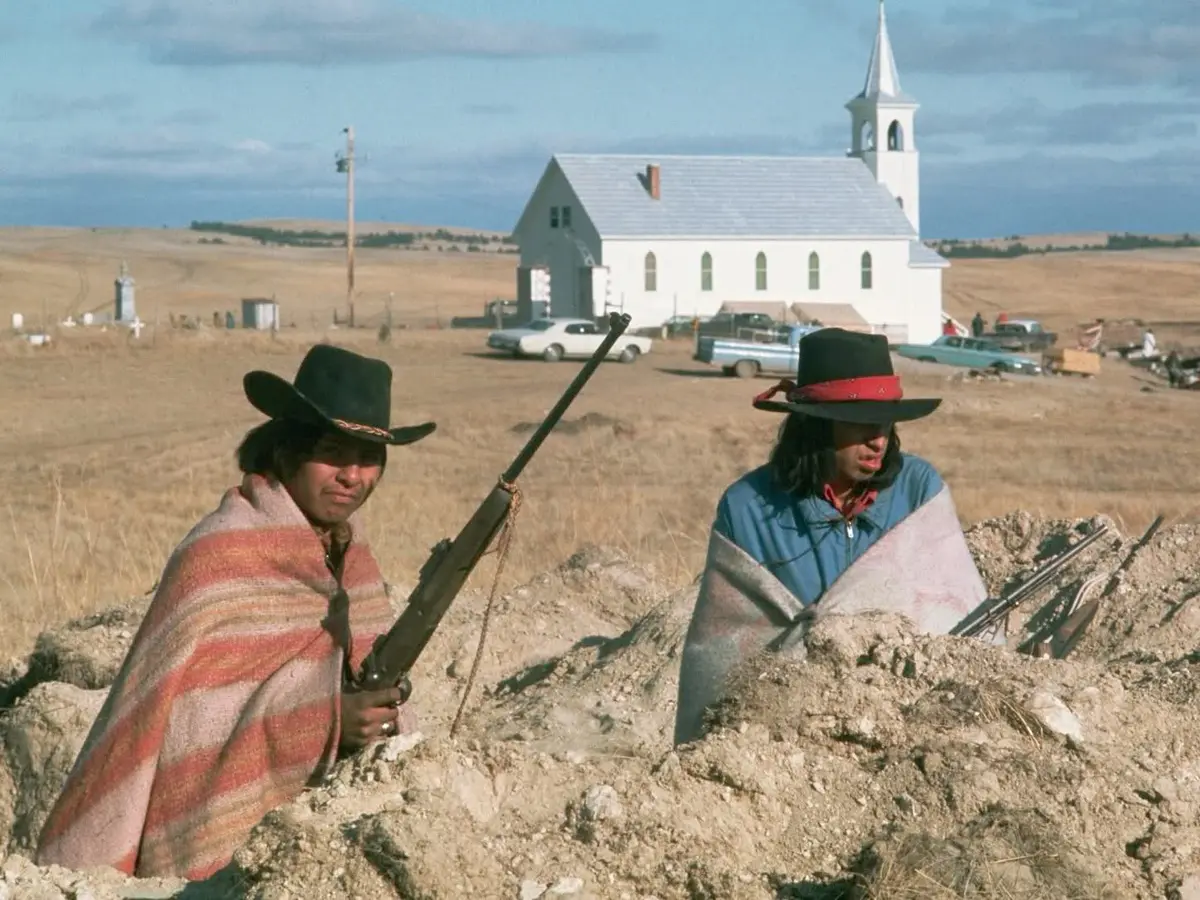
X-posting late, but in preparation of a post on Captain Cook incoming. CLN posts have been covering a narrative leading into the Occupation of the Wounded Knee hamlet by AIM in 1973.

OG Post on Hexbear: https://lemmygrad.ml/post/3566703?scrollToComments=true

From perspective of @ChunkaLutaNetwork@hexbear.net:

We last left you discussing the concept of the bordertown and the racialized violence enacted there through settler vigilantism, which is obvious through physical violence. In a new era, however, what about online discourse? This is one thing I’d like to introduce to our discourse and hopefully help settler allies understand when they might accidentally dawn a hood and cape for the state. I see settler vigilantism as synonymous with Kluxism, or at least they stem from the same psyche. The spirit of Manifest Destiny seemingly possesses these settlers to act out in monstrous ways, depriving us and themselves of humanity and life. There are no more bounties to collect for a scalp, so this shows these actions to murder Indians are deeper than just monetary gain. It is always about the land. Briefly we spoke on Raymond Yellow Thunder and Wesley Bad Heart Bull, both victims of settler vigilantism. Raymond died due to injuries sustained in a fight, and Wesley was stabbed in a fight at a bar. Both resulted in AIMs activism, and ultimately pushed them further to Wounded Knee. Raymond Yellow Thunder was killed before the Trail of Broken Treaties in 1972, and inspired the famous “AIM Song” which is actually the Raymond Yellow Thunder Song and should be respected as such.There is a great deal of controversy still surround Raymond’s death, but from every perspective I’ve heard one thing remains true; it is colonialism that murdered him.

Colonialism’s claws come from many directions, and it brings death in a systemic, planned and targeted manner, contrary to Engels' view of social murder. In a colony that target gives a slight reprieve for the colonizing nation’s working classes, and seemingly at the root of every boot strap story, is a mystified deluge of the eldritch horrors of capitalism and colonialism. These horrors which possess, steal, and murder are often described as primitive accumulation by contemporary Marxists (or the motor of capitalism), the tongue-in-cheek humor often becomes lost. Primitive accumulation which once derided the ruling class's view of themselves, now it is used by chauvinists to be synonymous with pre-Columbian political-economy. In the case of the Oceti Sakowin, we remained primitive in the eyes of these chauvinists until 1868. The people who make these arguments don’t seem to realize the cloak and hood they have proudly proclaimed as their own, but to us the colonized, we see the same two mouths our white siblings have become known for.

English is known for its one word with many meanings, or perhaps many words with the same sounds, but each uniquely specific. In the case of Wesley Bad Heart Bull we can see this most clearly in the settler’s courts, which proclaim law and order, but really only on behalf of the landowner. When there is no clear land owner, it's about which party most represents the landowners. In a settler-colony with a case of assault with prior consideration to ‘kill him an Indian’ it is of course manslaughter when you kill somebody who was fighting another person. This is of course sarcasm, generally speaking when you “accidentally” kill someone it is still a degree of murder especially with prior expression to want to kill an Indian, and when the assailant wasn’t involved in the fight. Murdered in the street like so many before and after, and that was a well known fact of life in South Dakota. You could be murdered and like Raymond or Wesley, your attackers might get charged with a small fine and manslaughter, but when you ask every settler when justice comes they all play innocent. This is why AIM went to the streets. When you ask Pine Ridge elders when AIM became a symbol, you are told the Gordon protest. When Russell Means took the Chief of Police’s hat and threw it, David Swallow Jr recounted his feelings as “we can do that?” This is where a fire was reborn that still carries on today, as my nation’s president banned Kristi Noem from our reservation after she tried to stoke xenophobic fears at a rally. We are standing once again, and it is time to stand with us and learn our revolutionary history.

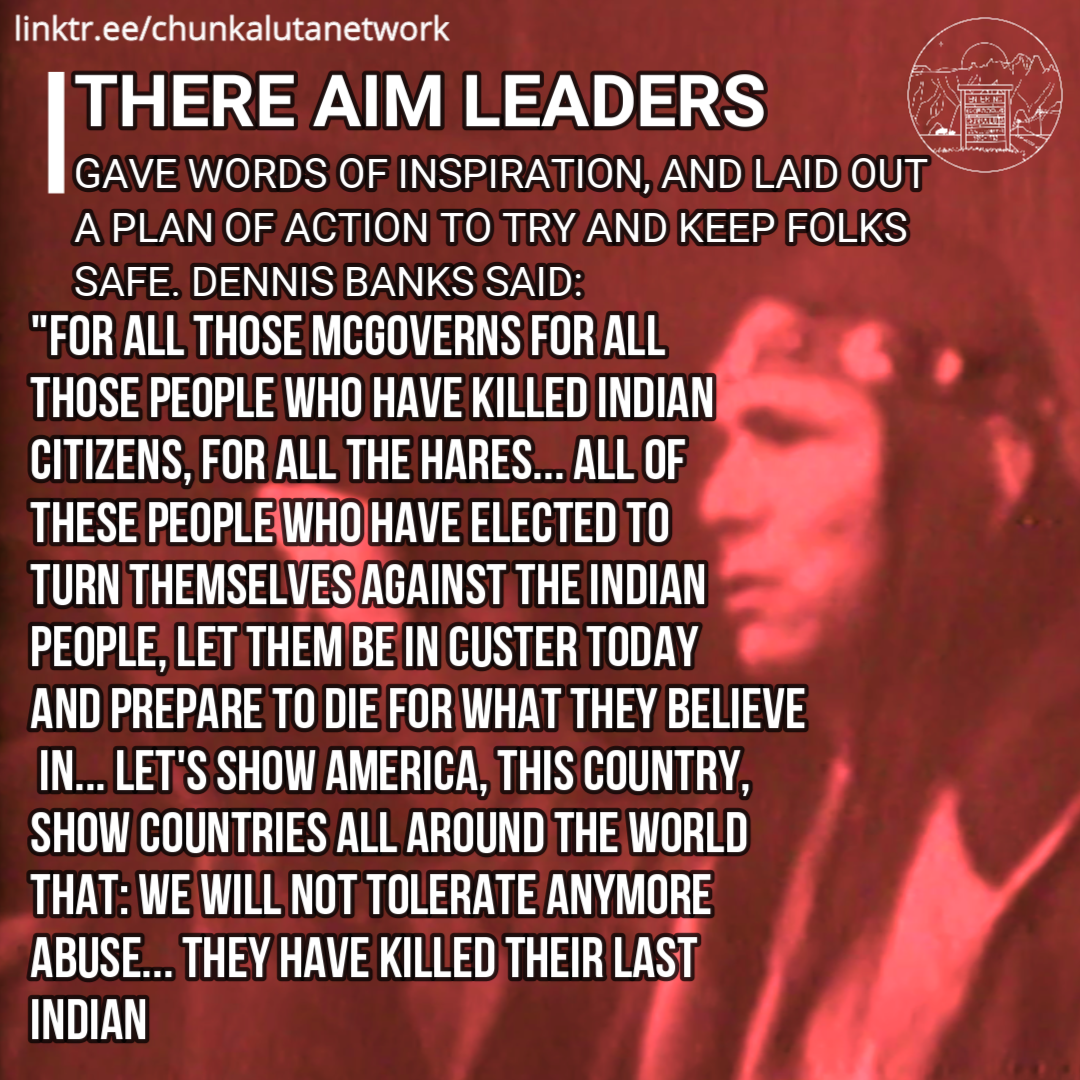
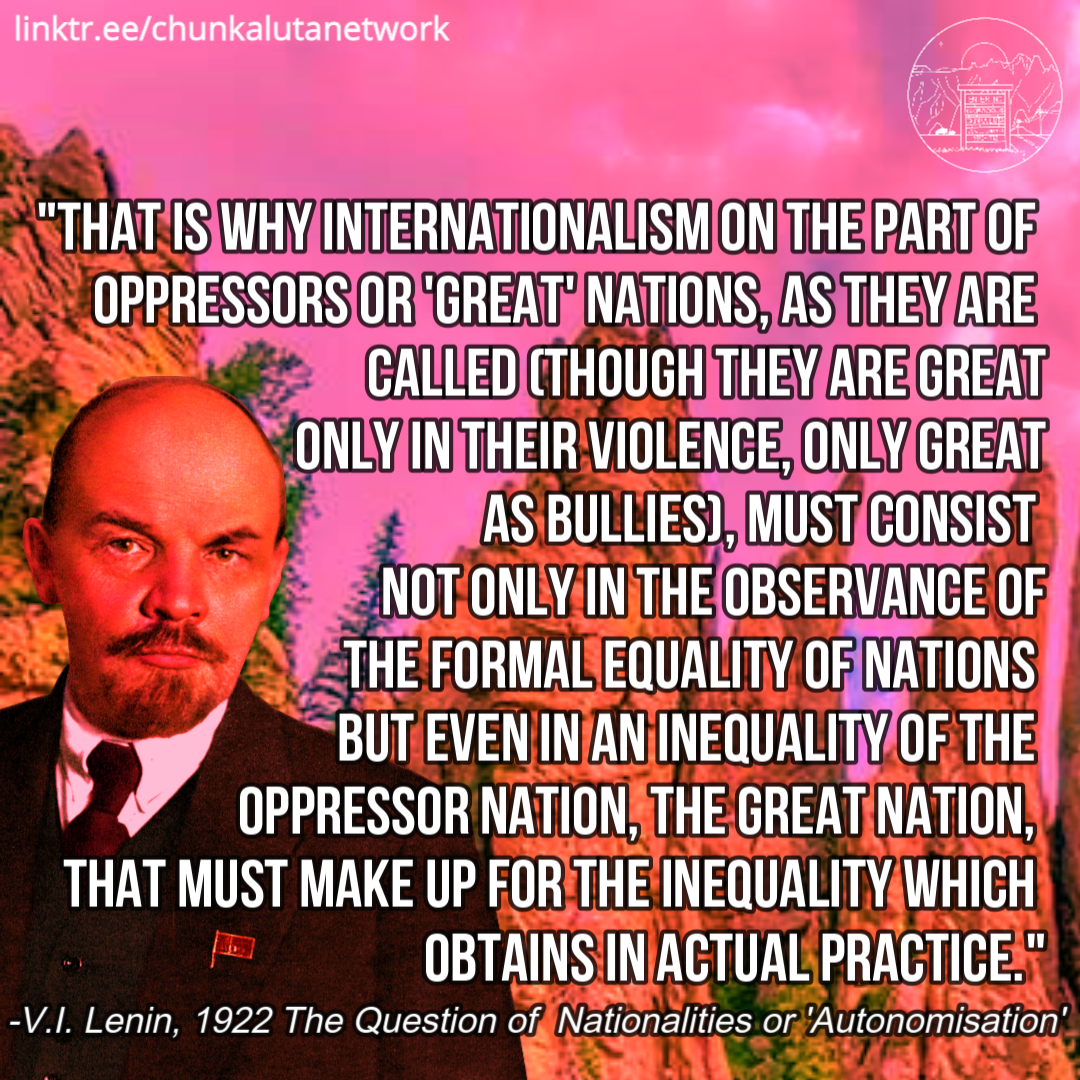
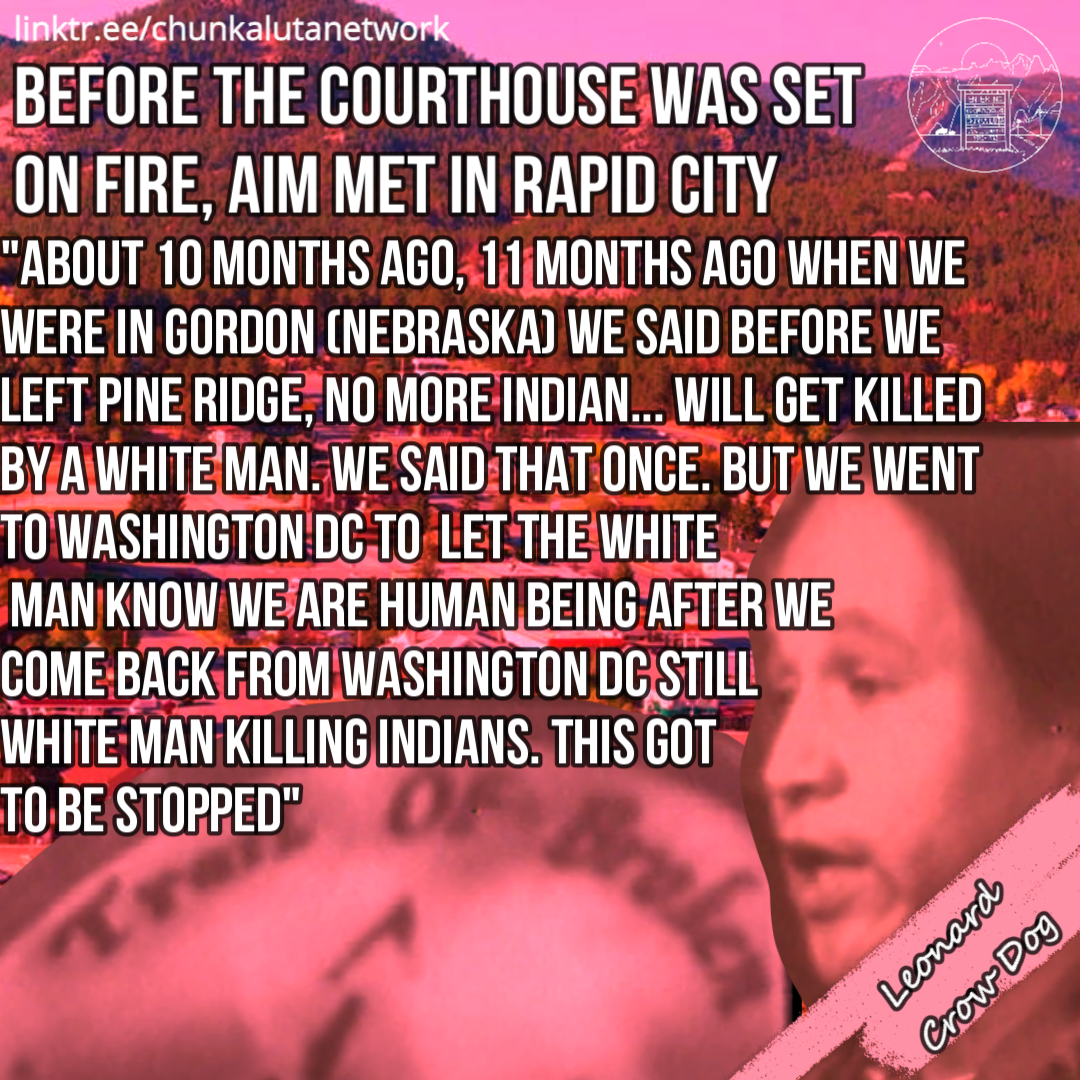
So today on February 6th was the day of the Bad Heart Bull trial in Custer, South Dakota. To this day as landback grows more prominent and our elders and leaders move forward with decade old plans and conversations, the contradictions here grow. Because of this I’ve sought to see the perspective of various communities and generations, on the ‘Indian problem’ as it has always been called here. The Indigenous question is only the colonial question, and the communist movement has had a century, decade, and a year to discuss this since Stalin's publishing on the subject (1913, of course the conversation predates Stalin). One of Lenin’s last works was on this specific topic, and the question of who should be okay with having an autonomous region of their own in a larger state: is one that places great nations at the whim of the nations they oppressed.

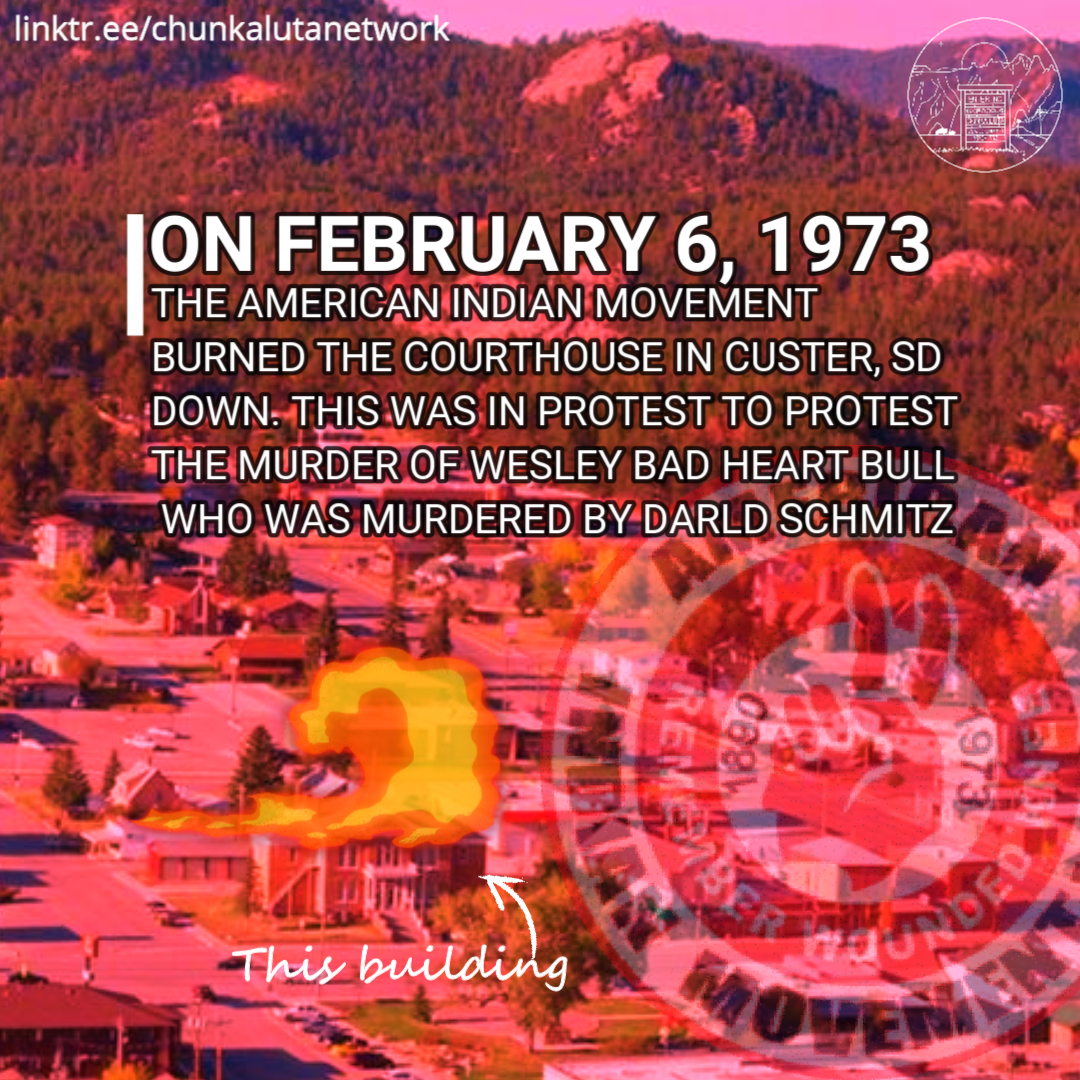
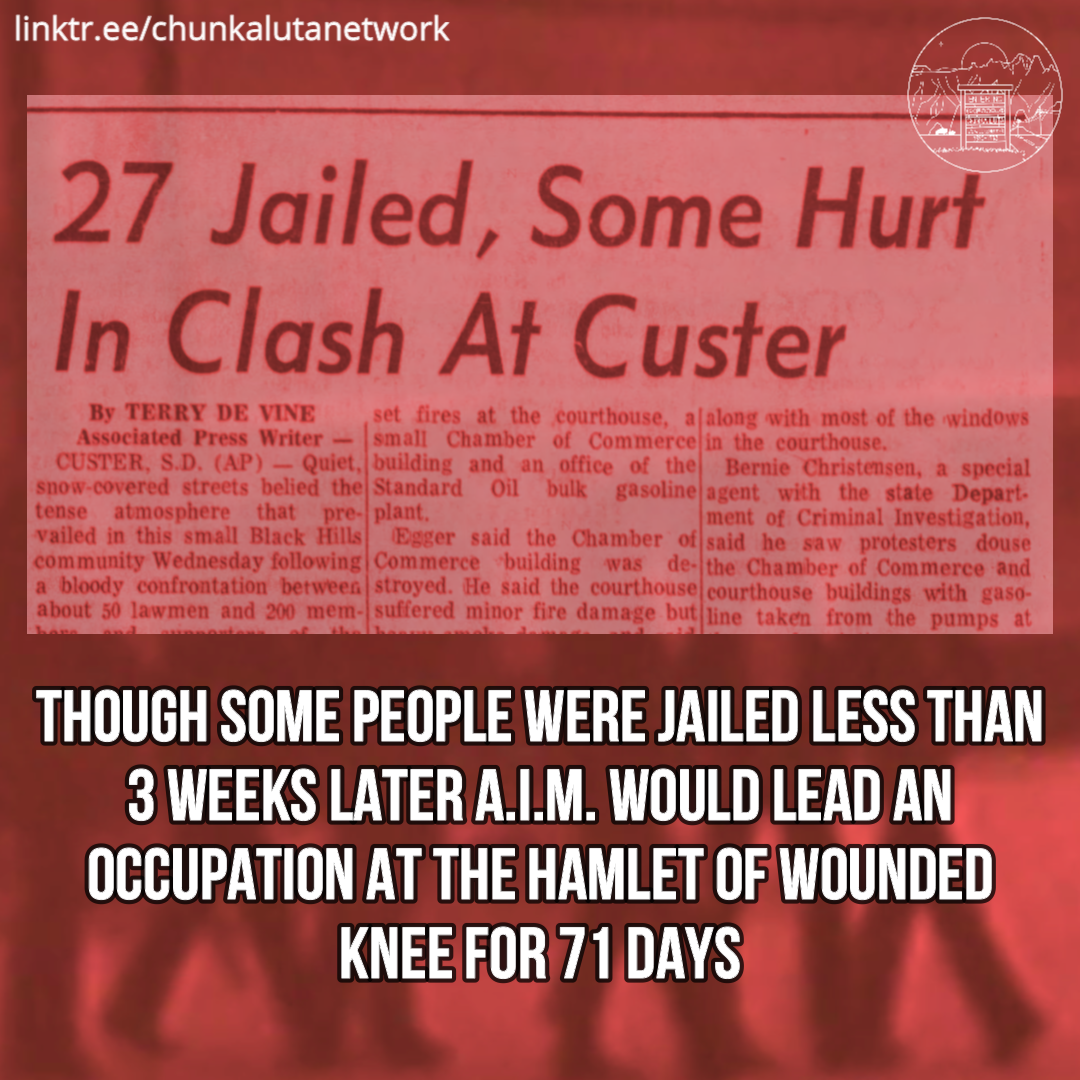
Because of the words Lenin has spoken on the subject, people like Ho Chi Minh froze all night just for a chance to see the great man’s body. The pan-African revolution, the third world movement, fourth world theory and so much more have a red light shining on them from the star that is Lenin streaking across the sky: calling us to revolution. We don’t know if that star was shining at the time the molotov was thrown, but when the court house went up in flames, it certainly caused a stir. Nobody knows who threw it either, I’ve talked to a considerable bulk of living participants, but it was thrown after the cops pushed Wesley’s mother down the stairs with a billy club. Only 3 people were going to be allowed into the courtroom, and when Dennis Banks, Russell Means, and David Hill entered the cops stood in the way of the mother of the victim, and brutalized her. David punched that pig-fucker in the face and the riot ensued. Custer is THE symbol of settlement in the Black Hills, it's one of the first towns, and to this day makes its money from exploiting the land and treating it like an amusement park. While people on my reservation don't have water, Rapid City has a water park. Custer had a literal amusement park that flew a replica of the 7th Calvary's flag; we already had the real one, so during the riot that replica flag was also taken. Cy Griffin was a film maker from the video freak movement that was there, he went back to New York and told his friends about everything happening there. A war in South Dakota is how he described it. We call it the Reign of Terror. See, it wasn’t just in the bordertown we were being murdered in the street, on Pine Ridge a seemingly innocuous man named Richard Wilson (only one parent was Lakota) became Tribal chairman. He employed his family (legal in our laws) , began embezzling money (not legal) and established a right-wing paramilitary called the GOONs (Guardians Of the Oglala Nation, questionably legal). The GOONs would enact violence on Dick Wilson’s political opponents by firebombing, drive-bys, and gunning people down in the street. This spurred the organization OSCRO (Oglala Sioux Civil Rights Organization) to form, and begin collecting signatures to impeach Wilson. They were successful in collecting the signatures, however Dick was the one who presided over the impeachment, and of course found himself not guilty. OSCRO is an often overlooked organization, and I believe this to be the goal of federal agents to remove the grassroots elements from these struggles and obfuscate the lessons we could learn. As mentioned in a previous post, Dick Wilson would oversee the equivalent amount in deaths to Pinochet’s first 3 years. This is in South Dakota, and nobody knows these facts, and pretend colonialism is some bygone era. Because of the fire lit in Custer, in Gordon, in the Pacific Northwest, in DC and so many more places, we see the modern land back movements stem. Those movements stemmed from the wars, those wars stemmed from the early capitalists accumulation of wealth to jump start global capital today. In these circles we see how yesterday is today, and only by understanding both can we move on to tomorrow. We must pull capitalism up from its roots which are soaked in the blood of the colonized, until we do that we are doomed to fail. We mentioned briefly how these concepts go beyond physical violence, and one way is the erasure and silencing of Indigenous and other marginalized voices. This might sound farfetched to the insensitive, but in a critical period of rupture, we have to make sure we don’t get bogged down in what is socially mainstream. If the mainstream is saying our talking points then we have failed to stay at the head of the movement, and are merely another voice consumed into the acceptable protest movement. We have to stand arm and arm with trans comrades as opportunists and state agents both turn their sights on them across the country, seeking to separate them from would-be allies who are worried they will lose mainstream support for daring to stand against the face of oppression. Those who can’t stand in solidarity with everyone, yet voice opposition to Israel in this critical moment, are capitalizing and being opportunists. This has to be combatted. People like Jackson Hinkle make Trans and Indigenous people their target for a reason and you should learn why. Especially if folks like Hinkle can sell stolen Palestinian Gold, and people give passes to communists defending him. The movement is in a critical moment where it has to struggle with the colonial contradictions, failure to do so, means failure to form a vanguard. In our next post we will discuss Captain Cook and his death on February 14th, my birthday is then next so y’know if you like these posts and the work we do I recommend supporting us! We have a linktr.ee/chunkalutanetwork with all of our social media, gofundme efforts we are engaged in, a liberapay and a patreon that all go to supporting the work CLN does. This post was short as it's mostly a timely bridge to send us on our way to the real Wounded Knee 1973 post at the end of the month, so lots of learning to do. I also recommend checking out the Indigenous Anti-Colonial Institute podcast and the CLN podcast for more education. Our patreon also has a ton of episodes, and there’s also Marx Madness where we read you theory. Right now we are reading a custom Gramsci Reader that you can check out in our library listed on the linktr.ee. I also want to stress, don't wait for us to learn about this stuff, start with Blood of the Land by Rex Weyler, read the Erdoes biographies, and then ask what a Marxist perspective on this stuff should be. I will be releasing a companion to the book later this month hopefully, of a stream of thought journal kept on my 3rd read through.


og on hexbear

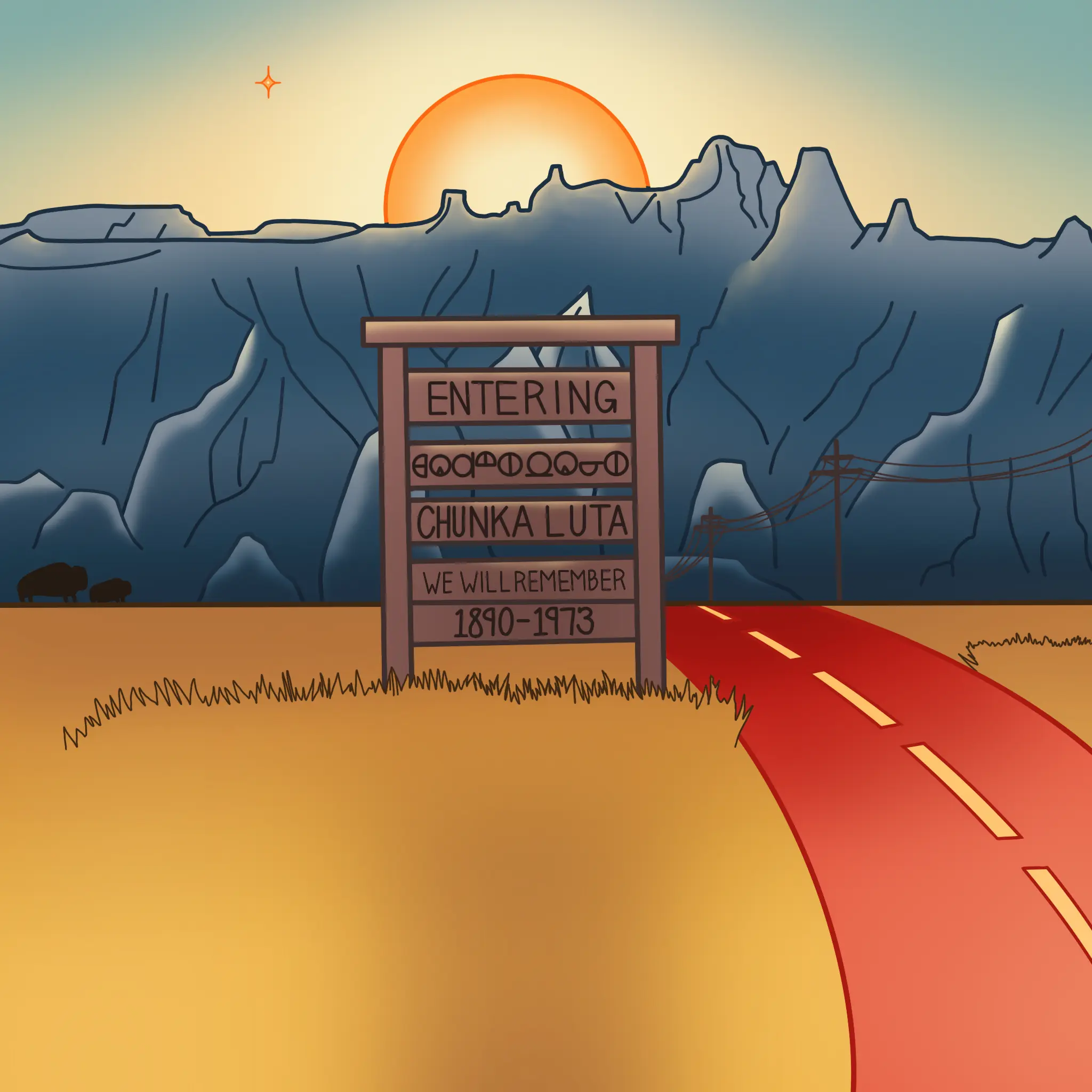
Sungmanitu of Chunka Luta Network: Would it surprise you that I had more to say? Due to the character limit, this wonderful and relevant story had to be broken into 2; this one I called the 1973 part, well almost. The day I released the first part[hex] was not on the massacre date, but instead the day they assassinated Tatanka Iyotake, Bull Who Sits on Hind-legs or Sitting Bull. This name is given to him by a Canadian Mountie officer ignoring the commands of his higher officers, to offer refuge to the radical band of Tatanka Iyotake who were waiting to rendezvous with Tasunka Witiko, Crazy Horse. This rendezvous never happens as they are able to trick him, arrest him, and then kill him on his way into the jail. If you believe our Medicine Men, he saw this, and on Bear Butte he did only 3 days of a traditionally 4 day vision quest called hembleycha, in hopes he would be spared to finish the ceremonies. Where we last left off was the aftermath of this assassination, where their brother-in-arms Unphan Gleske, Spotted Elk (or “Bigfoot”) then fled to seek refuge with Mahipya Luta, Red Cloud, at Pine Ridge agency. This brings us to the infamous massacre of 1890, but the blowback of this act wouldn’t be faced for another 80 years.

Between then and 1973, we have several land grabs, the kidnapping of children into boarding schools, border towns rising off the exploitation of us and our lands, planned genocide through make-work programs of the New Deal like the Pick-Sloan plan, and so much more happen, that it makes sense why Cap. R. H. Pratt and the common sense of the time acknowledged the “students” openly as hostages.

According to Ezra Hayt, the Commissioner of Indian Affairs from 1843–1893, “the children would be hostages for the good behavior of their people.” (To read more here is my former employer’s award winning article on the subject of bodies in boarding schools, years prior to the mainstream news of the fact at High Country News and for the full context to the quote)

Even after the boarding school practices mostly ended (I say mostly as the recent federal report shows 90 of those schools still operate), this program of holding children hostage manifested itself in the selling of our children into what amounts to slavery. It cost only $10 to buy an Indian child as recently as 1952, and many who were bought were used as cleaning servants. Instead of this practice ending, it developed into the modern foster care and adoption system we know today. Even my brother has been enslaved in this system. On top of this, you have a continued mass incarceration and atrocious education statistics that all stem from their attempts to “save the man.” The tipping point came in the Termination era and essentially provided a liberally condonable means of genocide, via pen and paper. If it wasn’t bad enough to force different cultures and peoples into conglomerate nations for your convenience in managing our concentration camps, they began to declare nations non-existent or even completely eradicated with the case of the Ohlone and many California groups. The most famous case however is the Pacific Northwest's termination of fishing rights and Wisconsin's attempt to do something similar with the Menominee people, and an added land grab.

In 1954 the Menominee Termination Act would be passed under Public Law 280, which would remove nations' rights to determine their affairs, let alone their futures. In 1963, three Menominee would be charged in violation of Wisconsin state laws, while hunting on land distinguished as Menominee land. They were found not guilty, only to have the case brought to the state’s supreme court, where they ruled that they no longer had hunting rights. The historiography available places the onus of the overturning of this decision in 1968, thanks to the efforts of Ada Deer, who should not go unmentioned. But reformism is hardly why I write and the hunting and fishing rights were not the end-all issue of the Termination of the Menominee (but we will continue in a minute). In the PNW as I mentioned, the hunting and fishing rights issue was rearing its head in the famous fish-in struggles led by Billy Frank Jr who was arrested over 400 times for fishing on the dock his family has lived on since time immemorial along the Nisqually River.

“As long as the rivers run, as long as the tide flows, and as long as the sun shines, you will have land, fish, and game for your frying pans, and timber for your lodges.” -Washington Territorial Governor Isaac Stevens 1855

He wasn’t the only person the promise made was broken, and so it became a form of civil disobedience to fish, and fish they did. They were beaten, threatened, and even people like Leonard Peltier would be radicalized at these ‘fish-ins’. Peltier wasn’t the only one finding inspiration there either; in fact some Oceti Sakowin students attending Berkley at the time were so inspired that they staged an action on Alcatraz, symbolically reclaiming it under the 1868 Fort Laramie treaty. This was in 1965, and most people forget this initial inspiration for the later 1969 occupation on the island. The 1969 occupation utilized the same method of claim, only this time they refused to allow the coast guards removal to be the end. At first, organizers were only going to sail a boat near the Island and then give a press statement on land. But when the boat came close enough, a young Mohawk organizer named Richard Oaks leapt over the edge and swam to the prison. Generally speaking, most people swimming around Alcatraz were swimming away from the island towards their freedom; but to him and everyone who followed, freedom was the prison, so they swam. The coast guard quickly removed them and on land, Oakes read what is called The Proclamation to the Great White Father. I recommend everyone read it for yourself as there is a lot of clever phrasing. Or you can wait until the audio documentary we are making on this era fully releases. The part I’d like to highlight is why they saw this prison as freedom:

We feel that this so-called Alcatraz Island is more than suitable as an Indian Reservation, as determined by the white man's own standards. By this, we mean that this place resembles most Indian reservations, in that:

  1. It is isolated from modern facilities, and without adequate means of transportation.
  2. It has no fresh running water.
  3. The sanitation facilities are inadequate.
  4. There are no oil or mineral rights.
  5. There is no industry and so unemployment is very great.
  6. There are no health care facilities.
  7. The soil is rocky and non-productive and the land does not support game.
  8. There are no educational facilities.
  9. The population has always been held as prisoners and kept dependent upon others.

Further, it would be fitting and symbolic that ships from all over the world, entering the Golden Gate, would first see Indian land, and thus be reminded of the true history of this nation. This tiny island would be a symbol of the great lands once ruled by free and noble Indians.

This place has become a practical Mecca for us and it is no wonder, when we place this occupation in its full historical context, why 71 occupations happened between 1965 and 1973 (and many more after). However this isn’t a story about these 71 occupations; it’s about Wounded Knee specifically (for the 71 story, join the patreon) and the overarching blowback that will be covered in more depth in our upcoming series; yes this is an ad, a 20k word ad. What we want to focus on however is the American Indian Movement. Jumping back to 1968 and over to Minneapolis, a meeting was held after several prison organizers were released from Stillwater prison. Each of them started in boarding school, and ended in prison, before being thrown to the wolves in the Twin Cities. At that time it was routine for the police to systematically arrest Indian bar patrons under drunk and disorderly charges; every Friday at 9pm- you could count on it. They would utilize kettling tactics, driving them from the front out the back, where the van was waiting for a mass booking. Over the weekend, they would be used as slave labor then, released on Monday without seeing the courtroom. This became routine, and must have been informed by some sick joke that we liked keeping the Earth clean. Editorializing aside, this was a systemic issue, and that's how AIM was formed. The night the meeting was held, Dennis Banks was speaking to a coalition of groups in the cities, when a familiar voice spoke up asking, ‘what do you plan to do about those cops?’ That night they formed the red car patrols, and began filming the cops actions, and before long they were at Alcatraz to make connections. Upon doing so, consecutive actions took place. A group known as United Native Americans, led by Lehman Brightman, would stage a takeover of “Mt. Rushmore'' renaming it Crazy Horse Mountain; the sentiment was okay, but really this site is known to my people as the Six Grandfathers. This term refers to the four directions, the sky, and wakan tanka (the great mystery, our closest approximation to a “god” which really collapses the expanse of the idea).

In Minneapolis, you had the takeover of Ft. Snelling. In California, you have a take over of an electric company and enforcement of national sovereignty through the enforcement of tolls on the Pit River nations land. In Milwaukee however is where one of the more important (and ignored) events happen. Herb Powell was a visionary, who after Alcatraz seized an abandoned lighthouse in Milwaukee, which resulted not in eviction, but land back for the very first time in 1970. There they built the first ever Indigenous spirituality based alcohol treatment, that has since spread across the continent, and is the most successful form of rehab for Indian people. They did a breakfast program similar to the Black Panthers, which they learned in Oakland during solidarity trips from Alcatraz, and this is directly where the survival school concept was born. Herb’s wife claims prior to the Nixon admin ending the termination era Then when the occupants were finally removed from the island, a takeover of the Nike missile site was staged due to its closeness to Alcatraz. From 1969 to 1971, Alcatraz was ours. They kept this occupation alive through mailed envelopes of money, solidarity festivals hosted, barges donated by Creedence Clearwater Revival (the barge was then named The Clearwater), and from families who dedicated their time to caretaking the warriors on the island.

The era of Red Power had officially begun, and that’s exactly why, despite in 1971 COINTELPRO and CHAOS were declared over, and the show commission of Church occurred, the program lived on and sought to focus on the growing Red Power movement. Black Power had been so thoroughly entrenched in combating the original forms, it was easily subsumed by the Black elites and whatever homunculus replaced the CIA, FBI, and NSA’s counterintelligence programs. We know for fact these programs merged thanks to the history of AIM. All these fires were being lit across Turtle Island, a national Indian organization, and it was quickly realized that now was the time for unified action, not just the basic call to consciousness (read more in Akwesasne Notes book Basic Call to Consciousness). The International Indian Brotherhood (led by George Manuel), National Congress of American Indians (led by Vine Deloria Jr and Hank Adams), and many other Indigenous led groups that were very wary of AIM joining.

Despite being wary, they were allowed to join and it was common practice for them to send groups ahead to secure housing, food, etc for the children and elders who often came in the caravans with their younger family members engaged in direct action, as they offered support in a variety of ways including moral and inspiration to action. Despite these efforts the Nixon admin pressured the churches and people who agreed to deny us access, and forced elders and children into a dingy basement filled with rats (to read more see Behind the Trail of Broken Treaties by Vine Deloria Jr. Eventually they went to the BIA headquarters in DC, and just never left. It wasn’t supposed to be an occupation, it was supposed to be an airing of grievances that, due to the stonewalling and neglect of the US government, forced these families to occupy. This is obviously not about this story, but it should be noted the Black Panthers and AIM became even closer with offers of dynamite, infiltration of police lines by BPP, and as an alternative to the dynamite strategic pouring of gasoline around building while literal tons of documents about the stealing of land and resources were loaded into a Uhaul to Pine Ridge and sent with various groups they were relevant to. The government claims 700k in damages were done, mind you many of this is “theft” of things they stole from us originally, but with a suitcase full of cash- Nixon sent the Indians home.

For us Lakota, and frankly any Indigenous people, home meant coming back to the same problems the US government just denied to help with (it took the a day to respond to the 20 points of the Trail of Broken Treaties which were all very milquetoast liberal demands, that any communist today should use as a bear minimum for what we should uphold). These problems are still relevant today if you read Red Nation Rising: Bordertown Violence in America by Melanie Yazzie and co. but beyond the explicit state violence, the overall superstructure is built on a phenomenon known as settler-vigilantism where settlers act on behalf of the state, to quell Indigenous resistance. At the center of the bordertown is this phenomenon, and the result is the bordertown becoming more than a place, but an idea. This idea being one that the bordertown arises anywhere settler order is confronted by Indigenous order to paraphrase a line from RNR:BVA. It's the violence the bordertown brings with things like starlight tours (where police in Canada bring Indigenous people who might be intoxicated into the wood to walk miles home during winter, usually dying to exposure) or Indianrolling. Indian is a legal term defining us based on a level of blood quantum, we use this word still as those laws still exist, Indianrolling is when settler vigilantes take it upon themselves to ruthlessly assault or kill Indigenous people in bordertowns or even on our reservations.

The most famous cases relevant to this discussions would be Raymond Yellow Thunder (murdered 1971 prior to the Trail of Broken Treaties, chronology doesn't matter in oral histories, this is written to be an oral history) and Wesley Bad Heart Bull (murdered 1972 prior to the Wounded Knee Occupation).

To go into these important events at the end of this effortpost would cause a disservice and dishonoring of these martyrs. In a time when Palestine is being butchered, I see constantly what happened in the 70s, and settlers here try to downplay the social murder, explicit genocide, and vigilantism (see the West Bank for Palestinian examples where settlers deny ongoing genocide). There is a book called The Death of Raymond Yellow Thunder which is named that because the conclusion is; it wasn’t murder. However, having read the book, his manuscripts, and listened to his cassette interviews which we plan to digitize and release with the help of my nation's college, I do not agree. We will address this in the actual 1973 part, as this is unfortunately the end of our story for now. However please go research this stuff yourself, there are so many sources like Blood of the Land by Rex Weyler, the various biographies of AIM leaders and activists, and so many other resources everyone who organizes in North America should be familiar with- and I would die on that hill gladly. You can find these resources and more in our developing public access library on our linktree, where I will also make the audio files and archive footage I’ve gathered over my 3 year, cross country, investigation of this exact story. A lot of the people we will discuss are family, there is a yearning for truth I have to demystify what is or isn't real, and so I pride myself with being able to openly criticize AIM in a principled way (I have yet to hear someone in the pod sphere actually offer worthwhile criticism beyond the errors of leaders, ya know, like strategy) because I have taken extreme care to meet the people. To hear their story for myself, to gather as much as I possibly can to help the movement advance. I want to see us overcome the great hurdle of American chauvinism, and see the end of settler-colonialism and the global project of Imperialism it helped birth.

The real reason for this post besides more suspense towards the Wounded Knee documentary and actual post, is to talk about our winter fundraiser which the immediate needs have been handled! We were able to get our organizers who deliver and cut the wood a new vehicle after theirs broke down (and 1200 in repairs already this year we fundraised), secure a Uhaul to deliver a ton of wood, pallets, clothes, water barrels, cases of water bottles (water there will give you cancer in 10 years due to Uranium mines runoff, so its only good for washing stuff really. We got it shut down in 2018 but there's been no clean up besides us growing Hemp and Sunflowers) blankets, and whatever else we could gather that could be useful there. We were also able to pay for the cameraman to tag along and document the whole trip, so look forward to that content as it releases overtime. The best way to see these updates first would be our patreon but they take a big cut! So if you dont mind waiting for a public release, liberapay is a much better way to support our efforts directly. Our plan with the money is to enable several organizers to work consistently on our fundraising through other means, and organizing the soft infrastructure to enable a mass org, functional steering cadre, and help grassroots organizers do their thing. We only need 1800/month in order to accomplish this and some peoples allyship is based on whether or not we don’t criticize their favorites; but here at Hexbear and Lemmygrad we seem to have found actual class traitors who see the principled nature of the stances we take. I am sure there is something I forgot to mention but you will hear from us more 2024 and beyond, especially once the 5 year plan is ready for publication.


"x-posted" from https://hexbear.net/pictrs/image/62e0ddcf-3213-47d5-8200-c8845ac3faef.png since x-posts don't seem to show up on front pages.

Today we launch the official feed for the Chunka Luta Podcast https://podcasters.spotify.com/pod/show/chunka-luta-network/episodes/Ep-1-New-Directions-e2d11rb/a-aaneqt5 that is replacing the former Bands of Turtle Island pod. BOTI was started to tell the story of AIM, then I got paid to tell that story so why would I keep posting it free if Im posting it free down the line and actually well produced? The last few episodes on the feed will be that story completing a circle I started at 19, and we will start this circle with that same story; the story of Wounded Knee 1973. While documenting this story, somehow I ended up forming an International collective of Decolonial Marxists (MLs to be more correct, as to mean the scientists of Liberation) we have plenty in the pipeline for this podcast so I highly recommend following it and staying up-to-date. You can find all the links at our linktr.ee/chunkalutanetwork and find the patreon where you can gain access to content earlier than others, or the liberpay which yknow I can email the content or something early? Idk trying to figure out a work around but they dont take cuts so are urging people support there. On the linktr.ee is also a GFM to help our comrade Juche Gang, or Leaping Larry on Twitch, we already raised 3k before launching the GFM but he still needs help recovering from several storms. Supporting us monthly helps us help Indigenous families like Larry's easier, and enables professional organizing of very successful project so far; so who knows what the future will hold.

The elevator pitch is this: For only 1800 a month we would have 2 full time organizers (paid a stipend of 500 USD/month) and a transcriptionist paid at 2 USD/raw transcription audio minute to the extent their groceries and rent are paid, usually 360-400 USD, and they are always willing to help with admin tasks which has been invaluable behind the scenes this year. The last 400 is for our Media Teams needs, that is $35/month in web hosting, $35/month for a proposed newsletter and zine email thing, $105 for streamyard including taxes (im bad at math though), $100 a month for a constant stream of high quality b-roll, and another $100 for the 1 podcast a month promise we are aiming for, and all extra will be just done by me as time frees up and more of the organization is taken off my shoulders. All extra fund then gained after that go directly into organizing as they have been since restarting the patreon, and this disclaimer is a public accounting of our plans for the money and our current goals. By enable 2 full time organizers you allow another person to pursue the level of organizing capabilities as I have shown is possible over this last year. I will be taking on a second job to supplement the 1100 still needed, but I really hope people recognize how much we have accomplished as a network in a year.

The podcast covers the project briefly, and of course we plan to explain more in a episode coming out next year about everything we accomplished from the 2022 Winter Fundraiser to this current one you can also find at the linktr.ee (the Uhaul part is already paid for so now we are raising for a car, and then a storage container, and then more land to bring into trust and help an elder build a house) theres a lot of moving pieces, and so I am hoping this year in review episode will help explain things better; until then, here I will try to not mess up formatting normally Nikolai helps.

For those unaware the org and year began as I arrived home in the uhaul I raised in response to a devastating blizzard that swept the continent, literally arriving in time to celebrate New Years as we brought my son up to bed. Since then the org has grown to include over a hundred direct organizers, over a thousand associated organizers, and more sympathizers then I care to actually count as I know the number will only grow. In total we estimate around 70k to have been raised and will be hiring an accountant to handle everything that will be posted to the website for public view, bearing in mind the anonymity of individuals and censure of doxxing information. From providing the funds for a traditional ceremony, moving a house for the headsmen of the nation as well as the logs for another home, and are designing a community center we will begin actual construction of next year from which we will build a buffalo prairie to provide food FREELY to the people, and to give them away for ceremony. We will also be building food forests and community gardens to address the food insecurity, and developing a textile mill to process the 40 acres of self seeding hemp already on the land. A lot is happening beyond that but lets wait til things are more presentable before counting our chickens. However til then expect lots of photos and videos, also sorry the website is taking so long we will have update photos soon! Lastly we have a library on our linktr.ee even including the required reading for our organizers and cadre. I look forward to showing you just what we are and that we have a road to follow, thats wide enough for us all to walk to the next world together. We need only build the bridge there, and we have to do it together. As Ngugi Wa'Thiongo says "decolonization is colonizer and colonized..." we must work together to become human again, and it is by landback by which we can reclaim our humanity and dignity


"x-posted" from @Nakoichi@hexbear.net

Original twitter thread: https://twitter.com/DecolonialMarx/status/1736248614035272113

There's a lot of misleading things about this presentation; for one only the poorest of people were crossing the plains and Mountains. Instead those who could afford it preferred to sail to Nicaragua and walk across the isthmus, to then sail up to the West Coast. Yes the mountains were tough to pass, but not because they are mountains, but because the easiest paths are controlled by, and tolls are enforce by Indigenous nations across the west. Meaning it was not the Mountains that discouraged them, but instead the idea of following Indigenous laws; i.e. it's a political barrier. This barrier prevents a western expansion preferring instead almost a Roman style, build a fort around your enemy, style of invasion.

Palo Alto was further from the White House than it was from Mexico City. Frémont felt safe massacring unarmed indigenous groups in 1846, but the Anglo settlers were vastly outnumbered, and the tables could turn fast -never mind the European powers and wildcards like Russia and the Chinese. In the West, the United States was out on a limb. What the United States needed was for a bunch of people to go to California and stay there, anchor the territory, and ready it for statehood. The problem was that there were not a whole lot of reasons for settlers to try it. The sea routes around the Cape of Good Hope or down to British Nicaragua and up the West Coast after an overland trek were long, dangerous, and expensive; the Oregon Trail across the continent was even worse. When they got to the California territory, settlers found unsurpassed natural beauty and unbelievable biodiversity, but the pecuniary prospects the only thing that could lure them in large numbers were not all that great at first. There was plenty of land but no one was especially enthusiastic about working it for profit. Indians comprised the vast majority of laborers (as they comprised the vast majority of the population), but their connection to the land always left them an exit if the contracted terms were insufficiently remunerative.

So while people like Leland and William Randolph Hearst's dad fled the eastern side of the Mississippi after ending slavery cut into prophets, it became clear it was very easy to rip people off in California; and anti-slavery laws didn't apply to Indigenous workers who were disregarded as people, so remained a cheap if not free source of labor. A lot of folks then assume the railroad was made to cheapen the costs of traveling to the west, but in reality that was more of a marketing ploy by a group known as the Combine, or 'the Associates' that Leland Stanford would be made a de facto face of, hell he was even made the de facto governor. According to the eugenics science that was pioneered in Stanford University later in Leland's life, he was a great man because of great genetics. In reality it is birth lottery, as is always the case, and a uncanny ability to somehow take credit for everyone else's work making him the best of the capitalists.

He couldn't even pretend to be self made. Even his associates often made jokes about how all of his money is made for him, he doesn't have to do anything. At any rate it was land speculation by which this profit was made, just as George Washington's was made before him, this business was the American dream; the get rich quick scheme. One that practically presents itself to him after squandering the perfect opportunity he had on the Erie Canal. These excerpts come from Palo Alto a must read for movement members today.

After an apprenticeship, he opened his own law office, which suffered from his total lack of German-language proficiency, given that German immigrants formed the bulk of the settler population. A run for district attorney on the progressive Whig line flopped. In 1850 he briefly returned to Albany to marry Jane Lathrop, a merchant's daughter from his hometown milieu. Back in Port Washington, Leland's office burned down, taking with it his law books and legal career, such as it was. Leland's life to that point - he was in his mid-twenties - was a total loss. Despite the cosmic luck of being born alongside the Erie Canal, he'd squandered the little he put together. What he did have left was family, including four surviving brothers. He (scandalously) deposited his new wife back home, and set out to join the rest of the Stanford boys in California. With his family's support, he took the ritziest of the three routes west: a ship down to British-occupied Nicaragua, an overland trek, and another boat up the continent's flank.

Born at the edge of a commercial frontier, Leland was a restless young man, moving from mediocre school to mediocre school, performing in accordance with his surroundings. Leland liked reading more than he liked working, and he didn't like reading all that much. He decided on a career in law, perhaps with a quick transition to politics, a professional path forever beloved by ambitious slackers. A politician needs a good name, and so Leland dropped the biblical Hebrew Amasa, which, fittingly, means "burden." The frontier had lower standards than New York did, so he took the law books his father bought him and in 1848 moved to Port Washington.

Most people didn’t see the value in California 'til after 1848, but those who did saw the same vision the Combine had, and with a very small initial investment of 20k the transcontinental railroad was underway and heavily subsidized to drive the land speculation markets. Because of the rails maneuvering their way into prominence through clever marketing (as it remains cheaper to ship by sea just as it was back then) and began to sell land along the rails to settlers moving across the west.

The next morning the first passenger car passed from the Union Pacific to the Central Pacific tracks, and the inaugural batch of imported tea departed for the East, linking West Coast international trade to the nation’s financial centers via rail. This was more branding than anything else-goods from the East were just as easy to send to New York by boat, especially with the Suez Canal up and running-but the settler nation celebrated nonetheless.

In 1862 is when this happened, and this disregard (or most likely contempt) for Indigenous nations was an obvious underpinning of a long standing California and American history, of working class people organizing genocide campaigns for low wages and poor compensation. By 1866 the wanton murder and economic turmoil brought by the railroads, and the mining oligarchs funding them, are similar to the oil man camp issues we see today. Destruction of land, stealing of resources, rape and murder of women, children and elders; would lead to Red Cloud’s War and the 1868 Treaty of Ft. Laramie which established our nation on the basis of the Missouri and Montana River’s watershed. This was done by extensive multi-year survey but to this day we have Lakota people who are Asian because of Chinese workers who fled to our communities after being sold to white trading posts by their family if debt got to high. A sad reality, but one people forget when they think Indigenous is a race, and that you can homogenize all of us.

It was only the year before the treaty was signed, that Marx wrote his famous Das Kapital, meanwhile the Oceti Sakowin had won a war and wrote the treaty demanding communal ownership of land, continued self-determination, continue denial of the use of the money form in our economy, infrastructure like blacksmiths to create pig iron, and so much more it is no wonder our later leaders like Crazy Horse and Sitting Bull presented a People’s War. Their guerilla tactics being as well studied as anything Che did.

In reality the railroads primary purpose was the destruction of the Plains nations, this railroad wasn’t economically useful UNTIL the genocide and displacement of our nations. This is most exemplified by the fact the 60 million strong continent traversing herd was split by these rail roads, and a Army sponsored campaign (whose motto was ‘one dead buffalo is a dead Indian’) that provided bullets and guns to wantonly murder buffalo to ease the boredom on passenger trains. This is also the history the term ‘removed’ comes from where buffalo hides were valued at the same price as our scalps and were interchangeable, again because ‘one dead buffalo is a dead Indian’.

This railroad was the long standing dream of Indian killers that founded the US, so it should be no surprised when someone like Grant Shows us perfectly the extent that liberalism would never have been enough even if reconstruction went perfectly; and perhaps the words of Harvard fellows and graduates shouldn’t be as valued as they are by Marxists (looking Cornel West as well as pre-Marxist Du Bois being cited by ‘patsocs’ to deny Indigenous sovereignty, or famous NDNs who had fellowships there and now love to let billionaires and actors tokenize them without standing up) This is to say genocide is normal in liberalism and waiting for genocide to begin calling liberalism fascism, misses an important fact, that MANIFEST DESTINY INSPIRED ZIONISM, FASCISM, NAZISM and whatever else you want to call it; America is its origins. So anyway the mountains in the way were the people, the people of the Oceti Sakowin resisting class society being forced on them after already overcoming these contradictions multiple times before.


cross-posted from: https://lemmygrad.ml/post/3005738

cross-posted from: https://hexbear.net/post/1336560

From comrade Sungmanitu:

Last thread we dispelled some major misconceptions of Indigenous people and the founding of America, but what about Western Expansion? How much do you honestly know as a historical materialist? One of the most common misnomers I hear in educating people is “why should we care about something that happened hundreds and hundreds of years ago?” Capital was written 1867, the same time we signed our first treaty. When I say we I do not mean some homogenized conception of Indigenous people, but rather I am speaking specifically about the Oceti Sakowin and the ending of Mahpiya Luta’s (Red Cloud’s) War. Classically the story goes that as the US moved westward they conquered and erased nations in their wake, a seemingly unstoppable machine of capitalist expansion. In reality, the US lost many wars and only won the ones they started by surprise. In our classic conception of manifest destiny, we assume a wave of red, white and blue moving across the continent. In reality the situation was far more complex than what Marx simplified in Capital, and reality shows that the US and Canada (although wanting to) could not move across as a wave due to the level of military and political cohesion among Indigenous nations of the plains.

Instead what we actually see is the coasts be settled first (with some Mexican and Spanish settling occurring in the SW and West Coast, but it's not until the Anglos that we see the full extent of settler barbarity against an “other”- even other settler populations that weren’t Anglo) while the California gold rush starts in 1848, the Trail of Tears had been going on since 1830 and wouldn’t end until 1850. The land was not yet settled and they already were in such precarious positions they sought land across the continent, and worse through the plains. The Oregon trail of course is how we imagine everyone moving west, and that is certainly how worse off settlers would be, the reality showed most people preferred to safely sail to Mexico, walk across, and then sail to California or Vancouver (See Palo Alto by Malcolm Harris for more details).

Famously the “mighty Sioux” as Thomas Jefferson described us, exacted tolls and were expert scouts. Those “sioux” (a Anishinaabe slur adopted by the French) are us, the Oceti Sakowin, and when Louis and Clark set out westward they were told to make sure to become our friends. Instead they chose to try and avoid the toll, only to be caught a few days into our territory. Since then we watched and enacted our toll, and enacted our justice when it was avoided, against settlers passing through. The only issue is nobody who went west ever came back the same way. Muhpiya Luta saw that we were being surrounded, and so he went to the Big White Mountains where the mouths of the Missouri and Montana Rivers. There while they camped they had council and made the decision to make a long journey to pray on what needed to be done. They then went on to follow the watershed of these rivers deeply understanding the bioregion, only we had no way of explaining the science behind these decisions then. They crossed to the south side of the Platte River and followed it east to what is now Council Bluffs in Omaha, and crossed at the trading post that was there to the East River which is a small creek compared to all these others. There is where they began to complete their circle, following the watershed back to the headwaters, and when they arrived back they knew we must go to war.

The Civil War had only ended 2 years prior, and the US would seek to reunite North and South (and incorporate freedmen) by genociding Natives and giving people more “living space” or “living room” to solve tensions and economic hardship. This was also a large driver (as well as the economic turmoil leading up to the Civil War) in the move all the way to California, but some brave patriots would take up the call to fight in the Indian Wars. We get the famous Buffalo Soldiers from this era, and from there a slew of contradictions we face today wrt anti-blackness in Indigenous communities. By 1868 instead of being conquered and forced to sign a treaty as the common myth goes; Grant who was now president would urge the Army to make peace and “give the Indians whatever they want” so we won and wrote the treaty. This is why our oral histories to this day hold up as legal arguments in court, and why the US would renege on the treaty, it was a symbol of how badly they lost. This is our famous Fort Laramie Treaty of 1868, and with this treaty the watershed was turned into the Great Sioux Reservation, cutting us off from our siblings on Canada’s side of the line. This of course isn't the first misconception of the treaty settlers tend to have, another is clearly seen by assuming its about only land, which I have demonstrated the selection of land was based on the watershed of two rivers. This wasn’t just some arbitrarily chosen land, but an entire bioregion, and we can see that by the treaty’s stipulation that the border extended to the far side of the River where the tide rises. Along with this very specific border, this was not just a treaty between the US Nation and Oceti Sakowin Oyate (our concept of Nation), but we negotiated on behalf of the other-than-human nations on this bioregion. Most specifically, the buffalo.

Because of this close bond with other-than-human life, there have been a plethora of racist policies enacted against various nations, as well as vigilante actions. In Canada the federal government began relocation of bears to Indigenous land because “we thought you were kin”, and unfortunately they were lying, and in fact that they were being allies. Another example is the infamous “one dead buffalo, is a dead Indian” folklore, that resulted in the transcontinental railroad selling bullets to passengers to wantonly massacre Buffalo. Along with systemic ecocide campaigns, the term ecocide has always been synonymous with the murder of Indigenous peoples and cultures. My favorite is during the 1965 ‘Fish-ins' in the Pacific Northwest, ‘Back to the Land’ liberals and socialists counter protest with signs saying ‘save the fish, spear an Indian’ a slogan paraphrase around the Termination period of the Menominee nation. The only difference was these were conservative “rednecks”, whose bumpers read “save a deer, shoot an Indian” one fact remained the same however- settlers wanted Indians gone.

This fact was well known, the federal government had been powerless to stop settlers from organically organizing themselves into militias, and lynch mobs to kill Indigenous and Black folks. To this day Indian rolling remains a popular pastime in reservation border towns (see Red Nation Rising for more details), but we will return to this idea. In the treaty the US insisted on building first around the territory to assure whites would not enter, and illegally extract resources. This lofty goal was admirable of Grant, as should be expected for a champion of reconstruction, but like all well-meaning liberals- admirable goals of the bourgeoisie does not appeal to an emerging settler-worker. Settler-workers had only one way to achieve success, steal the land and money of those less fortunate, or even just less than you. In a white supremacist society it is easy to find your targets, especially with helpful charts race scientists had made by then. So for white workers in the plains they set their sights on finding gold somewhere closer than California, and folks like John Gordon, would be remembered and revered by their fellow workers for leading them illegally past the forts into Indigenous territory.

This is where the bordertown Gordon Nebraska gets its name, another detail we must remember for later, but it is this citizen organizing themselves to break the treaty without the aid of the federal government that leads to the conclusion that it is not enough to be a worker when claiming to want to liberate all. You must demonstrate an actual desire to liberate all peoples, and not just stop when your life has marginal gains. This lesson we did not learn from the communist movement, but instead we learned it from our own mistakes.

Muhpiya Luta’s War was filled with many atrocities, and so Oceti Sakowin on the Great Sioux reservation were happy to be at peace and have their own nation. What they did not realize was this was a prison disguised as what we wanted. We became an island nation suddenly, only there were no vast oceans. Horses were our vessels, the stars our GPS, and we knew the land better. Because settlers kept illegally entering our lands, the US military eventually decided they were no longer going to uphold the treaty, and congress decided in 1871 they would no longer deal directly with the Great Sioux, but instead introduced the Indian agents. These agents would become the Bureau of Indian Affairs when the department of War becomes the Department of Interior, and Indians to this day would be managed as national parks and wild game is. From there slowly one aspect of the treaty after another was repealed, and when Col George A Custer announced there was gold in the Black Hills officially, a renewed interest in war with the Oceti Sakowin was ignited. The Black Hills War is what it has become known as today, and it is this war where we find the infamous Tasunka Witiko (Crazy Horse) and Tatanka Iyotake (Bull Bison who sits on hindlegs, or Sitting Bull). Tatanka Iyotake was Hunkpapa Lakota, Tasunka Witiko was Oglala Lakota, and they led the radical faction to war by 1976 after a failed summit the previous year with more moderate chiefs (these chiefs would refuse to join the war still). Because these chiefs lacked the foresight to see the word of the wasicu would not be kept, we stopped at only liberating ourselves. It is by embracing the liberation of the Arapho, Cheyenne and others that Tatanka Iyotake was able to bring together a large coalition of bands by the Battle at Greasy Grass (Little Bighorn), and Custers folly would be realized as thousands of warriors road into put an end to the genocidaire.

For his defeat he was granted the rank of General, and now another myth has entered the American psyche, Custer’s Last Stand. The strategy would severely target women and children from that point onward (more than they already were) and after the slaughter of women, children and elders in obscene ways (like using infants as skeets for target practice) peace would be made and the railroad companies interests would continue to dominate, despite overseas shipping being cheaper than ever investing in the transcontinental- but that sure was a great ad campaign. Eventually the Great Sioux would lose its portions in Montana being and Nebraska being reduced to only the Dakotas, until the General Allotment Act of 1887 which helped divide us further into the reservations we see today. The first to be assassinated was Crazy Horse and it was by another Indian working for the BIA on Pine Ridge, my family is rode in his band, then they went after Sitting Bull (by this time that was actually his name as he gets it while running from the calvary in Blackfoot territory in Canada) when that new reached the Mniconjou chief Unphan Gleske (Spotted Elk) who was Tatanka Iyotake’s half-brother, they sought refuge with Red Cloud at Pine Ridge knowing he was one of the last leaders of the Black Hills War.

This wasn’t the only factor at play, but it's an undeniable one, the other two critical elements we must be aware of in telling this history are: the Ghost Dance Movement, and yellow-journalism of a young William Randolph Hearst.

For those unaware of the Ghost Dance Movement, it was a spiritual pan-Indian movement started by a Paiute man named Wovoka who had a vision that stemmed from an earlier vision that his father presumably taught him. This vision was about a violent end to the wasicu’s world, and a return to an Indigenous way of life, but this wasn’t some decolonial movement. It was instead a cultural reaction movement that was the result of the church’s influence on Indigenous communities, and although it dreamed of a future without oppression, it did so through idealized means of a Messiah figure. The Ghost Dance told this history and vision, and was easily adapted into nations beliefs across the US despite Wovoka never leaving his home in Nevada, but much like Marxism, each nation would develop it for their conditions and incorporate it with their other beliefs. By the time the Ghost Dance came around the Lakota people had already had many visions in much the same way, but there was no Messiah who would save us. It is instead the Oyate, the people, who must save themselves. The Ghost Dance particularly focused on the removal of white people from the land, some suggested divine intervention as if judgment day would take away the Christians leaving us heathens to enjoy our lives. The Lakota took our other visions from our leaders like Tatanka Iyotake, Tasunka Witiko, etc and we identified our enemy as the Indian agents. With an increase in hostilities, the US banned the movement and began repressing it along with other things like Sundances. This emergent liberation theology is the primary reason the 1890 massacre happened, but the lesser part of the story is the notorious anti-communist and nazi sympathizer, and media mogul; Hearst.

The Hearst name lasts into this century, and is because of specifically Williams yellow journalism, that helped expand the US empire. Most famously he is remembered for his reporting on Spanish occupation of Cuba, the issues were of course not the practical slavery, colonial violence, or anything real frankly. Instead much like our reactionaries today, he invented fake issues from real contradictions. One of the most offensive was the report of Spanish soldiers molesting Anglo women during inspections of boats, but there were also claims of feeding people to sharks and more. Before Bernays, we had Hearst. Through this journalism the drumbeat of war became louder, and because he was friends with the likes of Teddy Roosevelt (at the time the assistant secretary to the Navy) and the larger ruling class that craved a trans-oceanic Empire instead of one confined to the continent.

So when Teddy’s boss went on a trip leaving him in charge of operations, the USS Maine was stationed in Guantanamo Bay (before the US leased it), and ordered a fleet to begin sailing to the Philippines where the US was funding guerilla’s to destabilize Spanish holdings in the region. All of this without anyone’s approval but his own, as they were conspiring to manufacture consent for the war. The USS Maine caught fire and was blamed on Spain, historians suggest it was actually an engine fire, I suggest it was purposely destroyed to push the goals of the Empire. We get the War and America becomes a global power, betraying Cuban and Filipino “allies” who were really only pawns. This they accomplished with laws dictating the US has final say over decisions in Cuba, and by BUYING the Philippines from under the revolutionaries feet who they used for cannon fodder, as they shelled from warships. Once again this is a longer story for another time, but what I want to stress is this was not the first time Hearst fueled murder to undermine liberation of colonized peoples, nor would it be the last. After the fall of Custer, the General Allotment Act, and around when the Ghost Dance Movement reached the Lakota, we had already mentioned the lust for gold that made the wasicu lose more humanity. The people reporting this to the nation were capitalists like Hearst, who knew the foot soldiers for their accumulation were settlers breaking the law. However it wasn’t enough to have settlers move in, as the goal was to start another war, and take the rest of the land in my educated opinion. Most people are not well educated on the Hearst’s and so we limit our understanding to only the media campaigns that helped build the Imperial order. How many would argue this is an over prescription? But no, when you realize where Moribund capitalism crystalizes, Palo Alto, we have to ask what are the social and material conditions the San Francisco born William Randolph would be shaped by.

This is when all of our stories meet together, the book An American Genocide by Benjamin Hadley was covered by the Citations Needed podcast, highlighting just how common and blaise genocide apologia and support has been in the United States, but focuses on California. Similarly Palo Alto by Malcolm Harris (discussed only briefly really on Upstream podcast) lays out the policies in California, and frankly the crystallization of the banking cartel Lenin imagined, that inclined working class settlers toward organizing militias to kill Indians, of course at the behest of budding industrial titans that lay the folklore for the silicon valley geniuses like Elon Musk and companies like Apple, Bank of America, and much more. One of these budding capitalists was George Hearst, born in Missouri, found his way to California at the start of the Civil War. In Missouri he was already known for prospecting and land surveying, and brought those skills to California where he would become a gold mine owner (he would not do the mining himself of course, just owned the land he let people work) and ranch owner. If you can’t see the easily applicable theme here to the Black Hills, but gold and ranches were the original reason our land was stolen; the oil and uranium discoveries came later. This placed Hearst not only as a part of a family invested in the dispossession of natives from their land, but made his reporting on mining to encourage illegal excursion, as more of a favor to his father’s business instead of some pursuit of reporting the news (an exploration of Hearst’s reporting to come later on the Chunka Luta Podcast). This is of course because like most nepo babies, William’s dad gave him the job after acquiring the San Francisco Examiner. One of the most fascinating aspects of this dialectical relationship comes from the Hooverism that fueled Hearst’s anti-communism, and we would see some of the first examples of red coating happen when he suggest Lakota were all communists (a line we would here nearly a century later at the re-occupation of Wounded Knee) and reported on an ever looming threat on western civilization from a possible national liberation movement. A story as old as time really.

This increased the number of calvary members in the area, many young who had been propagandized by the latest myth of Custer’s Last Stand, and of course many of whom were rebuilding the US through the time tested tactic of Indian genocide. So we return to the band of Mniconjou fleeing Cheyenne River Reservation to Pine Ridge Reservation. This trail is memorialized today as BIA 27- The Chief Bigfoot Memorial Highway, or Bigfoot Trail. This is also the road the organization's land is on. It was the end of December, and considering it was only last year we saw dozens of people freeze to death, that spurred the need for this organization to exist; it comes to no surprise the conditions they fled in were dire. When discussing this topic it takes a great deal of tact, and you should learn about it so you don't post pictures of the mass grave to score clout points or whatever possesses people to ignore the wishes of the survivors and their children and grandchildren who survive them.Politics of Hallowed Ground is where you should begin, but needless to say we will only be brief. The trail took them through the Badlands which to this day are still bad. Jokes aside, Unphan Gleska (Chief Bigfoot) was walking in his too small shoes and caught pneumonia along the trail, succumbing to it before they reached Pine Ridge. The group continued on to the Agency, but before they arrived the calvary intercepted them and brought them to Wounded Knee Creek.

Separating the men from the women, they confiscated the guns and destroyed them, and while camped under a peace flag; they began to dance. Wovoka by the band Redbone captures the feeling a bit as to why, and their song We Were All Wounded at Wounded Knee tells the story. I highly recommend you listen to it before we continue. Ghost Dances are very sacred and very serious affairs, people have died continuing them to this day, but the dance simply requires special shirts, a round dance, and tossing dirt into the air. A symbolic gesture, a living history, call it what you will; it wasn’t threatening in the immediate. Nonetheless the reason the shooting started has many claims, some say it must have been one of the men when they confiscated the guns and hid one, some place the massacres start at the confiscation. In reality it was obviously the people who still had the guns. This would be the equivalent of claiming the group you control their access to food, water, medicine, and access to the outside world are at fault for retaliating after the kidnapping of countless children is at fault for resisting your oppression.

Even if we did fire first, the resulting battle (as the government framed it) was certainly an overreaction to what could've been at most one gun- we do see this same tactic again last century during Yellow Thunder Camp led by Russell Means, and again only last decade during the #NoDAPL protests arresting a close family friend through a honey trap (Red Fawn). Instead we call it what it is, a massacre of mostyle women, children, and elderly. There are plenty of accounts of the aftermath you can find elsewhere, but one of the most gruesome scenes is described by my ancestor Tasunka Wasicu (American Horse).

“...When the firing began, of course the people who were standing immediately around the young man who fired the first shot were killed right together, and then they turned their guns, Hotchkill guns, etc., upon the women who were in the lodges standing there under a flag of truce, and of course as soon as they were fired upon they fled, the men fleeing in one direction and the women running in two different directions. So that there were three general directions in which they took flight.

There was a woman with an infant in her arms who was killed as she almost touched the flag of truce, and the women and children of course were strewn all along the circular village until they were dispatched. Right near the flag of truce a mother was shot down with her infant; the child not knowing that its mother was dead was still nursing, and that especially was a very sad sight. The women as they were fleeing with their babes were killed together, shot right through, and the women who were very heavy with child were also killed. All the Indians fled in these three directions, and after most all of them had been killed a cry was made that all those who were not killed wounded should come forth and they would be safe. Little boys who were not wounded came out of their places of refuge, and as soon as they came in sight a number of soldiers surrounded them and butchered them there…”

That very child lived a long time, and many of our leaders today knew her very well. At this time the official history I came to tell, but history doesn’t stop after the moment an event happens. Instead there is a great deal of blowback. Of course the podcast won’t do a season about Wounded Knee, so we will be discussing the blowback on an audio documentary I have been writing for the last 3 years, this piece will be a podcast episode as well, but I wanted to focus on the long history leading up to the massacre as that’s what this anniversary is about. The assassination of our leaders that our org and movement was born from, and the long road it took to get there. If you remember the last effort post was about the real Thanksgiving story, well now we see where that eventually led. There is plenty to the story we have left out, but I think you can see a beautiful mosaic I hope to create to tell the real history here.

The next post will cover the conditions between 1890 and 1973 on Pine Ridge, and settle on the Wounded Knee Occupation History which by that time our audio documentary series should be releasing. The best way to stay informed on its release and to here it early would be the patreon found on linktr.ee/chunkalutanetwork but I understand a lot of people here prefer https://liberapay.com/ChunkaLutaNetwork/ which I dont understand well enough, so if you have ideas how to keep ya’ll better informed. Part of my goals next year is to become more active in this space and lemmygrad, but obviously the real life stuff and mainstream social media take up so much time. We do have several organizers engaging here, but we all have lives y’know? When our website launches we will announce on all our social medias, but the public podcast finally launches the 20th, and early releases again will be on the patreon so listening there or the Marx Madness podcast will probably be the quickest ways to hear from us, besides patreon AND Marx Madness is free and educational. So why another post? Well this really about the harshness of winter and our genocide, that continues today both by gun, and through social murder. We are also doing a Winter Drive to help keep folks alive until we can start establishing more permanent changes to ease the struggle there. This would be things like poplar trees for pollarding, preparing dry material in the summer into heating bricks that will help start fires easier but also supplement the wood usage, and of course gather a larger stockpile this year. https://www.gofundme.com/f/deliver-wood-coats-supplies-to-pine-ridge it will only take 4-5k to send 2 organizers in a Uhaul to pick up the gathered supplies and bring it to the reservation. It will take several days so lodging will need to be paid for, gas, and food. A large portion of that (2k) is for more agitprop and paying the camera guy. Plus extra money to support our organizers family as they usually are the childcare, so without them their partner cant work unless they can afford childcare while one of the parents are gone therefore not losing a week of income.


cross-posted from: https://hexbear.net/post/1336560

From comrade Sungmanitu:

Last thread we dispelled some major misconceptions of Indigenous people and the founding of America, but what about Western Expansion? How much do you honestly know as a historical materialist? One of the most common misnomers I hear in educating people is “why should we care about something that happened hundreds and hundreds of years ago?” Capital was written 1867, the same time we signed our first treaty. When I say we I do not mean some homogenized conception of Indigenous people, but rather I am speaking specifically about the Oceti Sakowin and the ending of Mahpiya Luta’s (Red Cloud’s) War. Classically the story goes that as the US moved westward they conquered and erased nations in their wake, a seemingly unstoppable machine of capitalist expansion. In reality, the US lost many wars and only won the ones they started by surprise. In our classic conception of manifest destiny, we assume a wave of red, white and blue moving across the continent. In reality the situation was far more complex than what Marx simplified in Capital, and reality shows that the US and Canada (although wanting to) could not move across as a wave due to the level of military and political cohesion among Indigenous nations of the plains.

Instead what we actually see is the coasts be settled first (with some Mexican and Spanish settling occurring in the SW and West Coast, but it's not until the Anglos that we see the full extent of settler barbarity against an “other”- even other settler populations that weren’t Anglo) while the California gold rush starts in 1848, the Trail of Tears had been going on since 1830 and wouldn’t end until 1850. The land was not yet settled and they already were in such precarious positions they sought land across the continent, and worse through the plains. The Oregon trail of course is how we imagine everyone moving west, and that is certainly how worse off settlers would be, the reality showed most people preferred to safely sail to Mexico, walk across, and then sail to California or Vancouver (See Palo Alto by Malcolm Harris for more details).

Famously the “mighty Sioux” as Thomas Jefferson described us, exacted tolls and were expert scouts. Those “sioux” (a Anishinaabe slur adopted by the French) are us, the Oceti Sakowin, and when Louis and Clark set out westward they were told to make sure to become our friends. Instead they chose to try and avoid the toll, only to be caught a few days into our territory. Since then we watched and enacted our toll, and enacted our justice when it was avoided, against settlers passing through. The only issue is nobody who went west ever came back the same way. Muhpiya Luta saw that we were being surrounded, and so he went to the Big White Mountains where the mouths of the Missouri and Montana Rivers. There while they camped they had council and made the decision to make a long journey to pray on what needed to be done. They then went on to follow the watershed of these rivers deeply understanding the bioregion, only we had no way of explaining the science behind these decisions then. They crossed to the south side of the Platte River and followed it east to what is now Council Bluffs in Omaha, and crossed at the trading post that was there to the East River which is a small creek compared to all these others. There is where they began to complete their circle, following the watershed back to the headwaters, and when they arrived back they knew we must go to war.

The Civil War had only ended 2 years prior, and the US would seek to reunite North and South (and incorporate freedmen) by genociding Natives and giving people more “living space” or “living room” to solve tensions and economic hardship. This was also a large driver (as well as the economic turmoil leading up to the Civil War) in the move all the way to California, but some brave patriots would take up the call to fight in the Indian Wars. We get the famous Buffalo Soldiers from this era, and from there a slew of contradictions we face today wrt anti-blackness in Indigenous communities. By 1868 instead of being conquered and forced to sign a treaty as the common myth goes; Grant who was now president would urge the Army to make peace and “give the Indians whatever they want” so we won and wrote the treaty. This is why our oral histories to this day hold up as legal arguments in court, and why the US would renege on the treaty, it was a symbol of how badly they lost. This is our famous Fort Laramie Treaty of 1868, and with this treaty the watershed was turned into the Great Sioux Reservation, cutting us off from our siblings on Canada’s side of the line. This of course isn't the first misconception of the treaty settlers tend to have, another is clearly seen by assuming its about only land, which I have demonstrated the selection of land was based on the watershed of two rivers. This wasn’t just some arbitrarily chosen land, but an entire bioregion, and we can see that by the treaty’s stipulation that the border extended to the far side of the River where the tide rises. Along with this very specific border, this was not just a treaty between the US Nation and Oceti Sakowin Oyate (our concept of Nation), but we negotiated on behalf of the other-than-human nations on this bioregion. Most specifically, the buffalo.

Because of this close bond with other-than-human life, there have been a plethora of racist policies enacted against various nations, as well as vigilante actions. In Canada the federal government began relocation of bears to Indigenous land because “we thought you were kin”, and unfortunately they were lying, and in fact that they were being allies. Another example is the infamous “one dead buffalo, is a dead Indian” folklore, that resulted in the transcontinental railroad selling bullets to passengers to wantonly massacre Buffalo. Along with systemic ecocide campaigns, the term ecocide has always been synonymous with the murder of Indigenous peoples and cultures. My favorite is during the 1965 ‘Fish-ins' in the Pacific Northwest, ‘Back to the Land’ liberals and socialists counter protest with signs saying ‘save the fish, spear an Indian’ a slogan paraphrase around the Termination period of the Menominee nation. The only difference was these were conservative “rednecks”, whose bumpers read “save a deer, shoot an Indian” one fact remained the same however- settlers wanted Indians gone.

This fact was well known, the federal government had been powerless to stop settlers from organically organizing themselves into militias, and lynch mobs to kill Indigenous and Black folks. To this day Indian rolling remains a popular pastime in reservation border towns (see Red Nation Rising for more details), but we will return to this idea. In the treaty the US insisted on building first around the territory to assure whites would not enter, and illegally extract resources. This lofty goal was admirable of Grant, as should be expected for a champion of reconstruction, but like all well-meaning liberals- admirable goals of the bourgeoisie does not appeal to an emerging settler-worker. Settler-workers had only one way to achieve success, steal the land and money of those less fortunate, or even just less than you. In a white supremacist society it is easy to find your targets, especially with helpful charts race scientists had made by then. So for white workers in the plains they set their sights on finding gold somewhere closer than California, and folks like John Gordon, would be remembered and revered by their fellow workers for leading them illegally past the forts into Indigenous territory.

This is where the bordertown Gordon Nebraska gets its name, another detail we must remember for later, but it is this citizen organizing themselves to break the treaty without the aid of the federal government that leads to the conclusion that it is not enough to be a worker when claiming to want to liberate all. You must demonstrate an actual desire to liberate all peoples, and not just stop when your life has marginal gains. This lesson we did not learn from the communist movement, but instead we learned it from our own mistakes.

Muhpiya Luta’s War was filled with many atrocities, and so Oceti Sakowin on the Great Sioux reservation were happy to be at peace and have their own nation. What they did not realize was this was a prison disguised as what we wanted. We became an island nation suddenly, only there were no vast oceans. Horses were our vessels, the stars our GPS, and we knew the land better. Because settlers kept illegally entering our lands, the US military eventually decided they were no longer going to uphold the treaty, and congress decided in 1871 they would no longer deal directly with the Great Sioux, but instead introduced the Indian agents. These agents would become the Bureau of Indian Affairs when the department of War becomes the Department of Interior, and Indians to this day would be managed as national parks and wild game is. From there slowly one aspect of the treaty after another was repealed, and when Col George A Custer announced there was gold in the Black Hills officially, a renewed interest in war with the Oceti Sakowin was ignited. The Black Hills War is what it has become known as today, and it is this war where we find the infamous Tasunka Witiko (Crazy Horse) and Tatanka Iyotake (Bull Bison who sits on hindlegs, or Sitting Bull). Tatanka Iyotake was Hunkpapa Lakota, Tasunka Witiko was Oglala Lakota, and they led the radical faction to war by 1976 after a failed summit the previous year with more moderate chiefs (these chiefs would refuse to join the war still). Because these chiefs lacked the foresight to see the word of the wasicu would not be kept, we stopped at only liberating ourselves. It is by embracing the liberation of the Arapho, Cheyenne and others that Tatanka Iyotake was able to bring together a large coalition of bands by the Battle at Greasy Grass (Little Bighorn), and Custers folly would be realized as thousands of warriors road into put an end to the genocidaire.

For his defeat he was granted the rank of General, and now another myth has entered the American psyche, Custer’s Last Stand. The strategy would severely target women and children from that point onward (more than they already were) and after the slaughter of women, children and elders in obscene ways (like using infants as skeets for target practice) peace would be made and the railroad companies interests would continue to dominate, despite overseas shipping being cheaper than ever investing in the transcontinental- but that sure was a great ad campaign. Eventually the Great Sioux would lose its portions in Montana being and Nebraska being reduced to only the Dakotas, until the General Allotment Act of 1887 which helped divide us further into the reservations we see today. The first to be assassinated was Crazy Horse and it was by another Indian working for the BIA on Pine Ridge, my family is rode in his band, then they went after Sitting Bull (by this time that was actually his name as he gets it while running from the calvary in Blackfoot territory in Canada) when that new reached the Mniconjou chief Unphan Gleske (Spotted Elk) who was Tatanka Iyotake’s half-brother, they sought refuge with Red Cloud at Pine Ridge knowing he was one of the last leaders of the Black Hills War.

This wasn’t the only factor at play, but it's an undeniable one, the other two critical elements we must be aware of in telling this history are: the Ghost Dance Movement, and yellow-journalism of a young William Randolph Hearst.

For those unaware of the Ghost Dance Movement, it was a spiritual pan-Indian movement started by a Paiute man named Wovoka who had a vision that stemmed from an earlier vision that his father presumably taught him. This vision was about a violent end to the wasicu’s world, and a return to an Indigenous way of life, but this wasn’t some decolonial movement. It was instead a cultural reaction movement that was the result of the church’s influence on Indigenous communities, and although it dreamed of a future without oppression, it did so through idealized means of a Messiah figure. The Ghost Dance told this history and vision, and was easily adapted into nations beliefs across the US despite Wovoka never leaving his home in Nevada, but much like Marxism, each nation would develop it for their conditions and incorporate it with their other beliefs. By the time the Ghost Dance came around the Lakota people had already had many visions in much the same way, but there was no Messiah who would save us. It is instead the Oyate, the people, who must save themselves. The Ghost Dance particularly focused on the removal of white people from the land, some suggested divine intervention as if judgment day would take away the Christians leaving us heathens to enjoy our lives. The Lakota took our other visions from our leaders like Tatanka Iyotake, Tasunka Witiko, etc and we identified our enemy as the Indian agents. With an increase in hostilities, the US banned the movement and began repressing it along with other things like Sundances. This emergent liberation theology is the primary reason the 1890 massacre happened, but the lesser part of the story is the notorious anti-communist and nazi sympathizer, and media mogul; Hearst.

The Hearst name lasts into this century, and is because of specifically Williams yellow journalism, that helped expand the US empire. Most famously he is remembered for his reporting on Spanish occupation of Cuba, the issues were of course not the practical slavery, colonial violence, or anything real frankly. Instead much like our reactionaries today, he invented fake issues from real contradictions. One of the most offensive was the report of Spanish soldiers molesting Anglo women during inspections of boats, but there were also claims of feeding people to sharks and more. Before Bernays, we had Hearst. Through this journalism the drumbeat of war became louder, and because he was friends with the likes of Teddy Roosevelt (at the time the assistant secretary to the Navy) and the larger ruling class that craved a trans-oceanic Empire instead of one confined to the continent.

So when Teddy’s boss went on a trip leaving him in charge of operations, the USS Maine was stationed in Guantanamo Bay (before the US leased it), and ordered a fleet to begin sailing to the Philippines where the US was funding guerilla’s to destabilize Spanish holdings in the region. All of this without anyone’s approval but his own, as they were conspiring to manufacture consent for the war. The USS Maine caught fire and was blamed on Spain, historians suggest it was actually an engine fire, I suggest it was purposely destroyed to push the goals of the Empire. We get the War and America becomes a global power, betraying Cuban and Filipino “allies” who were really only pawns. This they accomplished with laws dictating the US has final say over decisions in Cuba, and by BUYING the Philippines from under the revolutionaries feet who they used for cannon fodder, as they shelled from warships. Once again this is a longer story for another time, but what I want to stress is this was not the first time Hearst fueled murder to undermine liberation of colonized peoples, nor would it be the last. After the fall of Custer, the General Allotment Act, and around when the Ghost Dance Movement reached the Lakota, we had already mentioned the lust for gold that made the wasicu lose more humanity. The people reporting this to the nation were capitalists like Hearst, who knew the foot soldiers for their accumulation were settlers breaking the law. However it wasn’t enough to have settlers move in, as the goal was to start another war, and take the rest of the land in my educated opinion. Most people are not well educated on the Hearst’s and so we limit our understanding to only the media campaigns that helped build the Imperial order. How many would argue this is an over prescription? But no, when you realize where Moribund capitalism crystalizes, Palo Alto, we have to ask what are the social and material conditions the San Francisco born William Randolph would be shaped by.

This is when all of our stories meet together, the book An American Genocide by Benjamin Hadley was covered by the Citations Needed podcast, highlighting just how common and blaise genocide apologia and support has been in the United States, but focuses on California. Similarly Palo Alto by Malcolm Harris (discussed only briefly really on Upstream podcast) lays out the policies in California, and frankly the crystallization of the banking cartel Lenin imagined, that inclined working class settlers toward organizing militias to kill Indians, of course at the behest of budding industrial titans that lay the folklore for the silicon valley geniuses like Elon Musk and companies like Apple, Bank of America, and much more. One of these budding capitalists was George Hearst, born in Missouri, found his way to California at the start of the Civil War. In Missouri he was already known for prospecting and land surveying, and brought those skills to California where he would become a gold mine owner (he would not do the mining himself of course, just owned the land he let people work) and ranch owner. If you can’t see the easily applicable theme here to the Black Hills, but gold and ranches were the original reason our land was stolen; the oil and uranium discoveries came later. This placed Hearst not only as a part of a family invested in the dispossession of natives from their land, but made his reporting on mining to encourage illegal excursion, as more of a favor to his father’s business instead of some pursuit of reporting the news (an exploration of Hearst’s reporting to come later on the Chunka Luta Podcast). This is of course because like most nepo babies, William’s dad gave him the job after acquiring the San Francisco Examiner. One of the most fascinating aspects of this dialectical relationship comes from the Hooverism that fueled Hearst’s anti-communism, and we would see some of the first examples of red coating happen when he suggest Lakota were all communists (a line we would here nearly a century later at the re-occupation of Wounded Knee) and reported on an ever looming threat on western civilization from a possible national liberation movement. A story as old as time really.

This increased the number of calvary members in the area, many young who had been propagandized by the latest myth of Custer’s Last Stand, and of course many of whom were rebuilding the US through the time tested tactic of Indian genocide. So we return to the band of Mniconjou fleeing Cheyenne River Reservation to Pine Ridge Reservation. This trail is memorialized today as BIA 27- The Chief Bigfoot Memorial Highway, or Bigfoot Trail. This is also the road the organization's land is on. It was the end of December, and considering it was only last year we saw dozens of people freeze to death, that spurred the need for this organization to exist; it comes to no surprise the conditions they fled in were dire. When discussing this topic it takes a great deal of tact, and you should learn about it so you don't post pictures of the mass grave to score clout points or whatever possesses people to ignore the wishes of the survivors and their children and grandchildren who survive them.Politics of Hallowed Ground is where you should begin, but needless to say we will only be brief. The trail took them through the Badlands which to this day are still bad. Jokes aside, Unphan Gleska (Chief Bigfoot) was walking in his too small shoes and caught pneumonia along the trail, succumbing to it before they reached Pine Ridge. The group continued on to the Agency, but before they arrived the calvary intercepted them and brought them to Wounded Knee Creek.

Separating the men from the women, they confiscated the guns and destroyed them, and while camped under a peace flag; they began to dance. Wovoka by the band Redbone captures the feeling a bit as to why, and their song We Were All Wounded at Wounded Knee tells the story. I highly recommend you listen to it before we continue. Ghost Dances are very sacred and very serious affairs, people have died continuing them to this day, but the dance simply requires special shirts, a round dance, and tossing dirt into the air. A symbolic gesture, a living history, call it what you will; it wasn’t threatening in the immediate. Nonetheless the reason the shooting started has many claims, some say it must have been one of the men when they confiscated the guns and hid one, some place the massacres start at the confiscation. In reality it was obviously the people who still had the guns. This would be the equivalent of claiming the group you control their access to food, water, medicine, and access to the outside world are at fault for retaliating after the kidnapping of countless children is at fault for resisting your oppression.

Even if we did fire first, the resulting battle (as the government framed it) was certainly an overreaction to what could've been at most one gun- we do see this same tactic again last century during Yellow Thunder Camp led by Russell Means, and again only last decade during the #NoDAPL protests arresting a close family friend through a honey trap (Red Fawn). Instead we call it what it is, a massacre of mostyle women, children, and elderly. There are plenty of accounts of the aftermath you can find elsewhere, but one of the most gruesome scenes is described by my ancestor Tasunka Wasicu (American Horse).

“...When the firing began, of course the people who were standing immediately around the young man who fired the first shot were killed right together, and then they turned their guns, Hotchkill guns, etc., upon the women who were in the lodges standing there under a flag of truce, and of course as soon as they were fired upon they fled, the men fleeing in one direction and the women running in two different directions. So that there were three general directions in which they took flight.

There was a woman with an infant in her arms who was killed as she almost touched the flag of truce, and the women and children of course were strewn all along the circular village until they were dispatched. Right near the flag of truce a mother was shot down with her infant; the child not knowing that its mother was dead was still nursing, and that especially was a very sad sight. The women as they were fleeing with their babes were killed together, shot right through, and the women who were very heavy with child were also killed. All the Indians fled in these three directions, and after most all of them had been killed a cry was made that all those who were not killed wounded should come forth and they would be safe. Little boys who were not wounded came out of their places of refuge, and as soon as they came in sight a number of soldiers surrounded them and butchered them there…”

That very child lived a long time, and many of our leaders today knew her very well. At this time the official history I came to tell, but history doesn’t stop after the moment an event happens. Instead there is a great deal of blowback. Of course the podcast won’t do a season about Wounded Knee, so we will be discussing the blowback on an audio documentary I have been writing for the last 3 years, this piece will be a podcast episode as well, but I wanted to focus on the long history leading up to the massacre as that’s what this anniversary is about. The assassination of our leaders that our org and movement was born from, and the long road it took to get there. If you remember the last effort post was about the real Thanksgiving story, well now we see where that eventually led. There is plenty to the story we have left out, but I think you can see a beautiful mosaic I hope to create to tell the real history here.

The next post will cover the conditions between 1890 and 1973 on Pine Ridge, and settle on the Wounded Knee Occupation History which by that time our audio documentary series should be releasing. The best way to stay informed on its release and to here it early would be the patreon found on linktr.ee/chunkalutanetwork but I understand a lot of people here prefer https://liberapay.com/ChunkaLutaNetwork/ which I dont understand well enough, so if you have ideas how to keep ya’ll better informed. Part of my goals next year is to become more active in this space and lemmygrad, but obviously the real life stuff and mainstream social media take up so much time. We do have several organizers engaging here, but we all have lives y’know? When our website launches we will announce on all our social medias, but the public podcast finally launches the 20th, and early releases again will be on the patreon so listening there or the Marx Madness podcast will probably be the quickest ways to hear from us, besides patreon AND Marx Madness is free and educational. So why another post? Well this really about the harshness of winter and our genocide, that continues today both by gun, and through social murder. We are also doing a Winter Drive to help keep folks alive until we can start establishing more permanent changes to ease the struggle there. This would be things like poplar trees for pollarding, preparing dry material in the summer into heating bricks that will help start fires easier but also supplement the wood usage, and of course gather a larger stockpile this year. https://www.gofundme.com/f/deliver-wood-coats-supplies-to-pine-ridge it will only take 4-5k to send 2 organizers in a Uhaul to pick up the gathered supplies and bring it to the reservation. It will take several days so lodging will need to be paid for, gas, and food. A large portion of that (2k) is for more agitprop and paying the camera guy. Plus extra money to support our organizers family as they usually are the childcare, so without them their partner cant work unless they can afford childcare while one of the parents are gone therefore not losing a week of income.


Article is written in Chinese so the auto translate is kinda wonky. This website belongs to Eric Li. The author is Yin Zhiguang of Fudan University.


Link is downloadable for free, but lmk if you can't get a copy through this portal.

I thought this paper was a fascinating read on the colonial ignorance and euro-centrism found in not only Liberal theories of Gentrification, but Marxist Geography as well. This paper seeks to expose the gap between Marxist Geography and struggles against gentrification from the perspective of Indigenous communities while using a Toronto neighborhood as a case study. I'll try to post some good blurbs out of this but I read and post it on the go so I'll have to come back.

While approaching from the perspective of dissecting Gentrification, this paper ends up attacking the heart of Settler Colonialism through criticizing the Bourgeois/Settler production of space.


Video covering the (very recent) colonization and enclosure of the waterways of the PNW, specifically Washington. The Indigenous struggle over fishing rights and environmentalism culminated into "The Fish Wars" of the 60s-70s. It also covers the settler State governments seeking to redefine indigenous such that none to very few indigenous people were "actually indigenous" and therefore unprotected by treaties. This comes after decades of boarding schools and institutions like the Child Protective Services and fostering (modern boarding schools) seeking to force assimilate the indigenous population.

view more: next ›