this post was submitted on 24 Aug 2026
30 points (100.0% liked)

Soviet

465 readers
8 users here now

C/SOVIET

Celebrate the art, music, history, architecture, and glory of the Soviet Union.

founded 2 years ago
MODERATORS
 

Hello everynyan, we're reading This Soviet World.

Week 6 we are reading Chapter 6: "The Technique of Leadership."

EPUB, a link to a PDF, and online reading options, can be found on Comrade's Library. If you find problems with the EPUB tell me and I will fix it. Dessalines has made an audio book.


Previous discussions:

Week 5 - Week 4 - Week 3 - Week 2 - Week 1


This user is suspected of being a cat. Please report any suspicious behavior.

top 11 comments
sorted by: hot top controversial new old
[–] Damarcusart@hexbear.net 4 points 22 hours ago

Very out of it this week, so my retention of this chapter is probably going to be a little low.

The Communists do not merely reflect the will of the masses, as a ballot might, or a showing of hands. They do not merely analyze what the “majority want” and hand it out. It is their job to lead, to organize the people’s will. No group of unurged soldiers would ever vote to storm a trench. Certainly the workers of the Soviet Union would not have voted, unurged, unled, for the hardships of the Five-Year Plan of rapid industrialization taken out of their own food and comforts, for the painful speed of farm collectivization without adequate machines or organizers.

But this is a really good line explaining how communists aim to work, it's not just handing out whatever the working class wants like a spoiled child, but directing them towards a better future and making them understand the benefit of hard work and sacrifice. So many people's misunderstandings of communism are either "it's not liberal democracy, so it's bad because not enough "Freedom"" or "It gives people too much freedom and no one wants to work." So this simple explanation tackles both anti-communist viewpoints simultaneously. It's not about encouraging people to be lazy and blindly letting them do what they want, but nor is it a brutal top down repression of the people's wants and desires. It's a process, it asks the people "where do you want to be in the future" and then going "Ok, here's what we need to do to get there."
[–] hello_hello@hexbear.net 6 points 2 days ago (1 children)

Communists of longest experience and best records have the greatest authority; but, be it noted, they do not call it “power.” “Power” resides in the will of the working masses; “authority” is that prestige of character and insight which enables its possessor to organize and release this power.

I enjoyed reading about the distinction between "authority" and "power" that Strong makes in this chapter. It provides a side-view perspective on leadership that is so thoroughly exaggerated in the capitalist world. In capitalist eyes, Stalin had power and authority through his domination of men and not by any connection to the working mass of society. Capitalists must constantly war with their own people to maintain their status in society and so Stalin would not be seen as any different.

“The earth from the stratosphere”—the man who said this was himself an aviation engineer. Men in the Soviet Union tend to see Stalin in terms of their craft. Railway workers call him “locomotive driver of the Revolution.” An economist said to me, speaking of the leaders of Party and government in the Red Square on May-day: “Our brains are there in the tribune.” Harvester-combine operators addressed Stalin as “friend and teacher”; managers of industry say informally “the boss.” Yellow-skinned Kazaks of the desert on the fifteenth anniversary of their republic hailed him “great leader of toiling humanity.”

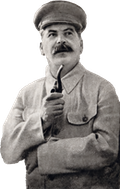
stalin-pipe Stalin can't stop aura farming. But it also reminds me of the adoration that people have for the Mount Paektu family in the DPRK which gets the identical anti-communist treatment that Stain did (now with "palace intrigue"). Kim Jong Un is the head of the WPK, but he isn't the most powerful figure by his own domination but by the democratic power of the Supreme People's Assembly. KJU has the authority to rally the WPK and the nation through socialist siege that became its worst in the Arduous March of the 90s.

It makes me see "De-stalinization" in an even more negative light. doggirl-gloom

Also, and I guess it's getting repetitive, but seeing Strong mention the socialist organizations of various SSRs and cities like Lugansk does contextualize further how devastating the illegal dissolution was. All the SSR have been forcibly converted to nationalist bubbles that could not survive on their own without neoliberal doctrine (or are actively self-destructing in the case of Ukraine and possibly later nations such as Estonia, Latvia and Poland).

Overall, I like how this chapter humanizes socialist leadership rather than how the West continually spreads anticommunist libel that are the same set of unfalsifiable tropes that even a book from the 1930s can debunk.

[–] Damarcusart@hexbear.net 3 points 22 hours ago (1 children)

Overall, I like how this chapter humanizes socialist leadership rather than how the West continually spreads anticommunist libel that are the same set of unfalsifiable tropes that even a book from the 1930s can debunk.

Especially considering a lot of myths about Stalin as the "brutal dictator" didn't exist yet, it continually pokes holes in the western narrative before the western narrative fully coalesced.

[–] edie@lemmy.encryptionin.space 3 points 20 hours ago* (last edited 20 hours ago) (1 children)

Especially considering a lot of myths about Stalin as the “brutal dictator” didn’t exist yet

I thought they did.


This user is suspected of being a cat. Please report any suspicious behavior.

[–] Damarcusart@hexbear.net 4 points 20 hours ago

He was called all sorts of names at the time, but the common perception of him being "more evil and ruthless than Hitler" didn't exist at all yet, that was a product of the cold war.

[–] edie@lemmy.encryptionin.space 13 points 2 days ago
[–] Cowbee@hexbear.net 7 points 2 days ago (2 children)

Continuing the theme of explaining core communist concepts in ways non-communists can easily understand, Strong shows both democratic centralism and further elaborates on the vanguard, while supporting it with anecdotes. The party structure really is core to communist organizing work, and understanding how to make an effective party is an enormously important task.

[–] hello_hello@hexbear.net 4 points 1 day ago (1 children)

The anecdotes continue to make this work very approachable. Being able to read about the workings of the USSR from both a macro and micro level leads to being able to have a comprehensive view of Soviet life.

[–] Cowbee@hexbear.net 3 points 1 day ago

Agreed! Strong's work as a journalist really helps her writing.

[–] CascadeOfLight@hexbear.net 6 points 2 days ago (1 children)

On that point about explaining to non-communists, I think a valuable part of this chapter and the last one is showing, not just the details of Soviet government and organization, but even that there is this much detail to be described, compared with the cartoonishly simplistic propaganda image of "authoritarian dictatorship" that is hegemonic in capitalist media. It reveals how paper-thin and ridiculous those descriptions are.

[–] Cowbee@hexbear.net 5 points 2 days ago* (last edited 1 day ago)

That's a great point! It works wonders for making it seem complex and real, rather than cartoonish.