She is also one of the five original authors of the UC STEM faculty open letter urging the University of California to restore the SAT and ACT.
Does anyone remember why UC got rid of SAT and ACT admissions to begin with?
California groups demand UC drop the SAT, alleging it illegally discriminates against disadvantaged students (archive.is)
Critics, however, say the exams are an unfair admission barrier to students who don’t test well or can’t afford to pay for pricey test preparation. Decades of research have shown that scores are strongly influenced by family income, parents’ education and race.
I can say from personal experience that privatized test-taking classes and insider info from test-prep companies that also author the tests themselves raised my SAT score from the mid-1100s to the 1500s over the course of a few months. I don't believe my core mathematical skills improved so dramatically during this time. But I gained a ton of insight into answering a specific kind of question quickly and accurately for the purpose of testing well.
And this trend is not unique to the SAT/ACT standardized testing regime. We've been experimenting with all sorts of standardized testing strategies down in Texas, and they have become a suffocating weight across all grade levels that fail to produce any noticeable improvement in education outcomes. Instead, we've seen standardized testing used as a tool of the state government to take over local school districts - HISD in 2023 and now AISD in 2026 - by shutting down poorer schools while funneling wealthier students into privatized programs.
Meanwhile, the cost to create, maintain, and administer these tests is astronomical, running up to $70/student/exam and amounting to billions annually.
It seems that students who "can't do middle school math" would be easily identified during the college admissions process by their... high school GPA. I haven't seen anything in this article that explains why students seeking admittance to Berkeley - especially students walking in the door with advanced mathematics credits from AP exams - would be unable to answer basic Algebra problems. Or why a school was passing over specific students with straight As in math subjects, while admitting students who were flunking remedial classes. But the article fails to address this question. It does include a very bizarre graph
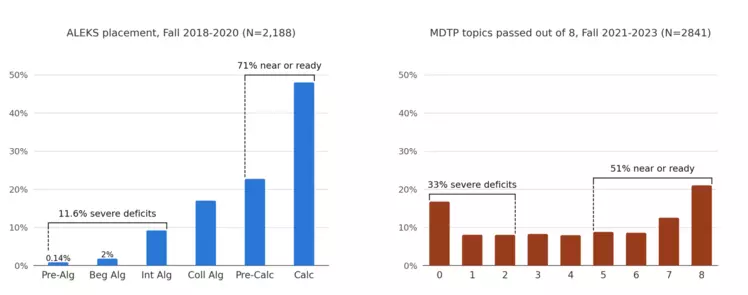
which seems to compare 2018 apples (ALEKS placements) to 2023 oranges (MDTP topics passed). I can also say from personal experience that proficiency in a subject matter in high school standardized testing is no guarantee of performance on a college-school exam in a heavily curved weed-out course. Any relationship between these two measures will tenuous at best.
Schools that find themselves inundated with students interested in a particular subject will routinely curb enthusiasm by gating upper-level classes behind mandatory lower-level courses that deliberately flunk north of 30% of students through grueling homework and exam filters. That's before you get into student lifestyles between at-home high school life and campus college life - drinking and poor diet, romantic drama, biting off more courses than you can chew, juggling part-time work to make ends meet - all of which can ruin college careers.
How on earth does the SAT/ACT solve for any of that? The article doesn't say. But it was written by a professor with an award-winning reputation... from a private organization whose awards are sponsored by the owners of the SAT and its exam prep affilates.
So that's something to chew on.