this post was submitted on 05 Mar 2026
23 points (100.0% liked)

Climate

8389 readers
314 users here now

Discussion of climate, how it is changing, activism around that, the politics, and the energy systems change we need in order to stabilize things.

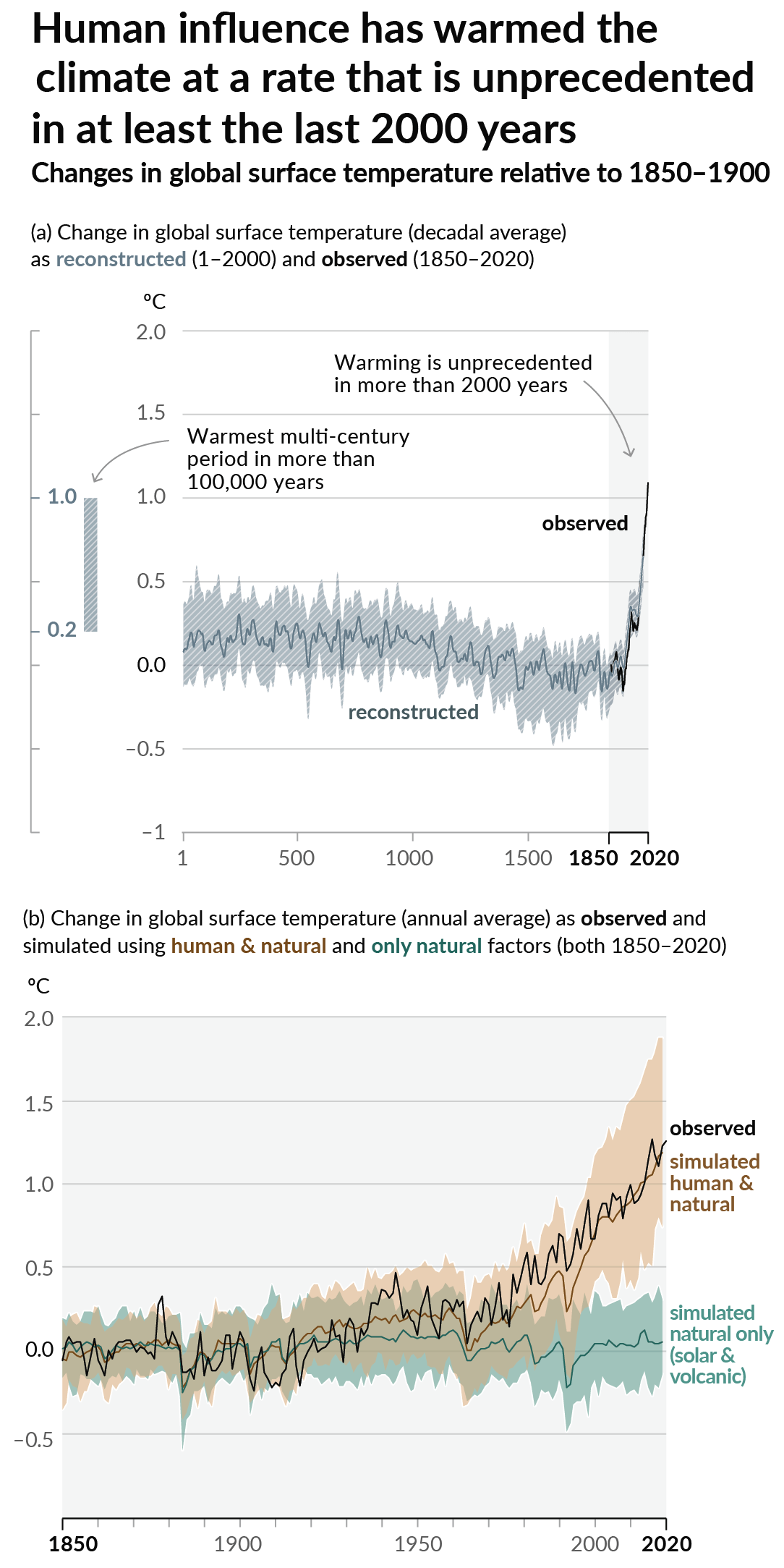
As a starting point, the burning of fossil fuels, and to a lesser extent deforestation and release of methane are responsible for the warming in recent decades: Graph of temperature as observed with significant warming, and simulated without added greenhouse gases and other anthropogentic changes, which shows no significant warming

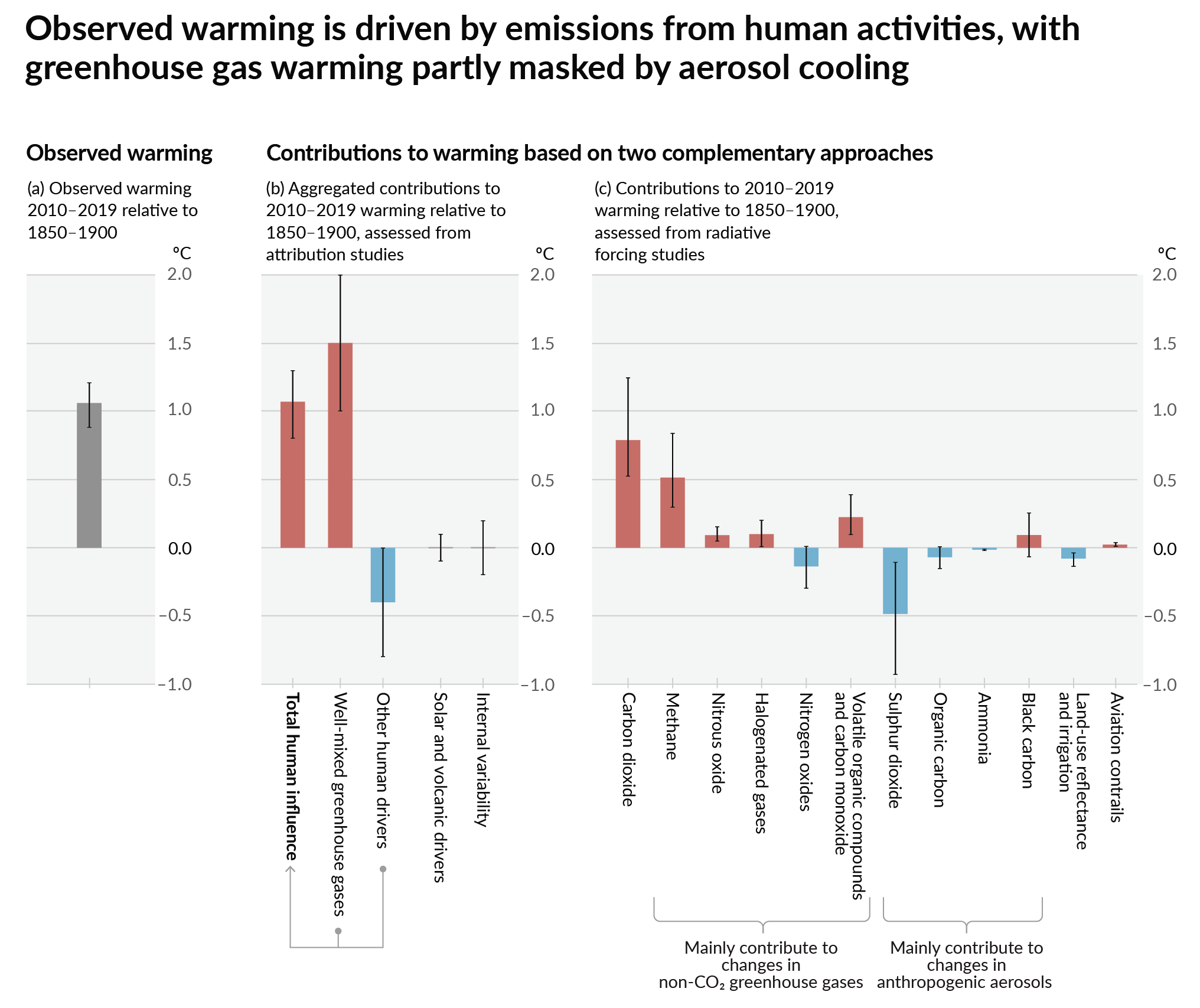
How much each change to the atmosphere has warmed the world: IPCC AR6 Figure 2 - Thee bar charts: first chart: how much each gas has warmed the world.  About 1C of total warming.  Second chart:  about 1.5C of total warming from well-mixed greenhouse gases, offset by 0.4C of cooling from aerosols and negligible influence from changes to solar output, volcanoes, and internal variability.  Third chart: about 1.25C of warming from CO2, 0.5C from methane, and a bunch more in small quantities from other gases.  About 0.5C of cooling with large error bars from SO2.

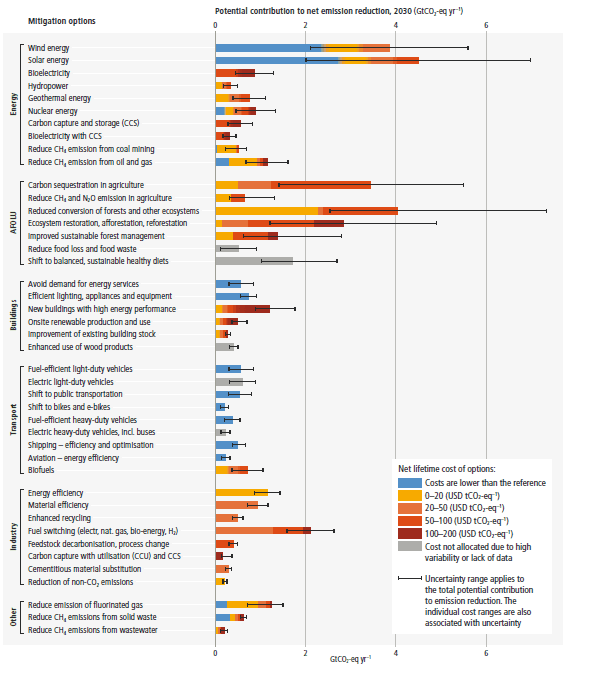
Recommended actions to cut greenhouse gas emissions in the near future:

Anti-science, inactivism, and unsupported conspiracy theories are not ok here.

founded 2 years ago
MODERATORS
 

The insurance industry is the climate crisis’s canary in the coal mine. As disasters become more frequent and intense, insurers have responded by increasing prices, dropping policies, and withdrawing from states and regions entirely. State-funded insurance programs have been created to cover the gap, but mounting losses threaten their viability as well. Insurance commissioner Dave Jones puts it bluntly:

Insurers in all states will be overrun by the increased risk and losses resulting from rising global temperatures. Unless we transition away from fossil fuels that continue to drive up global temperatures, we will continue to march - at an increasing pace - toward an uninsurable future.

In this post, we’ll be taking a look at insurance nonrenewals, or instances of insurers refusing to renew home insurance policies. This is a critical factor, as insurance is a requirement for a mortgage; when insurers withdraw, vulnerable regions may experience a mass exodus as homeowners sell or default on their loans.

In 2024, the Senate Budget Committee released a report titled Next to Fall: The Climate-Driven Insurance Crisis is Here – And Getting Worse. The report analyzed 249 million insurance policies from 2018 through 2023, and found that over 1.9 million homeowners have been dropped from their policies over that time period.

“The climate crisis is not just about polar bears, and it’s not just about green jobs,” Senator Sheldon Whitehouse, chairman of the Senate Budget Committee, said during a hearing on the investigation’s findings. “It actually is coming through your mail slot, in the form of insurance cancellations, insurance nonrenewals and dramatic increases in insurance costs.”

We’ve mapped that data so you can see which parts of America have been most affected.
top 4 comments
sorted by: hot top controversial new old
[–] Endymion_Mallorn@kbin.melroy.org 1 points 13 hours ago (1 children)

This is just late-stage capitalism and the centralization of capital. Areas become uninsurable for "homeowners", so large companies buy the land and "develop" it, using their influence to get bulk insurance. Then when the middle class have fled or been flattened into the working class, they're only going to be able to rent a much smaller place than before, which is more efficient for the real estate company.

Oh, and it's likely that the only reason for the development is because the equity firm involved has other companies they want local staff for.

[–] relianceschool@slrpnk.net 3 points 12 hours ago

Disaster capitalism is absolutely a thing, but there is a limit to how many times an area can be rebuilt before it's written off as a loss. Large companies can float losses longer than individual homeowners, but I believe we'll also see an abandonment of the most climate-vulnerable areas over the coming decades.

[–] JamieDub86@piefed.social 1 points 14 hours ago (1 children)

Bit annoying that the article only mentions the USA.

[–] relianceschool@slrpnk.net 7 points 14 hours ago

I wrote it, sorry you're annoyed 😅 I keep my focus on America as climate resilience is a huge subject, and I don't have the bandwidth to keep tabs on multiple countries. There's also pretty good data availability here, although I expect that'll take a hit during this administration. There are some commercial and open-source platforms which are starting to publish data for Canada & Europe, I just haven't come across insurance-specific info in my trawls.