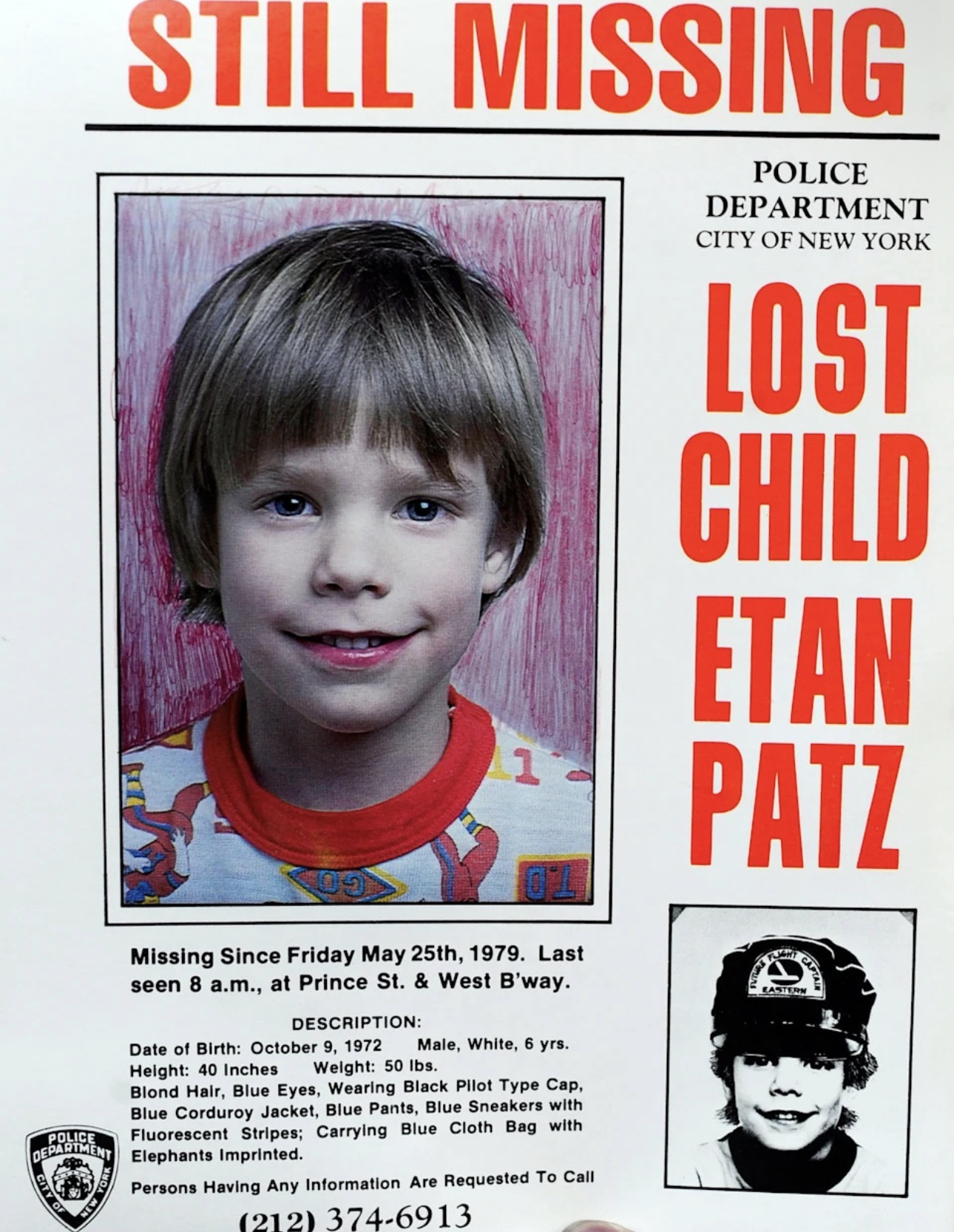
In the late 1970s and throughout the 1980s, few disappearance cases in New York City cast as long and unsettling a shadow as that of Etan Patz. Though he vanished on May 25, 1979, the investigation and its cultural impact defined the city for decades afterward, reshaping parenting norms and public awareness of missing children. His disappearance occurred not in isolation, but in one of the busiest and most densely populated urban environments in the United States, which is precisely what made it so disturbing.
Etan was six years old when he left his family’s apartment in SoHo to walk two blocks to his school bus stop. It was the first time his parents had allowed him to make the short trip alone. The route was simple and familiar. It was morning. Businesses were open. Commuters were on the streets. Within minutes, however, he was gone. He never boarded the bus. No confirmed witnesses placed him at the stop. Despite searches, interviews, and extensive media attention, no body or definitive physical evidence was found.
The apparent ordinariness of the circumstances heightened the strangeness. This was not a remote park or an abandoned industrial zone. It was lower Manhattan in daylight. The distance from his home to the bus stop was negligible. The idea that a child could vanish completely within such a confined, active space unsettled New Yorkers in a way few crimes had before. It challenged assumptions about urban visibility and collective safety. If a child could disappear in SoHo during morning rush hour, then perhaps no public space was inherently secure.
The case quickly expanded beyond a local investigation. Etan became one of the first missing children featured on milk cartons, a practice that spread nationwide in the 1980s. His image became emblematic of a broader social shift: increased awareness of child abduction and a growing anxiety among parents about allowing children independence. In many ways, the era of children freely navigating city neighborhoods alone diminished after his disappearance. The case transformed not only policing but everyday family life.
For years, investigators focused on various suspects, including a local man named Jose Ramos who had connections to acquaintances of the Patz family. Despite suspicion and circumstantial leads, no charges were filed. The absence of physical evidence complicated every theory. The case remained officially unsolved for decades, and its mystery deepened as time passed. The lack of closure contributed to its aura; it felt less like a crime with a missing piece and more like a blank space in the urban fabric.
In 2012, more than thirty years after Etan vanished, a former bodega worker named Pedro Hernandez confessed to luring the boy into a basement and killing him. Hernandez was later convicted in 2017. However, the resolution did not entirely dispel the case’s lingering ambiguity. No remains were ever recovered. There was no forensic evidence linking Hernandez directly to the crime scene. His confession, given decades after the event, raised questions about reliability and memory. While the legal system rendered a verdict, some observers continued to view the case through the lens of unresolved uncertainty.
What ultimately makes the disappearance of Etan Patz so enduringly strange is not simply the crime itself, but the way it exposed vulnerabilities in the urban landscape. The event occurred in a place defined by density and constant motion, yet produced an absence so complete that it seemed almost implausible. Even with a conviction, the lack of physical closure leaves a lingering sense of incompleteness.
The case stands as both a historical turning point and a haunting reminder that even in the most populated environments, moments can slip beyond witness and explanation. In that sense, Etan Patz’s disappearance remains embedded in New York’s collective memory—not only as a tragedy, but as a rupture in assumptions about visibility, safety, and the reliability of public space.