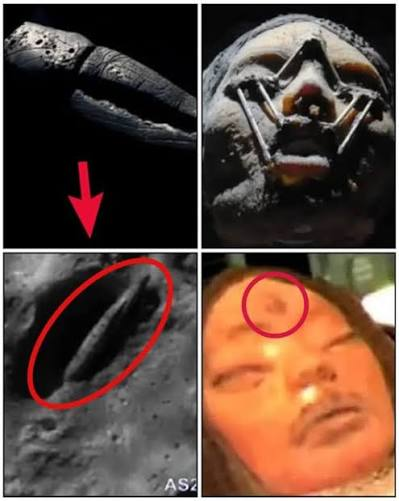
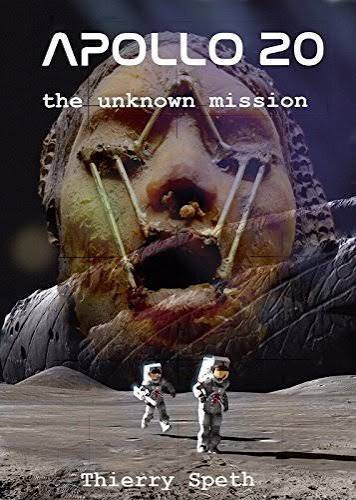
In the late 2000s, when YouTube was still chaotic and largely unmoderated, one of the most effective space-related hoaxes of the internet era began circulating: the so-called Apollo 20 alien woman footage. Presented as classified material from a secret lunar mission, the videos claimed that NASA — in cooperation with the Soviet Union — had landed astronauts on the far side of the Moon and discovered the remains of an extraterrestrial female inside an ancient spacecraft.
The story was structured with precision. The uploader, using the name “William Rutledge,” claimed to be a retired astronaut involved in a covert Apollo 20 mission. According to the narrative, Apollo 17 had not been the final Moon landing. Instead, hidden missions continued, culminating in the discovery of a crashed alien craft in a lunar crater. Inside that craft, astronauts allegedly found two alien bodies — one badly damaged and one preserved. The preserved figure, shown in grainy footage, became known online as the “Mona Lisa” alien.
The videos appeared convincing for several reasons. First, they incorporated real NASA archival footage — which is largely public domain — as foundational material. Familiar spacecraft interiors, authentic Apollo mission visuals, and recognizable telemetry aesthetics created a base layer of credibility. Over this, the creator layered staged inserts: dimly lit interior shots of a humanoid female figure with elongated features, visible veins, and a desiccated appearance. The editing intentionally mimicked 1960s film grain and compression artifacts, making the seams between archival material and fabricated footage harder to detect.
The alien body itself was not CGI. It was a physical prop — a carefully constructed dummy. Silicone skin, sculpted anatomical details, and surface texturing gave it a disturbing realism, especially under low lighting. The imperfections actually helped. In 2008, CGI was widespread but often looked artificial under scrutiny. Practical effects filmed in low resolution, however, tend to blend more naturally with archival-style footage. The grain and visual noise masked fine inconsistencies, allowing viewers to project authenticity onto what they were seeing.
As the videos gained traction, online forums and conspiracy communities amplified them. The Cold War backdrop made the premise feel plausible to some viewers: secret joint U.S.–Soviet cooperation, suppressed discoveries, classified space programs. The name “Apollo 20” sounded official. And because NASA missions are associated with complex technical language and obscure documentation, the average viewer lacked the tools to immediately dismantle the claim.
But the logistical flaws were obvious to anyone familiar with space history. The Apollo program officially ended with Apollo 17 in 1972. There are no records of Apollo 18, 19, or 20. A Saturn V launch cannot be hidden; the infrastructure, production chain, fuel logistics, and personnel requirements are massive and publicly documented. No funding trail exists. No astronaut rosters match the claim. No telemetry records or launch anomalies support it. A mission of that scale would leave an enormous historical footprint.
As scrutiny increased, researchers traced the origin of the footage back to a French artist and independent filmmaker commonly identified as Thierry Speth (or Thierry F. in some reporting). The “William Rutledge” persona was fictional. Eventually, the creator gave interviews acknowledging that the Apollo 20 material was a fabricated art project — speculative fiction presented in documentary style.
Crucially, in interviews he reportedly showed the physical alien dummy used in the footage. The prop, displayed outside of the dim lunar staging, made clear that the “extraterrestrial” was a studio creation. This detail collapsed the core claim: if the body exists as a practical effects model in a filmmaker’s possession, it was never recovered from the Moon.
Yet the hoax did not simply disappear. Like many viral myths, it detached from its origin. Once reposted without context, the footage circulated independently of the creator’s admission. For some believers, the filmmaker’s acknowledgment became part of the narrative — reinterpreted as a forced confession or cover story. This illustrates a common psychological pattern in conspiracy culture: once a narrative becomes emotionally compelling, contradictory evidence can be absorbed rather than rejected.
The Apollo 20 alien woman hoax stands as a textbook example of early internet myth-making. It blended authentic archival material with staged practical effects. It leveraged authority cues — NASA branding, technical jargon, Cold War secrecy. It used low resolution and grain as camouflage. And it exploited a moment in digital culture when verification mechanisms lagged behind content creation.
There was no secret Apollo 20 mission. There was no alien body on the Moon. There was, however, a skilled independent filmmaker who understood how cinematic realism, when stripped of context and uploaded into a hungry online ecosystem, could become modern folklore.
Link to video![] https://youtu.be/PiELhDFGDuI