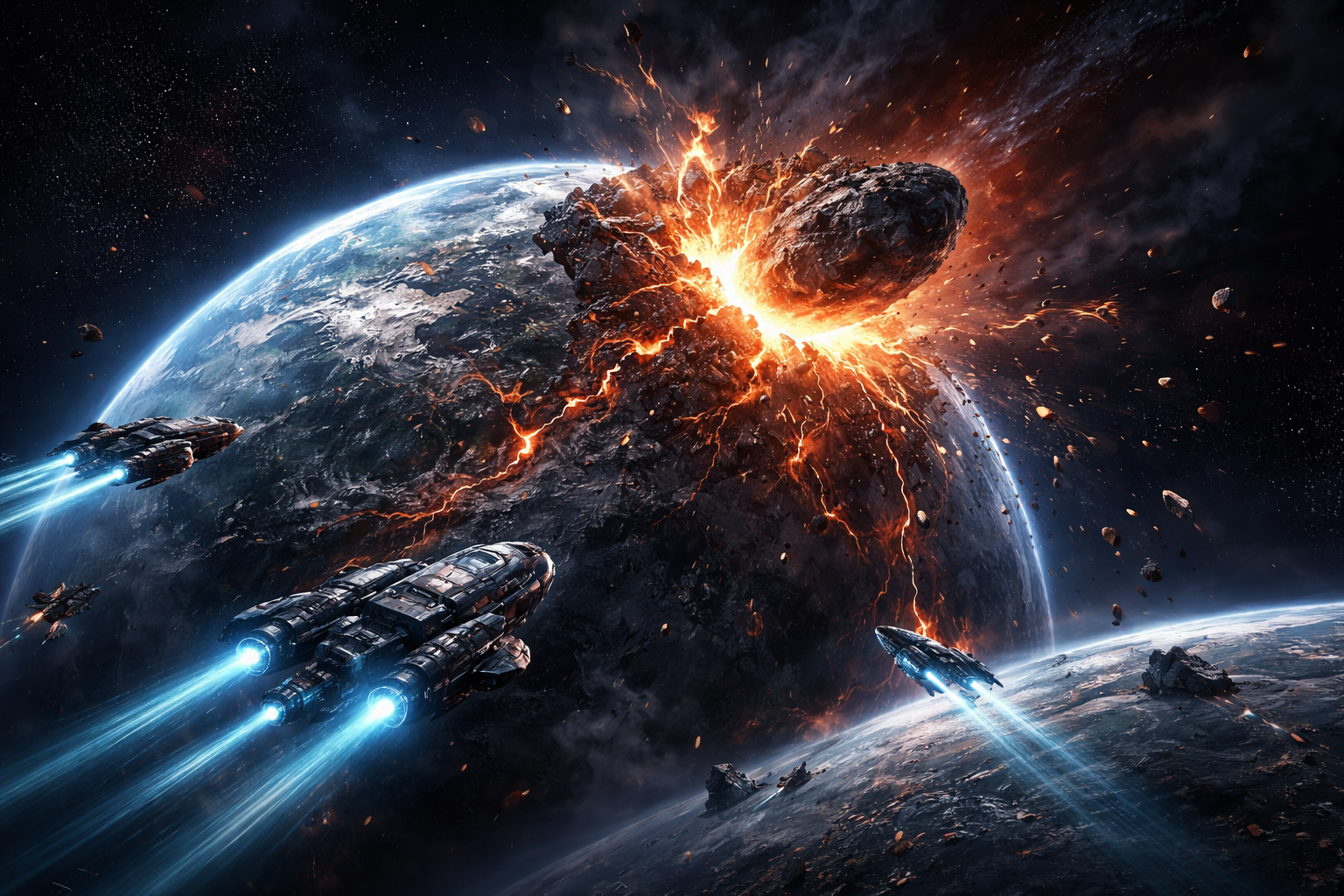
Phaeton Between the Worlds: A Lost Planet, A Story of Survivors, and the Weight of Evidence
In the long quiet stretch between Mars and Jupiter lies a band of stone and metal — the asteroid belt. To the modern eye it is debris, a scattered ring of remnants from the early solar system. But in the nineteenth century, before we understood how planets form, some astronomers saw something else entirely: the wreckage of a destroyed world.
This idea came to be known as the Phaeton Hypothesis.
The story begins in the late 1700s and early 1800s. When astronomers noticed that the spacing of planets roughly followed a pattern — often associated with the Titius–Bode rule — there appeared to be a missing world between Mars and Jupiter. In 1801, when Giuseppe Piazzi discovered Ceres in that region, it was first hailed as a new planet. Soon after, additional bodies were found: Pallas, Juno, Vesta. Instead of one world, there seemed to be many.
To some thinkers, the simplest explanation was dramatic: these objects were fragments of a once-intact planet that had shattered.
German astronomer Heinrich Wilhelm Olbers proposed in 1802 that the asteroids were debris from a destroyed planet. Later, other figures such as Johann Elert Bode lent weight to the idea by popularizing planetary spacing laws that seemed to demand a missing world. The hypothetical planet was given a name drawn from Greek myth: Phaeton — the son of Helios who lost control of the Sun’s chariot and was cast down in flames.
It was a poetic symmetry: a lost planet named after a fallen celestial driver.
For much of the nineteenth century, the hypothesis lingered as a plausible explanation. After all, what else could explain a ring of debris exactly where a planet “should” be?
Imagine, then, that Olbers was right.
Picture a world slightly smaller than Earth, orbiting quietly between Mars and Jupiter. Oceans glimmering under a thinner sun. Continents ringed with mineral-rich mountains. Perhaps a civilization advanced not in steel and combustion, but in subtle engineering — planetary magnetics, stellar observation, biological preservation. They would have watched Jupiter dominate the sky, a striped titan pulling tides through their atmosphere.
Perhaps they noticed something wrong long before the end.
Gravitational instabilities. Increasing meteor impacts. Internal stresses within the crust. Or perhaps — in a more speculative imagining — a catastrophic collision with a rogue protoplanet wandering inward from the outer system.
Their astronomers would have seen it first: a dim intruder, growing larger night by night.
And so the story continues.
Facing extinction, this civilization launches arks — not massive starships in the cinematic sense, but hardened vessels designed for survival. They carry frozen seeds, microbial cultures, DNA libraries encoded in crystalline matrices. Not conquest. Preservation.
The collision comes. The planet fractures. Oceans vaporize. The mantle ruptures. Billions perish. Debris scatters into a widening ring that will circle the Sun for billions of years.
But a handful of vessels escape.
One of them drifts inward toward a young, volatile world still cooling from its own formation — Earth.
The planet is harsh. Volcanic. Bombarded. But it has oceans forming. An atmosphere stabilizing. The survivors seed it — perhaps intentionally, perhaps simply through contamination — and their genetic vaults mingle with native chemistry. Life takes root. Over eons it diversifies. Forgets its origin. Evolves into creatures who will one day look at the asteroid belt and wonder.
It is a powerful story. Elegant. Tragic. Mythic in scale.
And it collapses under arithmetic.
Modern astronomy has weighed the asteroid belt with remarkable precision. When scientists add together the mass of all known asteroids — including the largest bodies like Ceres, Vesta, Pallas, and Hygiea — the total comes to only about 4% of the Moon’s mass.
Not 4% of Earth.
Four percent of our Moon.
That is vanishingly small.
If there had once been an Earth-sized planet between Mars and Jupiter, its mass would have been enormous — roughly 80 times the mass of the Moon. Even a Mars-sized world would have left behind far more material than we observe. There simply isn’t enough debris in the asteroid belt to account for a shattered terrestrial planet.
The numbers do not work.
Further, the asteroids themselves tell a story inconsistent with planetary destruction. They are chemically diverse — some primitive and carbon-rich, others metallic, others partially differentiated. If they had come from a single mature planet, we would expect more uniform layering signatures. Instead, they appear to be primordial building blocks — leftover material that never successfully formed into a planet at all.
The dominant modern explanation is less dramatic but more consistent with physics: Jupiter’s immense gravity prevented a planet from forming in that region. As rocky material began to clump together in the early solar system, gravitational resonances from the gas giant stirred the region violently. Collisions broke objects apart faster than they could merge. The asteroid belt is not rubble from destruction. It is a construction site where building was never allowed to finish.
There were likely large protoplanets in that region early on — embryonic worlds — but they were disrupted before reaching full planetary scale. Their fragments mixed with untouched primordial material. Over billions of years, further collisions ground everything down.
The romantic image of a blue-green world torn apart in a single apocalyptic moment does not survive gravitational modeling.
As for the idea that survivors seeded Earth — modern biology offers a simpler explanation. Life on Earth appears to share common ancestry tracing back to early microbial organisms that emerged relatively soon after the planet cooled. There is no evidence of external genetic architecture inconsistent with terrestrial evolution. While panspermia — the transfer of microbial life via meteorites — remains scientifically plausible in principle, it does not require a destroyed advanced civilization. It would require only hardy microorganisms and rocks.
The Phaeton Hypothesis, once taken seriously, is now largely historical — an instructive example of how scientific understanding evolves. Early astronomers filled gaps in knowledge with the best models available to them. As measurement improved, those models were revised.
And yet, the story persists.
It persists because it satisfies something deeper than orbital mechanics. It provides tragedy, memory, and cosmic continuity. It transforms the asteroid belt from a failed zone of accumulation into the graveyard of a world. It allows humanity to imagine itself not as an accident of chemistry, but as the heir to a forgotten civilization.
But nature does not bend for narrative symmetry.
The asteroid belt’s small total mass — roughly 4% that of our Moon — is the quiet, stubborn fact that dismantles the myth. There is simply not enough material. The debris ring is too thin. The gravitational dynamics too well understood. The chemical diversity too inconsistent.
The lost planet Phaeton almost certainly never existed as a full Earth-like world.
And yet, the hypothesis remains valuable — not as truth, but as a reminder. It shows how scientific curiosity begins with bold imagination. It demonstrates how early thinkers like Olbers tried to make sense of incomplete data. It highlights how later measurement can overturn even elegant ideas.
In the end, the asteroid belt is not a cemetery of a drowned civilization.
It is something more subtle: a fossil of planetary formation itself.
A region where a world might have been — but never was.
And sometimes, that quieter reality is more profound than any myth.