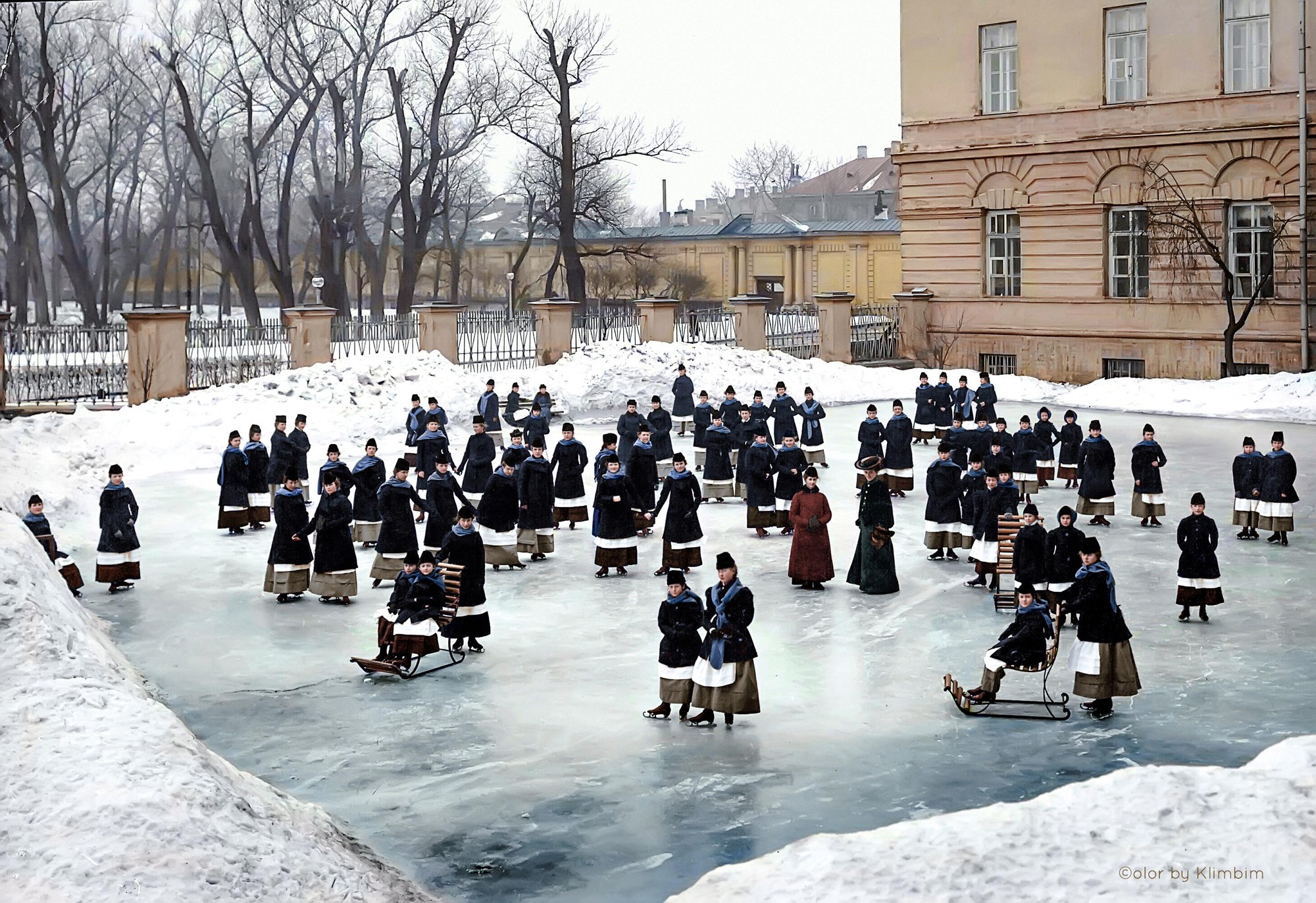
Colorized, presumably.
HistoryPhotos is for photographs (or, if it can be found, film) of the past, recent or distant! Give us a little snapshot of history!
Rules
Related Communities:
Colorized, presumably.
So it seems. We do have a ton of color photos from the era from This guy (Sergey Prokudin-Gorskii).
He took three b&w photos through filters at the same time, then would project them through filters to get the color.
Reverse image search shows some different attempts at colorization, and also black-and-white originals that have much less contrast.
Gotta say, this colorization fooled me at first, because it's exactly how old buildings in SPb look now.
P.S. The "color by Klimbim" signature in the corner should've probably been the biggest hint.
P.S. The “color by Klimbim” signature in the corner should’ve probably been the biggest hint.
lmao, I completely missed that
To me it's obviously screaming colorized.
The colors are way too uniform. All the blue scarves are exactly the same blue, all the skin tones are exactly the same, all the individual buildings have a color that's exactly uniform from corner to corner, etc.
And things like the ice are completely missing any color at all (except for maybe an overall blueish tint they added to the dark areas) but in real life everything has color. Objects that you might think are just monochrome black-gray-white actually have a lot of different colors in them. So when a section of a picture looks like a black n white photo instead of a color photo it immediately pops out to me.
Plus, the colors of all the different objects disagree on the type of light hitting them. Like for the black ice to have a significant blueish tint means the lighting of that day wouldn't create a pinkish skin tone.
And there's no atmospheric effects in the distance of colors. Like the column closest to the camera is the same color as the most distant column, but in reality colors fade as they go further into the distance even at the scale in this photo.
This concludes my procrastination ted talk.
I don't quite see the 'uniform color' on the building, the columns, or the wall in the back.
I presume! I don't know much about this photo, unfortunately!
The Institute building was also famous as the site of the headquarters of the Bolshevik party, and is currently the location of SPb governor and city administration.
However, I have a hard time figuring out where exactly this photo might've been taken. The long wall suggests the neighboring Smolny Convent rather than the Institute itself — but it turns out that some spaces behind the current Smolny building and inside the convent are walled off so hard that even Yandex doesn't have photos from there.
Wow, what a striking photo, and striking color / sharpness / contrast upgrade compared to the original.
So, I see that the Smolny Institute was Europe's first public educational institution for girls, founded in 1764 in accordance with a decree signed by Catherine the Great.
One wonders in what other culturally-significant ways Russia led Europe over the years. I do seem to recall leading painters and intellectuals liking to hang out in Moscow's cafes... er, well I think.
The Russian Empire has a very... funny history. At times the court was very progressive, but in such cases, it was almost always safer to be a foreign radical than a native one...
it was almost always safer to be a foreign radical than a native one…
Hmm!!
Looks like a modern Brueghel painting.
