30
Plug-in hybrids use three times more fuel than manufacturers claim, analysis finds
(www.theguardian.com)
Environmental and ecological discussion, particularly of things like weather and other natural phenomena (especially if they're not breaking news).
See also our Nature and Gardening community for discussion centered around things like hiking, animals in their natural habitat, and gardening (urban or rural).
This community's icon was made by Aaron Schneider, under the CC-BY-NC-SA 4.0 license.
It really depends on the owner and how they are driven. We have a plugin hybrid that probably uses even less fuel, since it mostly gets used around town and is consistently plugged in when at home. The gas engine doesn't kick in at all until the battery is drained, or until it decides the gas in the tank is getting too old.
It really depends on the owner and how they are driven
I'm not sure about this study (can't read any German oops), but expected vs real-life usage of PHEVs (Plug-in Hybrid) is exactly the problem brought up by T&E and others at the end of last year, see for example this report from October 2025:
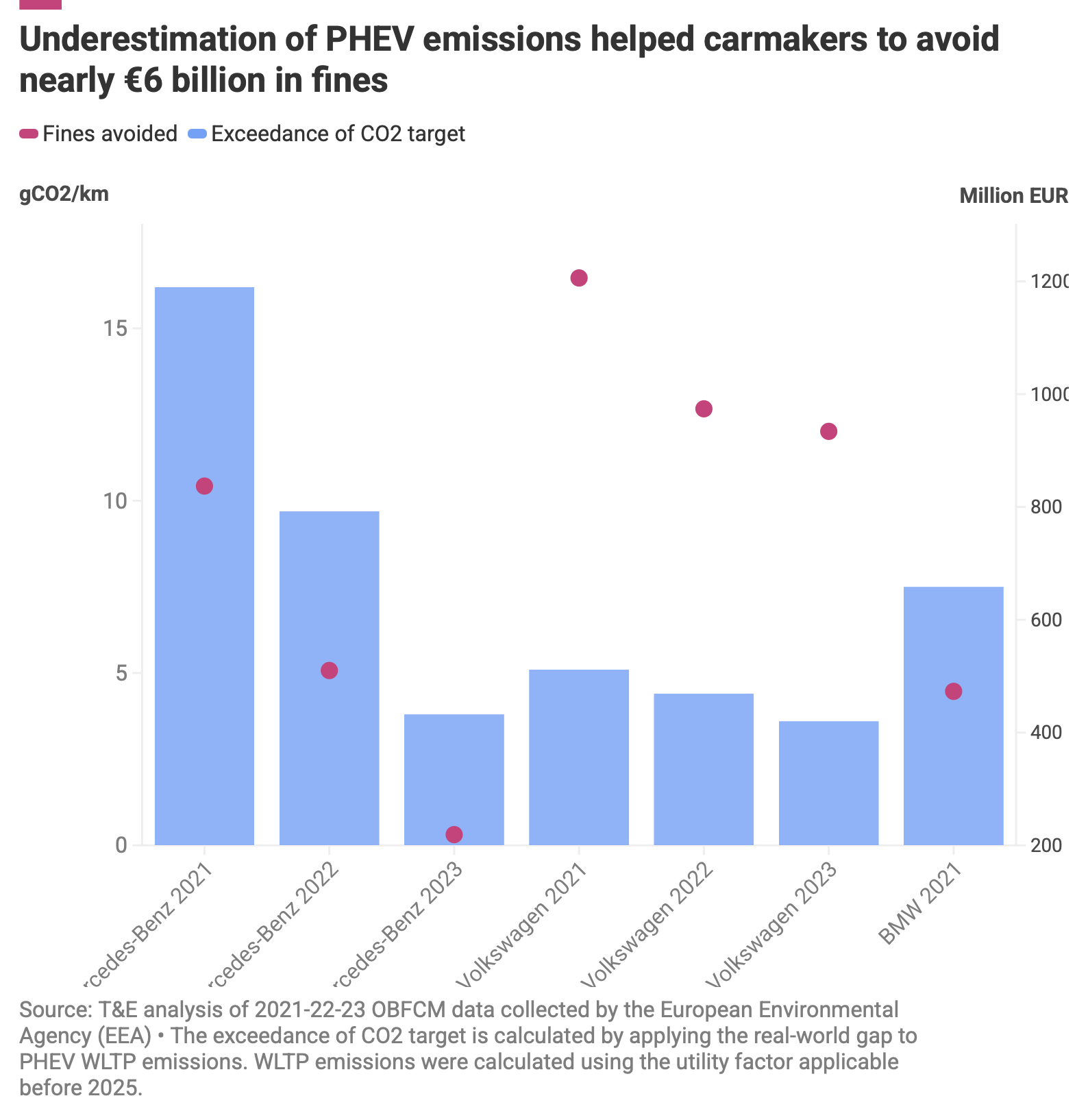
The [fuel consumption and CO2 emissions] gap is mostly caused by flawed assumptions on the share of electric driving mode (the ‘utility factor’, UF) which leads to a drastic underestimate of official PHEV emissions. The UF overestimated the electric driving share, assuming 84% over 2021-2023, whereas real-world data shows this to be just 27%.
I'm not doubting at all that you outperform the expected consumption, but sadly on average it seems like there's more of a systematic (and significant) under-performance. However, this is comparing WLTP testing to real-life driving EU data, for cars sold in the EU. I'm sure that this might be region-dependent as models and driving habits might be radically different.
EDIT: oops as mentioned by @Don_alForno@feddit.org, this seems to be more about the engine of certain manufacturers consuming more than expected in electric drive mode:
Until now it has been claimed by manufacturers that the vehicles used only a little or almost no fuel when in the electric mode. The studies showed that this was not in fact the case.
So not the same as the T&E study, and much less about usage.
My experience is only with the Chevy Volt which was sadly discontinued. The Volt's engine will occasionally come on if I'm accelerating from speed, like in a short merge to a fast expressway, but that doesn't last long. Aside from that and burning old gas, the engine never comes on while the battery has charge. I have no idea how other plugins function.
I had one and only put gas in it when taking a trip out of town. On a road trip I would get about 38mpg. Not great for what is was but better than anything else I owned before. I had that car for 5 years and 120,000 miles.
The fact that I used 0 gas for my daily use brought the cars lifetime mpg to 163mpg!
Also, I learned the hard way that gas can go bad fairly quickly.
or until it decides the gas in the tank is getting too old.
Thanks for answering a question I had about what happens if the gas starts getting too old.
I don't want to call this BS. But maybe something got screwed somewhere? My Prius totally rocks in fuel savings. I find it hard to believe that a hybrid jeep could do the same, but according to a friend that owns one it does get just a little worse milage. Not 3 times worse. But I could be wrong.
I haven't seen the paper itself, but the article does mention that there's quite a spread between manufacturers, e.g. Porsche being the worst offender.
I think the issue is driver be shoot more than the car.
eg.
-many companies bought plugin hybrids for corporate cars and handed them to employees since they would get some incentive, but employees did not have chargers at home so they just used them as a regular car.
-people buying them to get easier parking in the EV reserved spots
Around here public chargers are ridiculously overpriced so even if you use slow chargers you end up paying more per km for a plug-in hybrid than if you only put fuel in it. And if you want to use a fash charger then it's of course even more expensive. You only get cheaper costs per km if you can charge at home.
I think the concept behind plug-in hybrids is great: The battery of an EV is by far the most expensive part, and also by far the most polling part to produce. So making a car that acts like an EV with a battery only just big enough for your daily commute, with a back-up power system for when you need to go further and to avoid range anxiety makes a lot of sense. But unfortunately they are held back from reaching their potential by lacking charging infrastructure and too high electricity costs.
This is explicitly about the hybrid cars using far more gas than advertized in electric mode! Meaning the combustion engine turns on in battery mode regardless (which I did not know prior to this study).
I see. there was another similar study that touched on what I mention. I assumed it was the same https://www.transportenvironment.org/uploads/files/2025_09_TE_briefing_PHEV_gap_growing.pdf
I'm surprised this report isn't being mentioned at all in the Guardian's article. Maybe because this is more of German matter, with a report in German with results present on German broadcast going mainly against German manufacturers. Or maybe they're making it more about fuel consumption (and consumers) than emissions.
How old are they? I bet the efficiency decays over time and impacts the overall
Mine is like 15 years old. His is 2025.
I think that's part of it. Wait like 5 years for his to severely drop off from what I've seen anecdotally
Yeah probably. I can see that angle. But even then the system would be more efficient than a Normal internal combustion only system.
Definitely is, I suspect that consumers will see faster degradation with these new, heavier, vehicles.
I mean 6 litres per 100km still ain’t bad tho.
Maybe, but consumers might have to pay extra for gas compared to what they expected? And (in the EU) this allows companies to avoid paying fines for extra emissions (T&E).
It's worse than I got in my 1998 Civic, so I'm not sure I'd agree.
Arithmetic says 16.67km/L (I'm converting here for those of us across the pond), working out to 39.2 mpg. I was consistently exceeding 50 mpg.
My 95 civic did high 30s into low 40s. (Mpg) (17km/l)
My first Civic was a 1996, which was a new body style from 1995, but I can confirm about the same mileage.
Thing was, it was an automatic. My 1998 was a stick. I spent as much time in neutral as possible.
Okay, lets pretend I’m a huge idiot. Just for this exercise. From what I read it says that 6L gets you 100km. Is that not 6 litres of unleaded gasoline getting you 100 kilometres?