It's worse than that. In many places they rigged elections before handing over power to make sure that the country was still under control of whatever group they chose. Often the minorities they handed power to started brutally oppressing other groups to stay in charge. This prevented those countries from becoming stable democracies for decades, fueled genocide and created terrorist groups like Boko Haram.
History Memes
A place to share history memes!
Rules:
-
No sexism, racism, homophobia, transphobia, assorted bigotry, etc.
-
No fascism (including tankies/red fash), atrocity denial or apologia, etc.
-
Tag NSFW pics as NSFW.
-
Follow all Piefed.social rules.
-
History referenced must be 20+ years old.
Banner courtesy of @setsneedtofeed@lemmy.world
OTHER COMMS IN THE HISTORYVERSE:
- !historymusic@quokk.au
- !historygallery@quokk.au
- !historymemes@piefed.social
- !historyruins@piefed.social
- !historyart@piefed.social
- !historyartifacts@piefed.social
- !historyphotos@piefed.social
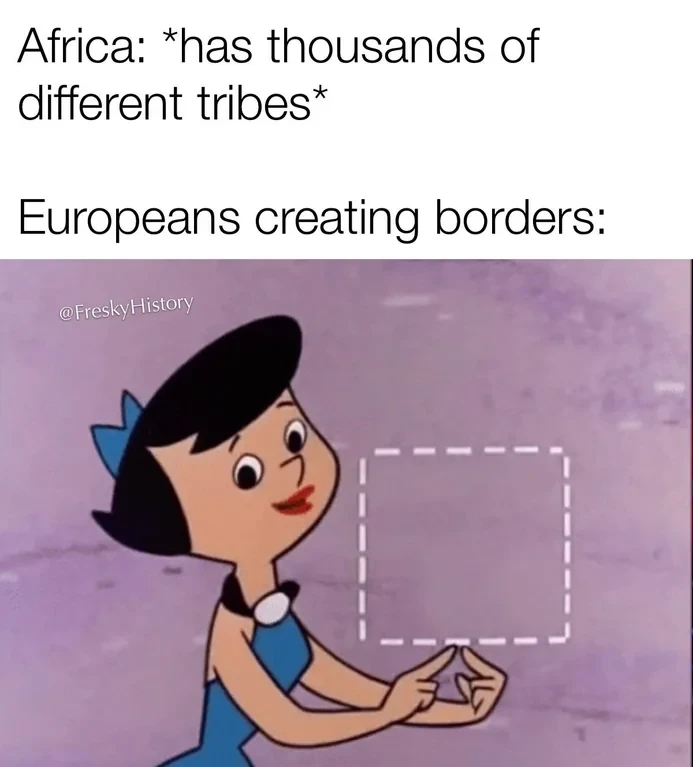
Explanation: During the late 19th century, Europe haphazardly colonized most of the African continent, which is a vast and diverse place.
In the 1950s, decolonization began as the empty promises made during WW1 began to catch up to the declining strength of European empires. The Euros, in releasing each newly independent country from their control, did so with pre-existing institutions and borders which were largely constructed either according to the arbitrary divisions Euros made amongst themselves ("This is MY square, and that is BELGIUM'S square") or with conscious intent to 'divide and rule', playing different ethnic groups against each other. While the European empires may not have intended to keep that sense of division after releasing the resulting states, they sure as shit did nothing to resolve it, suggesting, at best, callous apathy towards the future of these countries they insisted they had colonized for 'humanitarian' reasons.
For this reason, many African countries have struggled to forge cohesive national identities since independence, lacking longstanding ethnic ties (and often having multiple significant cross-border ethnic ties, making any internal conflict quickly escalate), uniting civic traditions, or even, in some cases, common economic interests.
They used the Congo river as a border before they even knew how long the river was. And ignoring that the river basin is a central geographic feature for many tribes, not a European style border separating countries. It would be like cutting Egypt in half at the Nile river, or cutting Brazil in half at the Amazon. But the Europeans knew so little about the interior of Africa at the time, but they knew where rivers had outlets to the ocean, so they made that the border.
It's crazy how that one decision is still such an important detail today. They're still fighting in the 21st century over these 19th century lines that were drawn by people who hadn't explored the interior of Africa.
Even in Europe, rivers frequently cut through populations (e.g. the rhine was decidedly not the border between French and German people), 19th and 20th century states in Europe were just better at forcing their populations into cohesion. Possibly because most of these states didn't just suddenly spring into existence in the 19th century, countries like France, Germany etc. had over a thousand years of history as more-or-less united polities.
A big river like the Rhine is usable as a border because it is absolutely a natural border easily defended for an army. Both armies come from their respective capitals and don't really care that the towns on both sides are friends and have deep cultural and economic ties. They only care how easily they can dunk on the soldiers or barbarians as they are waddling through the water, or funneled on a bridge.
The frontier is where you can guarantee protection with your army. If you can't cross the river fast enough to stop raids on the town on the other side, then it's not guaranteed protection, and it's not part of your country.
or cutting Brazil in half at the Amazon
Yeah, that's a really bad example.
But also, South America has a lot of borders in rivers that cut intermingled populations. The difference is that we were the ones that drew them (or asked some uninvolved 3rd party to draw them).
It's 'we' because you are the decendants of the colonizers no?
I mean "we" are the descendants of both colonizers and colonized.
My grandmother was (at least phenotypically) fully indigenous, my grandfather was (at least phenotypically) fully European. But both were born in Colombia.
It's very hard to draw a clear line between who is descendant of colonizer or colonized because of how much interracial rape, marriage, trade, business and everything in between there was.
We shouldn't whitewash our past (many people do), but depicting all South Americans not actively living in native reserves as fully European or fully indigenous is very misinformed or downright malicious at best.
The prevailing narrative in many South American countries is that either we were horribly oppressed and abused by the Spaniards / Portuguese, basically appropriating the plight and history of natives, or that we came on boats from Europe and erased natives, which invisibilizes their story and a huge part of our own history and ancestors.
South America is messy like that. And I have no doubt that if another great war breaks out in Europe, we will keep receiving European immigrants as we always have.
Makes sense, thanks
Eh... You could bother to learn one thing or another before making assumptions.