this post was submitted on 27 Jan 2026
189 points (100.0% liked)
History Memes
1524 readers
543 users here now
A place to share history memes!
Rules:
-
No sexism, racism, homophobia, transphobia, assorted bigotry, etc.
-
No fascism (including tankies/red fash), atrocity denial or apologia, etc.
-
Tag NSFW pics as NSFW.
-
Follow all Piefed.social rules.
-
History referenced must be 20+ years old.
Banner courtesy of @setsneedtofeed@lemmy.world
OTHER COMMS IN THE HISTORYVERSE:
- !historymusic@quokk.au
- !historygallery@quokk.au
- !historymemes@piefed.social
- !historyruins@piefed.social
- !historyart@piefed.social
- !historyartifacts@piefed.social
- !historyphotos@piefed.social
founded 8 months ago
MODERATORS
you are viewing a single comment's thread
view the rest of the comments
view the rest of the comments
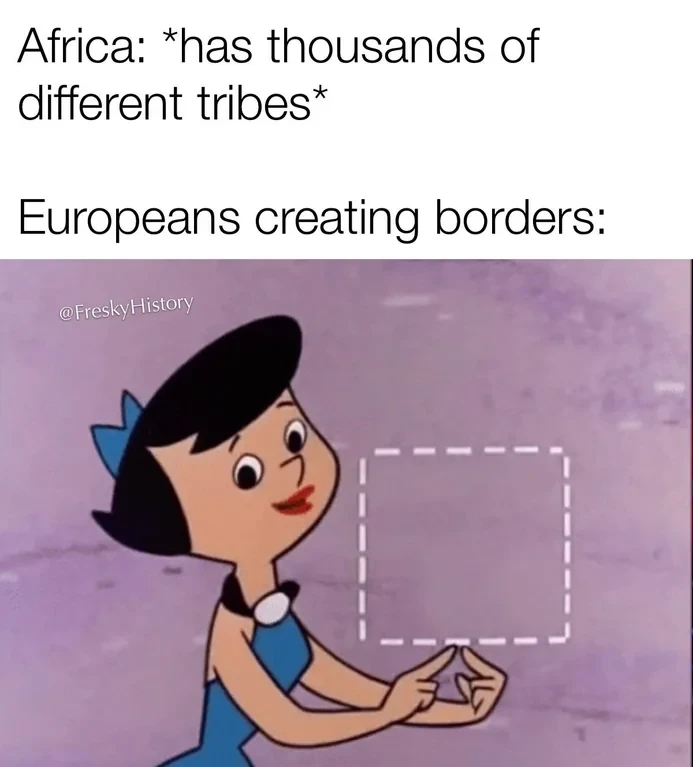
Even in Europe, rivers frequently cut through populations (e.g. the rhine was decidedly not the border between French and German people), 19th and 20th century states in Europe were just better at forcing their populations into cohesion. Possibly because most of these states didn't just suddenly spring into existence in the 19th century, countries like France, Germany etc. had over a thousand years of history as more-or-less united polities.
A big river like the Rhine is usable as a border because it is absolutely a natural border easily defended for an army. Both armies come from their respective capitals and don't really care that the towns on both sides are friends and have deep cultural and economic ties. They only care how easily they can dunk on the soldiers or barbarians as they are waddling through the water, or funneled on a bridge.
The frontier is where you can guarantee protection with your army. If you can't cross the river fast enough to stop raids on the town on the other side, then it's not guaranteed protection, and it's not part of your country.
Alsace/Elsass kept changing hands between Germany and France back and forth for hundreds of years. The Rhine is a good defensible position, which might be why the area that kept changing hands wasn't extended to Baden, Württemberg etc., but evidently not good enough to prevent the existence of German populations west of the Rhine.