cross-posted from: https://hexbear.net/post/7083726
cross-posted from: https://news.abolish.capital/post/14431
Photo by Suzy Brooks on Unsplash
Erin In The Morning is a reader-supported publication. To receive new posts and support my work, consider becoming a subscriber.
On Thursday, the Trump administration’s Department of Health and Human Services, under Secretary Robert F. Kennedy Jr., released a new proposed rule that represents the single most aggressive attack on transgender healthcare in U.S. history. The rule—effectively a “nuclear option” from the administration—relies on expansive and legally dubious authority to restrict Medicaid funding through what are known as “conditions of participation.” Rather than directly banning Medicaid reimbursement for transgender care, the rule would bar any hospital that accepts Medicaid funding from providing gender-affirming care for trans youth at all, regardless of whether that care is paid for by Medicaid. By making this a baseline condition for participation in the program, the administration appears to be weaponizing Medicaid itself to enact a de facto national ban on transgender youth care, following the passage of Marjorie Taylor Greene’s bill in the U.S. House and its likely inability to advance in the Senate.
The rule, document 2025-23465, is sweeping in scope. It introduces a new regulatory term, “sex-rejecting procedures,” defined as any medication or surgical procedure that “attempts to align an individual’s physical appearance or body with an asserted identity that differs from the individual’s sex.” Under the proposal, a hospital “must not perform sex-rejecting procedures on any child” in order to participate in Medicaid. This goes far beyond a simple ban on Medicaid reimbursement for transgender youth care. Instead, it functions as a direct threat to any hospital that continues to offer such care at all, regardless of funding source, and its adoption would likely force every hospital and major clinic that relies on Medicaid to immediately cease providing transgender youth care.
The new rule contains no exceptions for patients already receiving care, meaning transgender youth who have remained in treatment even under some red-state bans would immediately see that care cut off. For many, this would amount to forced medical detransition, particularly for those unable to find another provider—an almost impossible task given that no hospital accepting Medicaid could continue offering care under the rule. The document itself openly acknowledges this choice, stating, “In developing this proposed rule, we considered aligning our requirements with those States that already have restrictions on SRPs but with a variety of exceptions they provide as outlined in Section 1.B of this proposed rule. For example, we could have allowed those currently receiving these procedures to continue receiving them. Ultimately, however, we have decided to adopt the proposed provisions with fewer exceptions than are allowed in these States to maximize health and safety for all children.”
This rule appears to violate multiple U.S. statutes and constitutional limits on federal authority. Most notably, Section 1801 of the Social Security Act explicitly bars the federal government from using Medicaid regulations to exercise direct supervision or control over the practice of medicine. The statute states: “Nothing in this title shall be construed to authorize any Federal officer or employee to exercise any supervision or control over the practice of medicine or the manner in which medical services are provided, or over the selection, tenure, or compensation of any officer or employee of any institution, agency, or person providing health services; or to exercise any supervision or control over the administration or operation of any such institution, agency, or person.” By conditioning all Medicare participation on the cessation of a specific clinical practice, CMS is exercising direct ‘supervision and control’ over the practice of medicine.
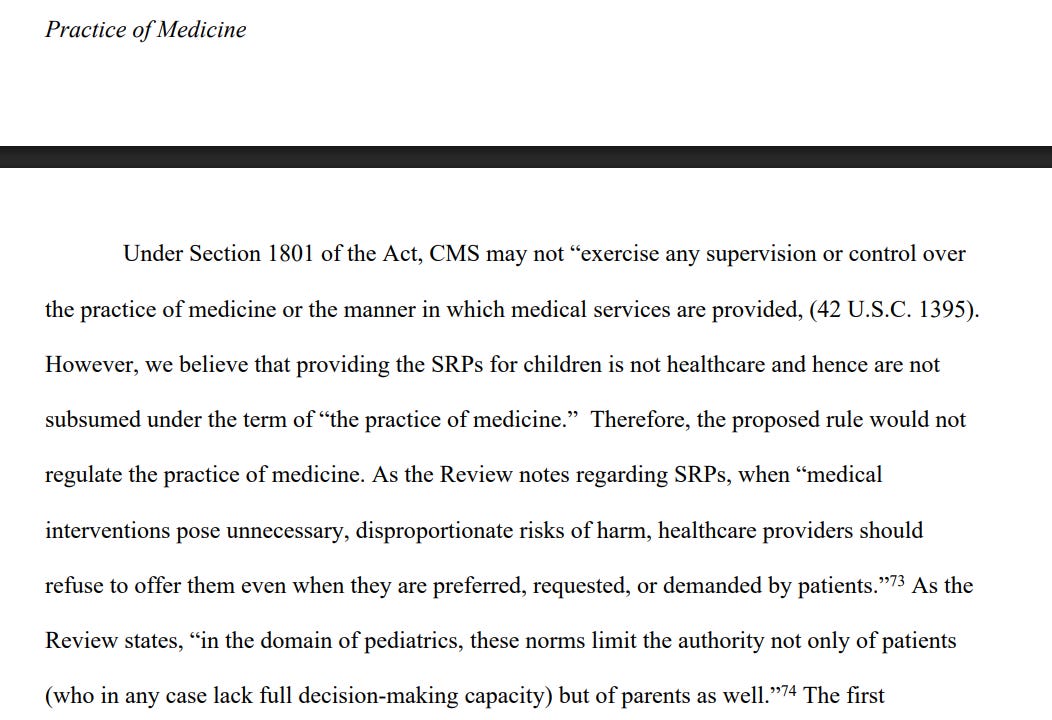
The government attempts to get around this by stating that gender affirming care is not part of “the practice of medicine.” In a section dedicated to this anticipated challenge, the new rule states: “Under Section 1801 of the Act, CMS may not “exercise any supervision or control over the practice of medicine or the manner in which medical services are provided, (42 U.S.C. 1395). However, we believe that providing the SRPs for children is not healthcare and hence are not subsumed under the term of “the practice of medicine.” Therefore, the proposed rule would not regulate the practice of medicine".”
Practice of medicine exception
The rule also likely violates the Constitution in two fundamental ways. First, it disregards the separation of powers. The executive branch cannot simply create a de facto nationwide healthcare ban through regulation when Congress has never authorized such a ban in statute. Agencies are empowered to implement laws, not to invent sweeping new prohibitions that Congress itself has declined to enact. Second, the rule represents a direct assault on states’ rights under the Tenth Amendment. By threatening to strip Medicaid participation from hospitals that comply with state laws requiring the provision of care, the administration would effectively coerce states into abandoning their own democratically enacted protections—or face the collapse of large portions of their healthcare systems.
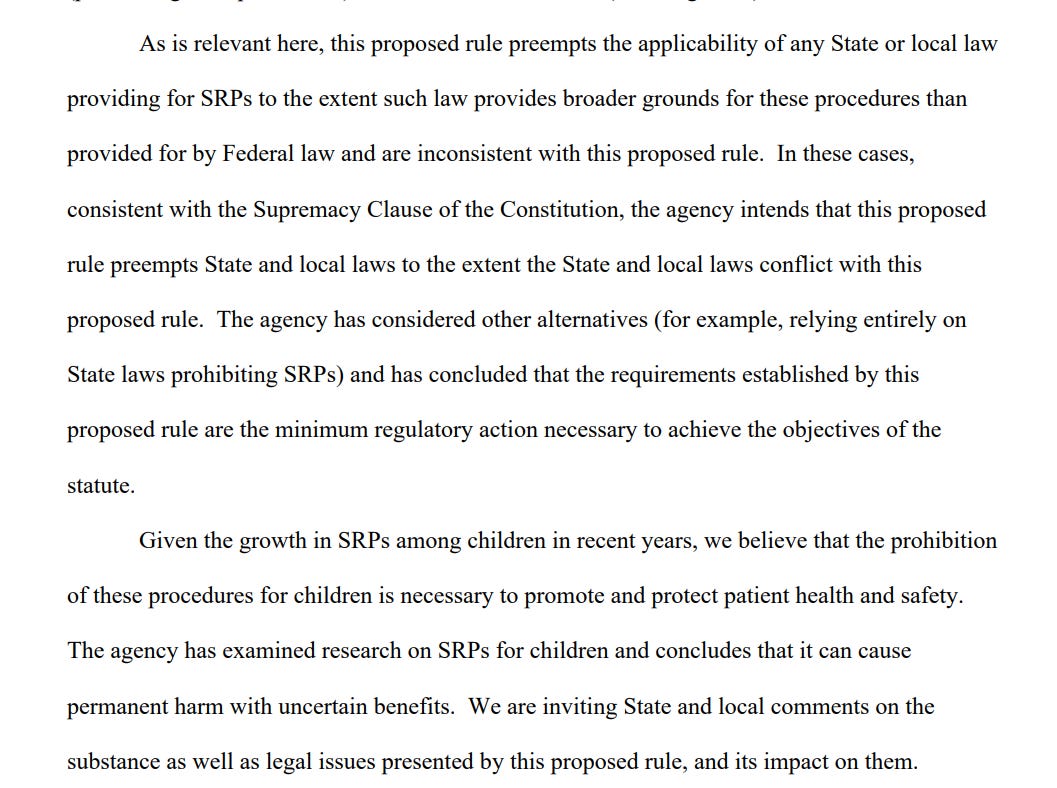
The proposed rule nevertheless asserts that these guidelines would preempt state laws, placing a direct target on the “shield laws” enacted by states like California, Minnesota, and New York. The text is explicit in its intent to override state sovereignty, declaring that any state statute requiring hospitals to provide gender-affirming care—or protecting the providers who do—would be superseded by this federal regulation. In effect, the administration is claiming that a bureaucratic rule change has the power to nullify the democratically enacted protections of “safe” states, attempting to shatter the legal firewalls these states have built to protect transgender youth and their families from persecution and to ensure that care could be continued to be provided.
Federal preemption of shield laws assertion
“These draft rules comprise a dangerous and unconstitutional attempt to undermine the longstanding right of states to ensure the health and well-being of their residents, the right of parents and caregivers to support and love trans and nonbinary young people, and the guidance of doctors and medical organizations on the well-established standard of care. This draft rule is based on a biased “report” written by anti-trans authors that distorts existing evidence and ignores decades of rigorous research supporting the safety and necessity of gender-affirming care for transgender and nonbinary youth,” says Khadijah M. Silver, JD/MPH, Supervising Attorney for Civil Rights at Lawyers for Good Government.
The ban would leave only a narrow window for transgender youth to access care from providers not affected by the rule. The only entities that could continue offering treatment would be private doctors or clinics that do not accept Medicaid at all. While there has been some discussion about establishing such clinics to fill the gap, those efforts have largely failed to materialize. As a result, most transgender youth would be left without any realistic alternative provider for their care.
The full federal rule can be read in this document. An unpublished version is available here, with the official published version expected to appear Friday. Once published, the rule will enter a 60-day public comment period, during which members of the public can submit feedback. After that period closes, the government is required to review and respond to those comments before the regulation can take effect, a process that can take an unspecified amount of time. Court challenges are all but certain, but if the rule is ultimately allowed to go into force, it would likely spell the end of most transgender youth care in the United States.
Erin In The Morning is a reader-supported publication. To receive new posts and support my work, consider becoming a subscriber.

From Erin In The Morning via This RSS Feed.