transgender
2630 readers
1 users here now
Welcome to lemmy.ml/c/transgender! This is a community for sharing transgender or gender diverse related news articles, posts, and support for the community.
Rules:
-
Bigotry, transphobia, racism, nationalism, and chauvinism are not allowed.
-
Selfies are not permitted for the safety of users.
-
No surveys or studies.
-
Debating transgender rights is not allowed. Transgender rights are human rights. Debating transgender healthcare is not allowed. Transgender healthcare is a necessity.
-
No civility policing transgender people. Transgender people have a right to be angry about transphobia and be rude to transphobes.
-
If you are cis, do not downvote posts. We don't like you manipulating our community.
-
Posts about dysphoria/trauma/transphobia should be NSFW tagged for community health purposes.
-
For both cis and trans people: Please alter your username (if possible) to include pronouns (or lack thereof, or questioning) so no one misgenders anyone. details. This rule is important for maintaining a safe place. If you can't change your ID, please let a mod know and include it in your bio.
-
Leftist infighting is not allowed.
Please remember to report posts that break any of these rules, it makes our job easier!
If you are looking for a more secure and safe trans space, we suggest you visit https://hexbear.net/c/traaaaaaannnnnnnnnns. While we will try our best, lemmy.ml/c/transgender is far more open to the fediverse, and also to trolls. One of the site admins of lemmy.ml, nutomic, is also a transphobe, while hexbear is ran mostly by trans people and has a very active trans community.
founded 7 years ago
MODERATORS
1
2
42
TERF Activist J.K. Rowling Threatens To Finance Wave Of Attacks On Amnesty International Over Report On Anti-Trans Groups
(www.erininthemorning.com)
cross-posted from: https://hexbear.net/post/9026834
cross-posted from: https://news.abolish.capital/post/64444
JK Rowling // Wikimedia Commons
Erin In The Morning is a reader-supported publication. To receive new posts and support my work, consider becoming a subscriber.
Billionaire TERF influencer J.K. Rowling has announced that she will cover the legal costs of anti-trans groups named in a report by Amnesty International (UK), which called them “anti-rights.”
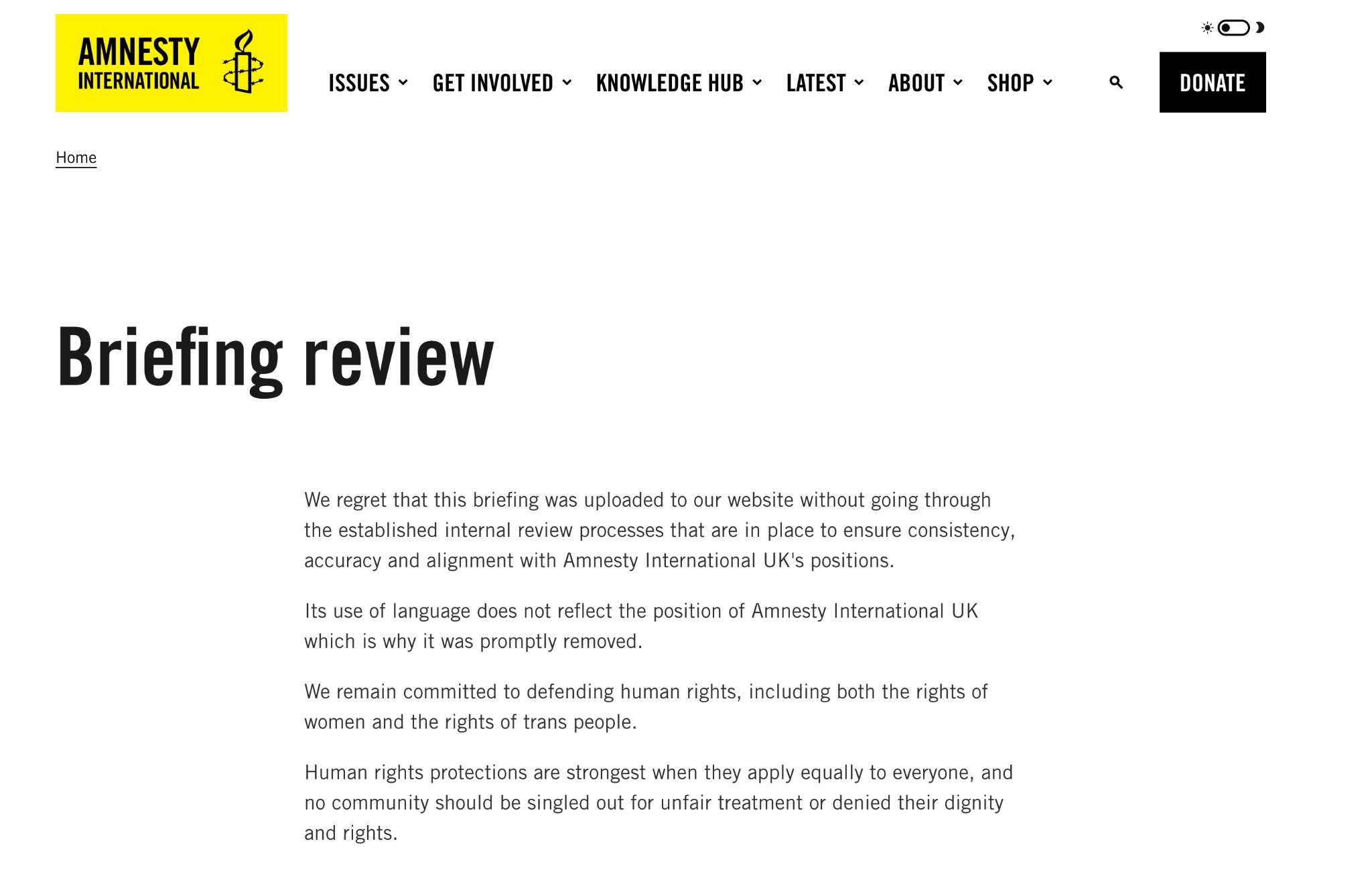
The report was retracted shortly after publication and replaced with a statement from the organization saying the report was uploaded “without going through the established internal review processes” and that its “language does not reflect the position of Amnesty International UK, which is why it was promptly removed.”
But the withdrawal and public acknowledgement was not enough to sate the organizations that have fought tooth and nail to exclude and/or antagonize the transgender community in the United Kingdom. The United Kingdom is notoriously more perilous for free speech than the United States. For our neighbors across the pond, the burden of proof lies with the defendant to prove the statement is true; here in the United States, the burden of proof lies with the aggrieved to prove that a statement is categorically false, and published knowingly or at least recklessly regardless. The US also benefits from “anti-SLAPP” laws to prevent such frivolous lawsuits waged by wealthy individuals or powerful corporations against those who criticize them.
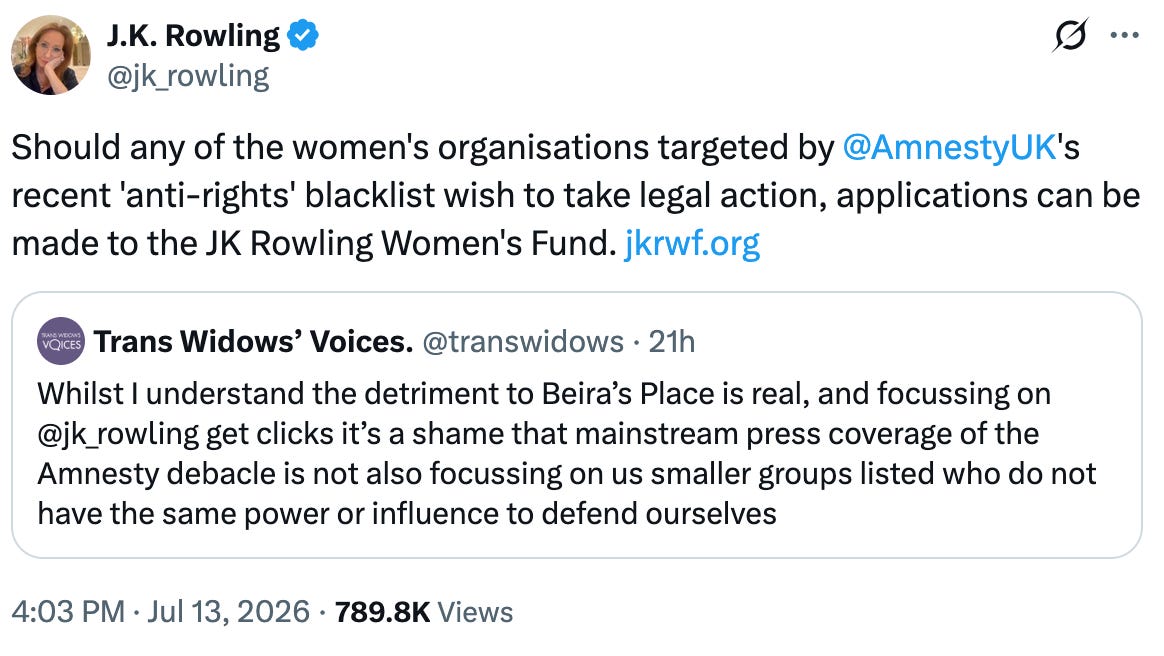
So Rowling capitalized on the spectacle to, in essence, help dozens of groups in what appears to be an attempt to sue Amnesty into oblivion.
CAPTION: Screenshot from Rowling’s Twitter, where she offers “women’s organizations” backing to sue Amnesty International (UK) through her own charitable fund. She quote tweets a group of people who self-identify as “trans widows”—referring to cisgender people whose spouses or ex-spouses came out as transgender.
The saga began earlier this month, when Amnesty International (UK) released a report titled “A growing threat: the anti-rights movement in the UK.” It released a similar report last year, but this year, it added a new category for what appears to be the anti-rights movement’s most rapidly growing sector: “Gender critical” groups, or groups that are antithetical to transgender rights and inclusion.
Rowling rushed to tweet about the situation.
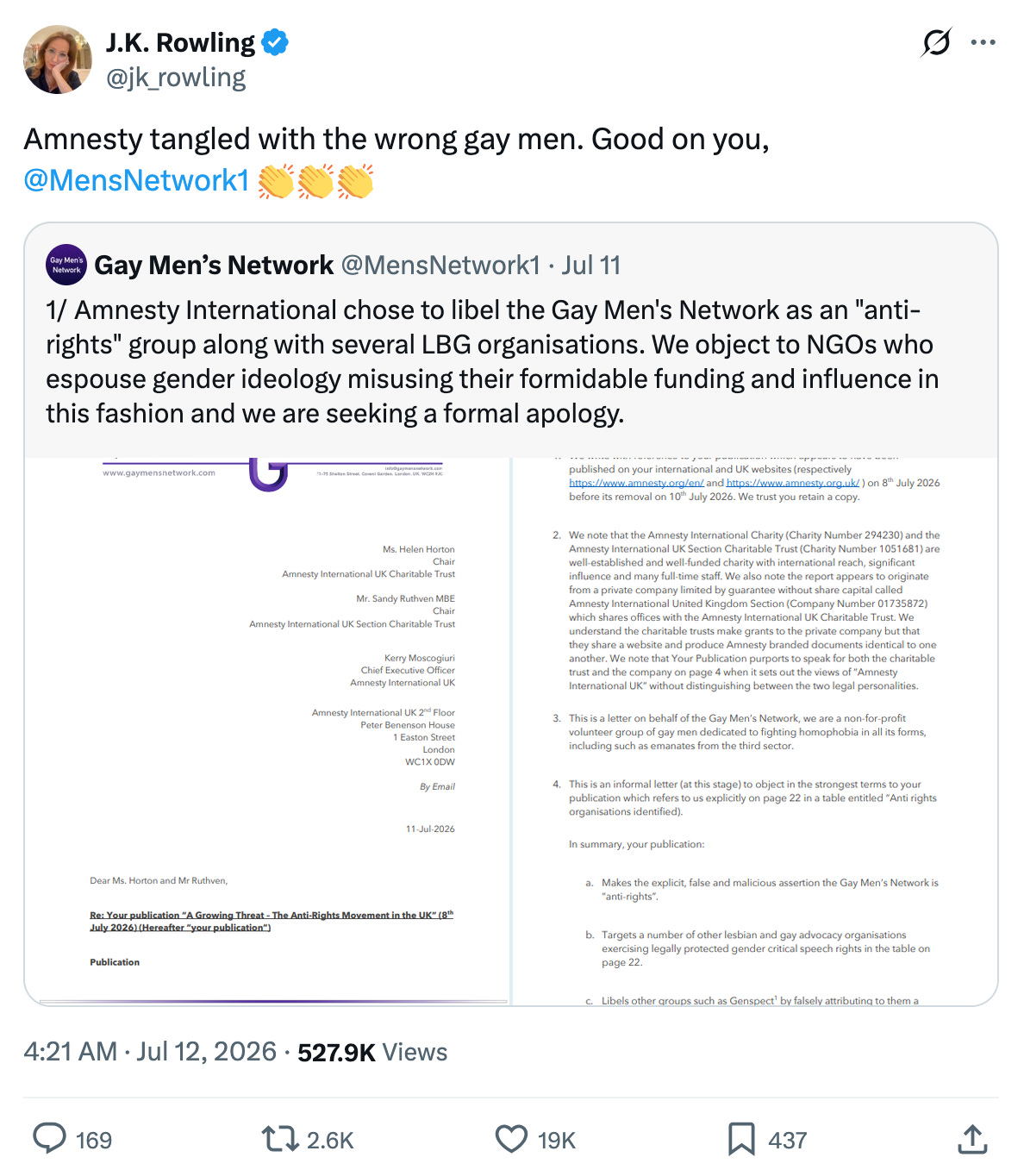
CAPTION: Rowling tweets a group’s response to Amnesty International (UK)’s report on “anti-rights” groups.
She lauded “LGB” groups—another anti-trans buzzword, which, as the name suggests, describes groups that wish to erase transgender people from the queer liberation movement—like the Gay Men’s Network, an organization that has pushed for anti-trans policies. That group posted a public letter indicating it might sue Amnesty International for defamation. The Network demanded a retraction of the report and then claimed that Amnesty is guilty of “trying to control gay and lesbian free speech.”
In the day or so that followed, Rowling retweeted around a dozen similar letters. The posted letters include groups like Genspect, a Southern Poverty Law Center-designated hate group that threatened Amnesty International with legal action, as well as groups like LGB Alliance and Sex Matters.
Amnesty International (UK) did not formally reply to a request for comment for this piece.
Gender critical activists, often financed by Rowling, rely on legal “guerilla warfare” said one U.K.-based trans rights organizer, who could only speak to Erin in the Morning if granted anonymity. The tactic is familiar: Wear down non-profits and individuals who dare speak out against anti-trans and anti-rights groups. They don’t have to win a lawsuit; they can just file again, and again, and again, draining valuable time and resources.
“They have sued organizations into the ground,” the advocate said.
Some context for just a handful of these groups so up in arms about being labeled as hateful: Helen Joyce, the director of advocacy for Sex Matters, gave a speech at a Genspect conference (both are groups on the anti-rights list) about how “beauty” is “inimical to trans bullshit.
She also boasted about manufacturing a moral and medical panic about how, although only a “small” segment of trans kids are prescribed puberty blockers, it has been a strategic “rhetorical device” to erode the rights of transgender people more broadly.
Depending on who you ask, TERFs are considered either a self-branded liberal faction of gender critical ideology, or a different term for what is essentially the same movement. TERF stands for “trans exclusionary radical feminist,” a term to describe self-proclaimed “feminists” who oppose giving transgender women and cisgender women equal rights.
Many of these TERF or “gender critical” groups have close ties to far-right Christian groups. DonorsTrust, the conservative donor behemoth and primary financier of initiatives like Project 2025, also forked over hundreds of thousands of dollars to groups like the Society for Evidence-based Gender Medicine and Thoughtful Therapists, both of whom made the “anti-rights” list because, as Amnesty International (UK) among many others have put it, they promote “conversion practices.”
One major point of contention was the inclusion of Rowling’s own organization, Beira’s Place. It does not primarily seem to function as any sort of advocacy organization. Rather, it’s a women’s shelter for those fleeing domestic violence, but it also has an explicit anti-trans policy, banning transgender women from accessing its services.
However, as the report explained, none of these groups exist in a vacuum. “These entities must be understood as an ecosystem sharing values, goals, strategy and tactics and, for some of them, formal collaboration,” it reads.
Amnesty isn’t the first or last institution or expert to call out gender critical ideology for being anti-rights. UN Women has published materials saying as much.
Meanwhile, University of Sheffield sociologist Dr. Sally Hines has called this framework “deeply conservative.” In the Journal for Gender Studies, she writes that “despite its origins within a branch of radical feminism, [gender-critical ideology] has a profoundly misogynist agenda that stands opposed to the rights of women.” It is a “key force within a current conservative pushback against the rights of women and minoritized sexual groups.”
Gender critical activists continue to use the language of oppression to characterize their plight. Many say “TERF” is a slur. Others believe criticizing a group because of its arguably regressive politics is grounds for a lawsuit.
Despite the fact that the report was pulled down, Erin in the Morning was able to retrieve a copy reposted by an anti-trans news outlet. You can read a full version of that archived version below.
Report A Growing Threat The Anti Rights Movement In The Uk July 2026
345KB ∙ PDF file
Erin In The Morning is a reader-supported publication. To receive new posts and support my work, consider becoming a subscriber.

From Erin In The Morning via This RSS Feed.
3
10
Dem Ohio Governor Candidate Amy Acton Endorses Trans Sports Ban, Igniting Intra-Party Firestorm
(www.erininthemorning.com)
cross-posted from: https://hexbear.net/post/9044667
cross-posted from: https://news.abolish.capital/post/65072
Amy Acton For Governor Instagram Account
Erin In The Morning is a reader-supported publication. To receive new posts and support my work, consider becoming a subscriber.
A growing uproar is consuming the Democratic Party after Ohio gubernatorial candidate Amy Acton, locked in a dead heat with Vivek Ramaswamy, took her turn at anti-transgender politics. In the wake of the Supreme Court's ruling that Title IX does not protect transgender people—a sweeping victory for the conservatives who have spent years engineering it—Acton was asked for her thoughts by a local newspaper, the Toledo Blade. She could have offered boilerplate responses or defended transgender kids. Instead, Acton embraced the ban, casting it as a matter of safety and vowing to enforce Ohio's "settled law." The fallout was swift: Democratic equality groups posted, then quietly deleted, criticisms of their own nominee, an intra-party rupture that now threatens the race itself—a pointless own-goal by a Democrat who apparently bought the idea that attacking her own most vulnerable constituents is how you win an election.
“I do not support boys playing in girls sports. This is already settled law in Ohio, and as governor I will enforce and uphold the law,” Dr. Acton said in a response to the Toledo Blade after the Supreme Court decision. “As a doctor, public servant, and a mom, I will always stand up for fairness and protect kids’ health and safety… While my opponent tries to divide us, I’m laser-focused on issues that matter most to Ohioans: lowering costs, cracking down on corruption, and cutting taxes for working families.”
Acton's response was quickly seen for its anti-trans sentiment. Ohio is home to some of the most extreme anti-trans laws in the United States, pushed by the same organizations whose attorneys defended trans sports bans at the Supreme Court. In 2024, the Republican supermajority overrode Governor Mike DeWine's veto to enact House Bill 68, which simultaneously banned gender-affirming care for trans youth and barred trans kids from school sports from kindergarten through college. Months later, legislators slipped a bathroom ban into an unrelated college-credit bill. The resulting law forces trans students out of bathrooms matching their gender identity at every school in the state—including private colleges like Antioch, where more than 80 percent of students identify as LGBTQ+. Trans Ohioans now risk their education, their healthcare, and their safety simply by existing in public.
The statement drew swift condemnation from Democrats across the state. The Ohio Democrats Progressive Caucus, an official advisory arm of the state party, issued a blistering rebuke: "ZERO Ohioans have become better able to buy groceries by keeping child sport players away from their favorite sport. Our hearts break for those kids. Those who disagree with that will never vote—let alone doorknock—for Amy Acton." The caucus warned that its members were less willing to volunteer for her campaign "not out of malice, but out of the bad feeling in our chests.” The party's Pride Caucus answered Acton's framing directly: "There are no boys in girls' sports. Trans girls are girls." Maria Bruno, executive director of Ohioans Against Extremism, called it "frustrating to see an otherwise strong candidate take the bait by trying to triangulate a response rather than just being frank: can we please just leave trans kids alone and get back to talking about how we can make life more affordable for Ohioans?" And in The Buckeye Flame, writer NV Gay put it plainly: "On the last day of Pride month, the transgender community of Ohio was betrayed—all for the sake of winning an election." But the condemnation itself became a controversy. The Progressive Caucus’s post vanished from the group's Facebook page. The caucus has not responded to questions about why—leaving Ohio Democrats to wonder who, exactly, wanted the warning unsaid.
The candidate's statement is all the more puzzling given recent elections. In Virginia, Abigail Spanberger had every opportunity to throw transgender people under the bus with similar statements and never took the bait—even as Republicans poured millions into anti-trans attack ads, with more than half of all GOP ad spending in the race devoted to the issue. Spanberger won by more than 15 points and Democrats flipped 13 House of Delegates seats, transforming a razor-thin 51–49 majority into a commanding 64–36 majority. New Jersey told the same story: Mikie Sherrill faced a similar anti-trans barrage and won by nearly 14 points, outrunning Governor Phil Murphy's 2021 margin in all 21 counties. And in 2023, Andy Beshear vetoed both a trans sports ban and a sweeping ban on gender-affirming care in Kentucky—a state Trump carried by 26 points—then won reelection by 5. The evidence is not ambiguous. Democrats who refuse to abandon trans people have a good track record. Acton chose the one strategy with no record of success.
The law Acton has promised to enforce reaches far beyond the marquee sports conservatives fixate on. While bans like Ohio's are sold through images of swimming and volleyball, House Bill 68 prohibits athletic associations from making case-by-case judgments about competitive fairness and instead imposes a blanket ban on transgender participation from kindergarten through college—replacing the Ohio High School Athletic Association's individualized policy, which functioned without incident for eight years and saw a grand total of 19 transgender girls compete among roughly 400,000 student athletes. This sweeping approach means transgender Ohioans can be excluded from activities such as darts, billiards, dancing, disc golf, fishing, and other sports where claims of unfair advantage are tenuous at best. Even chess—recognized as a sport by multiple universities—could fall under the ban's scope, echoing a recent move by FIDE, the international chess organization, to bar transgender women from women's chess competitions. Notably, each of these sports has seen targeted attacks from Republicans in recent years. This is what "settled law" looks like in practice: a teenager barred from throwing darts with their classmates or from playing chess with other girls.
What Acton's statement will cost her is not yet measurable. What is measurable is the race: the polling average separates her from Ramaswamy by less than a single point. In an election that close, transgender people are not a rounding error. They are one to two percent of the population—more when nonbinary people are counted—and every one of them has partners, parents, siblings, and friends: a web of people who love them and vote like it. If Acton loses this one by a point, it will not be because she stood up for transgender kids. More likely, it will be because she didn't.
Erin In The Morning is a reader-supported publication. To receive new posts and support my work, consider becoming a subscriber.

From Erin In The Morning via This RSS Feed.
4
20
IL Gov. Pritzker Signs Law Protecting Trans Patients By Removing Testosterone from Govt. Monitoring Program
(www.erininthemorning.com)
cross-posted from: https://hexbear.net/post/8970001
cross-posted from: https://news.abolish.capital/post/62851
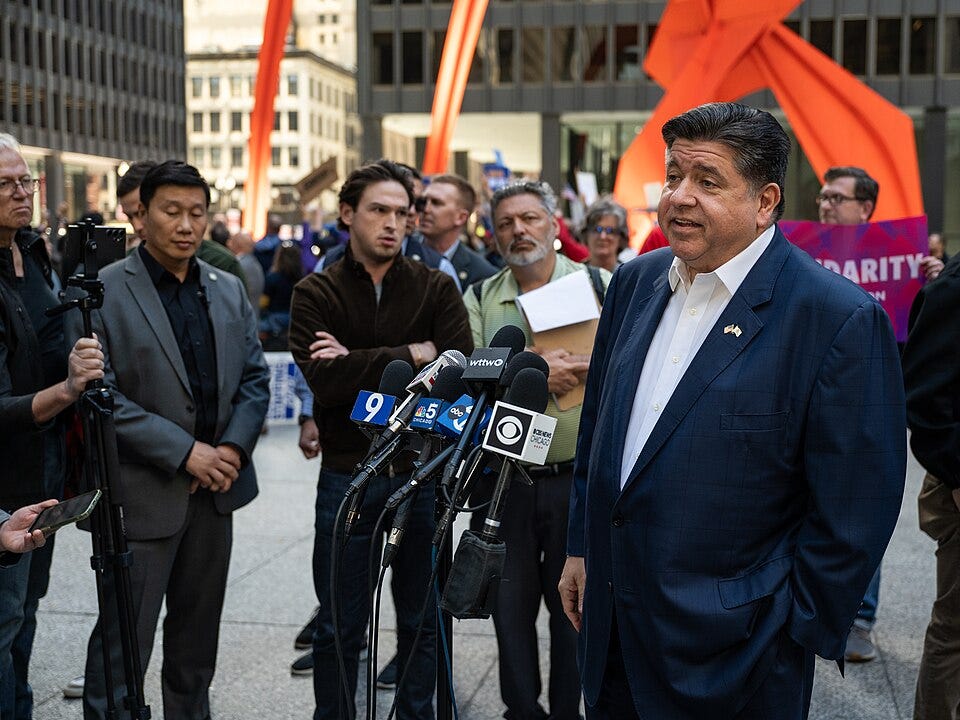
Wikimedia Commons // Paul Goyette
Erin In The Morning is a reader-supported publication. To receive new posts and support my work, consider becoming a subscriber.
Governor Pritzker rounded out Pride Month by signing a trio of bills that will protect transgender people’s privacy from out-of-state attacks—most notably, by removing testosterone from the list of prescriptions required by law to be added to a government database.
“The work will continue until all Illinoisans are safe, healthy, and free to express their truest selves,” said Governor JB Pritzker in a June 28 press release.
The Illinois Prescription Monitoring Program (ILPMP) is a longstanding interstate database that enables health care providers to track the prescription of certain substances, in order to curb drug abuse. Transgender people are often prescribed testosterone for hormone replacement therapy—it is most notably associated with trans men, but it may also be prescribed to any trans person who receives gender-affirming surgery impacting their hormone production.
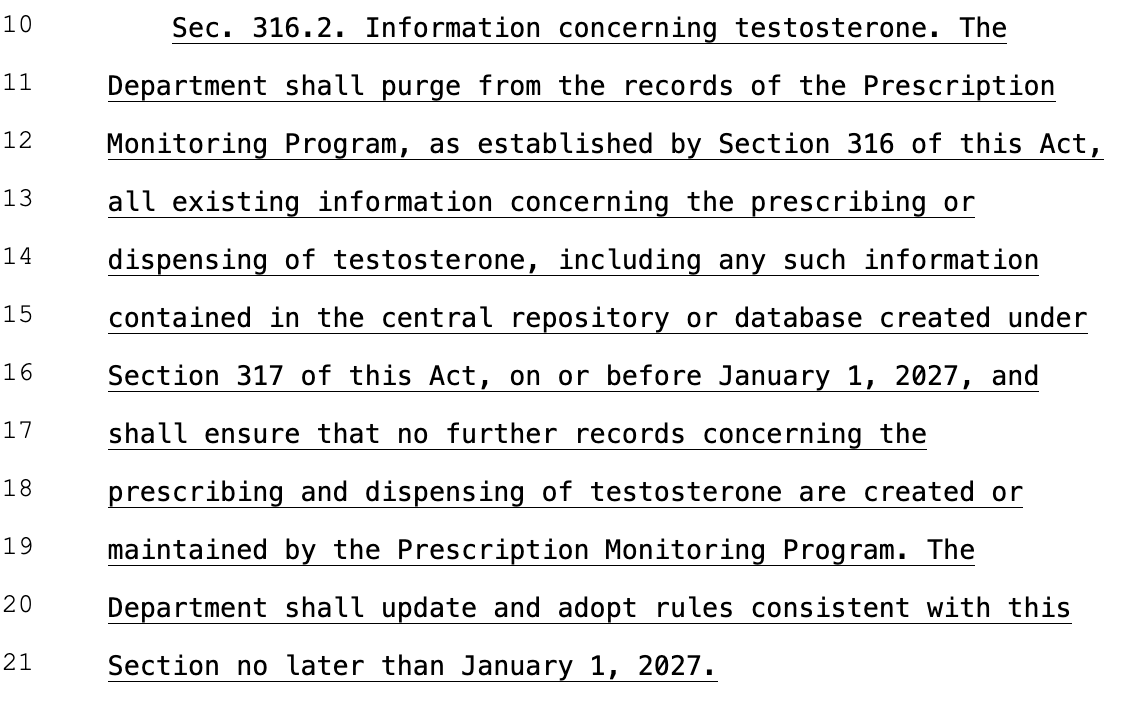
The bill, HB 4834, also preemptively banned adding certain drugs to the program in the future—such as estrogen or mifepristone and misoprostol, a pair of medications used for at-home abortions.
EXCERPT FROM HB 4834
Policies like this “protect trans people from invasive surveillance over their health care,” Alejandra Caraballo, a Harvard law instructor and privacy expert, told Erin in the Morning. In a 2025 report she penned for this newsletter, she explained how similar systems, called Prescription Drug Monitoring Programs (PDMPs), could be exploited to carry out anti-trans attacks.
“The database enabling this crackdown was never billed as a tool for political persecution,” she wrote. “PDMPs were originally established in the 2000s to combat the opioid epidemic and ‘doctor shopping’ for narcotics. Every U.S. state and territory now maintains a PDMP—an electronic registry of controlled substance prescriptions, typically Schedules II through V, that doctors and pharmacies are required to report.”
The ubiquity of this system means it could give bad actors from other states access to someone’s personal medical records, even without a warrant from the state where this care was rendered.
The signing of the law comes as a response to increased efforts by the federal government and red states across the country to reach into trans-friendly jurisdictions to prosecute providers. However, there are currently no public reports of a transgender person or a health care provider being successfully, directly prosecuted with information from a PDMP simply for providing, receiving, or being the parent of someone receiving gender-affirming care.
Hospital systems have comparatively faced more blowback from the Trump Administration, but it’s still important to remember they, too, have managed to avoid any sort of criminal convictions simply for offering gender-affirming care.
But that hasn’t stopped the Trump Administration from antagonizing them anyway, underscoring the importance of laws like this around the country as a protective measure. For example, NYU Langone received a criminal subpoena from the Northern District of Texas, a federal court, demanding information about trans youth care. The move is widely considered to be an act of judge-shopping from the Department of Justice; this district court, though thousands of miles away from New York City, is considered among the most conservative in the country.
It has continued to hang over the heads of trans people and their doctors everywhere.
“No one should fear being monitored or tracked for receiving hormone replacement therapy prescribed by their healthcare provider,” said Illinois State Senator Adriane Johnson, a Democrat. “Protecting medical information is essential to ensuring patients feel safe seeking care, asking questions, and making personal health care decisions.”
Cisgender men and cisgender women may also be prescribed the hormone for anything from cancer treatments to menopause symptom relief. Compared to other hormones associated with gender-affirming care (such as estrogen, progesterone, or spironolactone), testosterone access is especially scrutinized because it’s also heavily associated with drug abuse among cisgender athletes.
It’s also not the only protective law Pritzker signed that day. HB 5492 expands access to hormone therapy by mandating insurance companies cover up to a six-month supply of prescription hormone therapy when a pharmacist or health care provider deems it appropriate.
“In a time when gender affirming care is under constant attack by the federal government, dispensing prescriptions in bulk will give patients from Illinois and others traveling from out of state for care the assurance that they will have access to needed medications,” Pritzker’s press release says.
There was also HB 5095. This takes existing policy by Illinois’ Secretary of State, which makes it easier for people to choose their preferred gender marker on state IDs, and codifies it into law—making it a more permanent fixture, rather than a rule that can be changed on a whim by the next gubernatorial administration.
“Across the country, lawmakers are attempting to strip rights, erase identities, and target our most vulnerable community members,” said Channyn Lynne Parker, CEO of Equality Illinois.
“But here in Illinois, we are fighting back and winning,” Parker continued. “HB5095 preserves gender markers on state IDs; HB5492 expands access to hormone therapy; and HB4834 shields our most private medical information from surveillance. These are not small victories. They are a declaration that in this state, LGBTQ+ lives matter.”
HB 4834 went into effect upon Pritzker’s signing, and agencies have until the new year to transition to compliance. The other two laws will take effect on January 1, 2027.
Erin In The Morning is a reader-supported publication. To receive new posts and support my work, consider becoming a subscriber.
From Erin In The Morning via This RSS Feed.
5
6
25
Newly Released Texas GOP Platform Calls For Ban On Trans Teachers And Trans Care Under 26 Years Old
(www.erininthemorning.com)
cross-posted from: https://news.abolish.capital/post/59456
Photo by Pete Alexopoulos on Unsplash
Erin In The Morning is a reader-supported publication. To receive new posts and support my work, consider becoming a subscriber.
Last month, the Texas Republican Party held its biennial convention at the George R. Brown Convention Center in Houston, where over 4,000 delegates assembled to elect new leadership, adopt an official platform, and set legislative priorities for the upcoming legislative session. Delegates overwhelmingly elected D'Rinda Randall as the new state party chair, carrying 25 of 31 Senate District caucuses in what political scientists described as a further rightward shift driven by the MAGA wing's primary victories. The platform attracted national attention, but one section of it went unnoticed: a set of anti-trans provisions that, if enacted, would be among the most draconian in the country—including a ban on all gender-affirming care up to the age of 26 that extends to legal name changes, an absolute prohibition on transgender people working or volunteering in public schools, and a ban on private businesses expressing any support for transgender people.
"Gender Identity Ideology in Schools: The official position of the Texas schools shall be that there are only two genders: biological male and biological female, which are immutable and cannot be changed. We support the total prohibition of so-called social transitioning. We oppose transgender normalizing curriculum, library materials, and pronoun use. We support the prohibition of transgender individuals from serving in any school district positions, including in volunteer roles, and mandate the exclusive use of pronouns corresponding to a person's biological sex at birth.”
Plank 116 of the platform goes on to call for banning any curriculum, library materials, or extracurricular offering that "adopts, supports, or promotes gender fluidity or transgender ideology" and prohibiting school staff from "engaging in sexualized drag activities, crossdressing, or transgenderism."
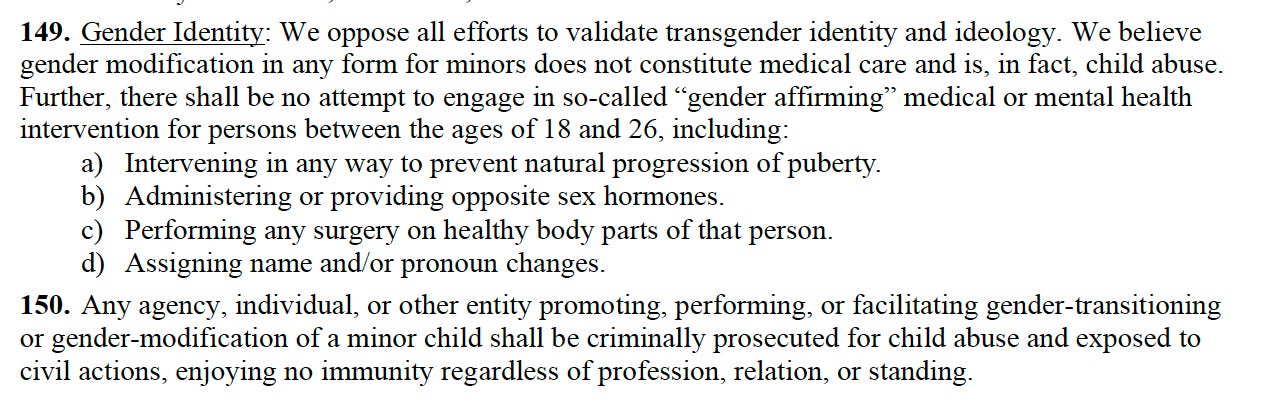
The platform also calls for the criminal prosecution of parents of transgender youth under child abuse statutes—something Governor Abbott has already attempted, directing the Department of Family and Protective Services to investigate families of trans children in 2022. Plank 150 states: "Any agency, individual, or other entity promoting, performing, or facilitating gender-transitioning or gender-modification of a minor child shall be criminally prosecuted for child abuse and exposed to civil actions, enjoying no immunity regardless of profession, relation, or standing." Importantly, the platform does not stop at minors. Plank 149 extends its prohibitions to legal adults as old as 25, banning all gender-affirming "medical or mental health intervention for persons between the ages of 18 and 26," including not just surgery, puberty blockers, and hormones, but even "assigning name and/or pronoun changes.”
See the section of the platform here:
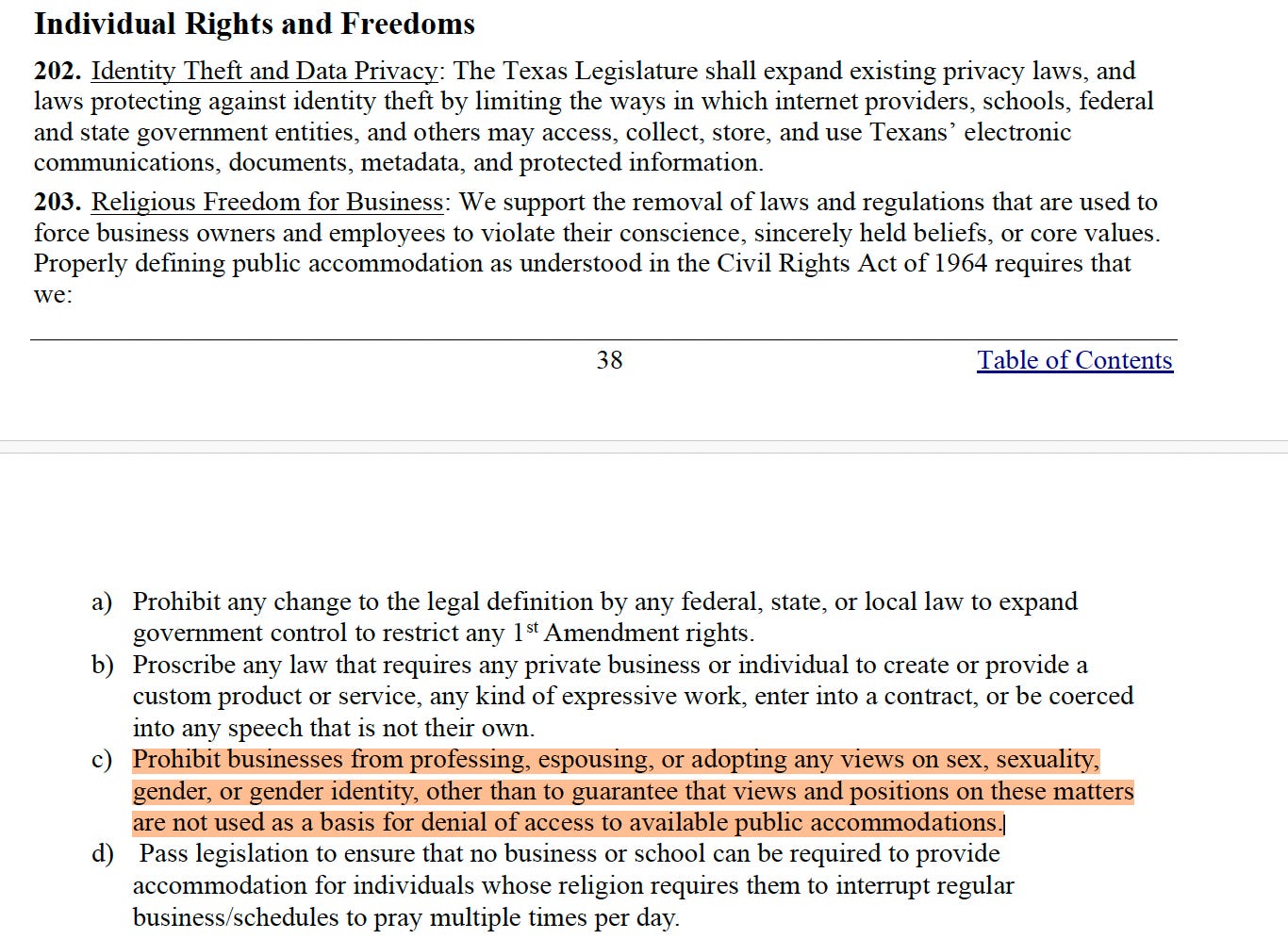
The platform also targets the private sector. Under the heading "Religious Freedom for Business," Plank 203 calls for removing laws that "force business owners and employees to violate their conscience, sincerely held beliefs, or core values"—providing legal cover for businesses to discriminate against transgender people. But for businesses that want to be supportive, the platform offers no such freedom. Plank 203(c) goes further than any state party platform in the country, calling for an outright ban on businesses expressing support for transgender people:
Lastly, the platform does not just target transgender people—it targets LGBTQ+ people broadly. Its section on homosexuality opens with a declaration that would not be out of place in the 1950s: "Homosexuality is an abnormal lifestyle choice." Plank 152 endorses conversion therapy for people of "any age with identity disorder or unwanted same-sex attraction"—a practice condemned by every major medical organization in the country. Plank 208 declares the party is "opposed to same-sex parenting, intentionally subjecting a child to the loss of their biological father or mother, and other non-traditional definitions of family." And Plank 211 calls for nullifying Obergefell v. Hodges, the Supreme Court decision legalizing same-sex marriage, stating it "has no basis in the Constitution." Taken together, the platform reads as a blueprint for rolling back not just transgender rights but decades of LGBTQ+ civil rights progress.
“I think the most concerning part is that the Texas GOP wants to cut off mental health support for trans people between the ages of 18 and 26. Because of AG Ken Paxton’s aggressive weaponization of the law, Texas is already the only state that bars that kind of mental health care from trans minors in direct violation of the Supreme Court’s recent conversion therapy ruling. Having been personally affected by the prohibition a couple years ago, it gives me chills to think of what will happen if the ban is extended even further,” says trans journalist Aleksandra Vaca, a resident of the state, in a quote provided to Erin In The Morning.
Many of these provisions are not new. The 2024 Texas GOP platform already declared homosexuality "an abnormal lifestyle choice” and already called for criminalizing anyone who facilitates youth transition. However, it is clear that the policy platforms are escalating in the Texas Republican Party. And the party has a track record of turning its platform into law—SB 14 banned youth care in 2023 and SB 8 restricted bathrooms in 2025. Transgender people in Texas, meanwhile, have to sit and wait to see which draconian policy from the platform gets implemented in 2027 due to a party that seeks to make the conditions of life impossible for transgender people.
Erin In The Morning is a reader-supported publication. To receive new posts and support my work, consider becoming a subscriber.

From Erin In The Morning via This RSS Feed.
7
14
The US Government Is Engaged In A Modern Red Scare, And WPATH Is Its Latest Target
(www.erininthemorning.com)
cross-posted from: https://hexbear.net/post/8802567
cross-posted from: https://news.abolish.capital/post/57846
Ted Eytan // Flickr
Erin In The Morning is a reader-supported publication. To receive new posts and support my work, consider becoming a subscriber.
Between the 1940s and 1950s, the House Un-American Activities Committee and Senator Joseph McCarthy's investigations targeted Americans for their beliefs, their associations, and their speech. The mechanism was not primarily criminal prosecution—it was investigation, subpoena, and the threat of institutional destruction. Its goal was compliance through fear. That fire burned through Hollywood, through the federal government, and through universities, before finally being recognized for what it is today: one of the most extreme government overreaches in American history, wielding extraordinary powers to persecute a disfavored group. Now, the federal government is engaged in a structurally identical campaign—but this time, it is waged against transgender people and the institutions that serve them, targeting hospitals with subpoenas, threatening organizations and nonprofits with funding cuts, and hauling medical societies before kangaroo courts in an attempt to beat them into submission. And with a lawsuit filed yesterday against the World Professional Association for Transgender Health (WPATH) in a transparently forum-shopped court in Texas, the administration has turned toward its most prized target of all: the central organization that advocates for trans healthcare worldwide.
The lawsuit, brought by the FTC and the attorneys general of Texas, Alaska, Iowa, and Nebraska, alleges that WPATH has violated the FTC Act by engaging in "deceptive acts or practices in or affecting commerce"—weaponizing federal consumer protection law, statutes designed to go after companies selling snake oil and fake cancer cures. The complaint alleges that WPATH "provided the means for medical providers to make false and unsubstantiated claims to parents in order to sell pediatric medical transition services," and that this makes them a target under consumer protection laws. This is despite the fact that WPATH sells nothing—it is a nonprofit medical advocacy organization that publishes guidelines based on its assessment of the available science, advocating for a transgender patient population that governments and medical institutions had historically forsaken. Its advocacy has led to expanded insurance coverage for transgender healthcare, recognition by every major American medical organization that gender-affirming care is legitimate medicine, and an infrastructure of clinical standards that thousands of providers rely on. For this—for succeeding in its mission—the government has deployed an unprecedented legal theory to destroy it.
Or, mostly unprecedented. During the Red Scare, the federal government targeted organizations and individuals not for crimes but for their published views. In 1949, Owen Lattimore, a professor of international relations at Johns Hopkins University, was accused by McCarthy of being "the top Russian espionage agent.” The evidence was Lattimore's published academic writings on China policy, which McCarthy deemed too sympathetic to communism. Lattimore was indicted over testimony about his scholarly work—charges that were eventually dismissed, but not before his reputation was destroyed and he was placed on leave. The government simultaneously maintained a Hollywood blacklist that affected more than 300 people in the entertainment industry—actors, screenwriters, directors—none of whom were convicted of crimes. The government weaponized its investigatory powers specifically to make it impossible for anyone in a position of institutional influence to associate with, employ, or support people whose views ran counter to the government's preferred ideology. This is exactly the architecture we are seeing deployed against transgender healthcare today: the government is threatening any organization that opposes its stance on transgender people, the blacklist is developing in real time, and anyone who pushes back is investigated.
So, too, is there a parallel in the choice of tribunal. During the Red Scare, McCarthy chose the Senate Permanent Subcommittee on Investigations because it gave him maximum control—everyone on the committee was sympathetic to his crusade. The FTC's forum shopping follows the same logic. The government first targeted WPATH with subpoenas in Washington, D.C.—the natural venue for an action by a federal agency headquartered there. When that failed, when Judge Boasberg found "extensive evidence of animus and wafer-thin justifications" behind the investigation, the government did not accept its loss. Instead, it ran to the Northern District of Texas—where Trump-appointed Judge Mark Pittman and George W. Bush appointee Reed O'Connor handle virtually every civil case, and where the administration has already centralized its legal campaign against gender-affirming care. The venue justification? WPATH was originally incorporated in Texas in 1980, even though it actually operates out of Illinois and its principal place of business is in East Dundee, outside Chicago. A 46-year-old incorporation filing is the thread on which the government hangs its choice to bypass the D.C. court that already ruled against it and bring its case before a judge it knows will be sympathetic.
Not that this justification even matters, because the government is weaponizing the same forum-shopping playbook against hospitals across the country. The DOJ has been issuing criminal grand jury subpoenas to hospitals demanding lists of doctors and trans youth. When the government attempted to enforce similar subpoenas in the states where the hospitals actually operate, it lost virtually every time. So what was the tactic they used afterwards? The DOJ “based its investigation” in the Northern District of Texas—convening a grand jury there to subpoena hospitals in New York, Rhode Island, and elsewhere—specifically to land before Judge Reed O'Connor, another reliable conservative appointee. Even a federal judge acknowledged from the bench that "it's pretty clear to me that this was shopped to Texas." Harvard Law's Alejandra Caraballo called it "a blatant unlawful effort by the DOJ to intimidate providers of gender affirming care to trans youth by engaging in judge and forum shopping." The rationale is extraordinary: if you base an investigator in Texas, you can use a Texas grand jury to demand the private medical records of children treated at a hospital in Manhattan. The government lost in the courts that play fair. So it found one that wouldn't.
This campaign extends far beyond medical organizations and doctors, but into all organizations for any perceived political or social support of transgender people people. During McCarthyism, the government did not just investigate suspected communists—it demanded that institutions purge any association with disfavored views. Federal employees were screened for loyalty. Teachers were forced to sign oaths. Libraries were pressured to remove books. The goal was not just to punish the accused but to make the ideology itself unspeakable in public life. The Trump administration is executing the same strategy against transgender people.
The administration’s latest proposed federal rule would evaluate every federal grant recipient in America—not the grants themselves, but the recipients—for promotion of "gender ideology," defined as any acknowledgment that gender identity differs from sex assigned at birth. It has already forced the National Center for Missing and Exploited Children to erase all references to transgender people from its materials and ordered it to deadname transgender children in its missing persons reports. It pressured RAINN, the nation's largest anti-sexual-violence organization, into removing all support for LGBTQ+ survivors. It has scrubbed federal websites of scientific studies on transgender health, removed data on transgender populations, and erased the word "transgender" from the Stonewall National Monument—the birthplace of the modern LGBTQ+ rights movement. Republican-controlled states have in some cases barred transgender teachers from classrooms. During the Red Scare, the Attorney General maintained a list of "subversive organizations." Today, the federal government is building something just as powerful: a regulatory infrastructure that treats the mere acknowledgment of transgender people as grounds for institutional punishment.
This chapter in American history will be remembered alongside the darkest abuses of government power against disfavored groups. What is happening now to transgender people is structurally identical to those prior abuses. The administration has rejected every check on its power: when courts rule against it, it moves to friendlier courts. When medical organizations push back, it investigates them too. WPATH is its latest target. But this will not stop with WPATH. It will continue until transgender people have nowhere left to turn for care, for recognition, or for the basic dignity of being acknowledged as human beings—unless, as in every previous era of persecution, enough people recognize what is happening and say “enough.”
Erin In The Morning is a reader-supported publication. To receive new posts and support my work, consider becoming a subscriber.
From Erin In The Morning via This RSS Feed.
8
9
cross-posted from: https://hexbear.net/post/8725363
cross-posted from: https://news.abolish.capital/post/55604
Photo Credit Corey Saunders
Erin In The Morning is a reader-supported publication. To receive new posts and support my work, consider becoming a subscriber.
New York City has been ground zero in the fight over Trump's campaign to scare hospitals into dropping gender-affirming care for trans youth. When Zohran Mamdani ran for mayor, he promised to fight back—showing up to protests outside NYU Langone, pledging $65 million for gender-affirming care, and vowing to use every lever of city power to protect trans New Yorkers from federal intimidation. Since taking office, those promises have largely gone unfulfilled: no enforcement action against the hospitals that shuttered their programs, no fines from the Commission on Human Rights despite complaints open for over a year, and no public accounting of the promised funding. So when Health Commissioner Dr. Alister Martin announced Friday that the city would open its first-ever direct-care clinic for transgender people, it seemed like the administration was finally delivering. It isn't. This morning, Erin in the Morning can confirm that Mayor Mamdani's new clinic will deny care to anyone under 19 years of age—adopting the exact age cutoff from Trump's anti-trans executive orders.
"Transgender, gender-nonconfirming, and nonbinary New Yorkers deserve age-appropriate health care that is affirming, respectful, and considerate of all their needs. That’s why, for the first time later this summer, the NYC Health Department will be expanding services to provide gender affirming hormone therapy to adults 19 years of age and older at our Corona Sexual Health Clinic. As with the other clinic services, gender-affirming hormone therapy will be offered at no to low cost and regardless of immigration status. We look forward sharing more details upon launching the pilot,” said a NYC health Spokesperson in a statement to Erin In The Morning.
The confirmation comes after a city council budget hearing on Friday, where the exchange that first surfaced the clinic also revealed the administration’s reasoning. Councilmember Tiffany Cabán asked Commissioner Alister Martin—the city’s top public health official, appointed by Mamdani in January—whether the city would be expanding gender-affirming care. Martin announced the direct-care clinic, calling it “one of the first times a public health department has ever taken that step.” But when Cabán pushed back, pointing out that trans youth are the ones most under attack right now—noting that there are “almost no providers” left for youth the entire city—Martin indicated the clinic would not serve youth, citing the need to “strike a balance” between providing care and avoiding “clawbacks from the federal government.” This morning, EITM can directly confirm that the age cutoff is 19—matching the Trump administration’s executive order threshold, not the standard legal age of adulthood in New York. See the exchange:
Commissioner Alister Martin: “It’s incredibly important that we get the messaging right here and that we lean in on the comms and the campaign here, but it’s also important to deliver for people and to provide the services they need. And we’re excited to say that pretty soon we’re going to be able to offer gender-affirming care directly at our clinics. We have a clinic that will be opening up in Corona which will offer gender-affirming hormone therapy for adults. It’s like one of the first times a public health department has ever taken that step, and we’re proud to not just stop there. We’ll continue moving forward with this.”
Councilmember Tiffany Cabán: “Can I ask a follow-up on that? Particularly because that’s a really big deal, but also—we’re seeing this devastating decrease in services for youth, and especially youth under 13, 12—like, there are almost no providers who provide that care. And the one or two that do is obviously under attack from the federal government. So is there going to—are you thinking about an expansion in that youth care? Because I’m talking to parents all the time and they don’t know where to take their children.”
Commissioner Martin: “As you can appreciate, the balance that we have to strike is—we are committed to this issue and want to make sure that we provide the services and resources for youth, as well as making sure that we don’t expose ourselves to clawbacks from the federal government, which disrupt the rest of the care that we can give. And so there’s much more to come on this, trying to sort of figure out that right balance. We’re eager to work with you on this, but rest assured we are working on this and we’re trying to figure out how to do this.”
The news comes amid mounting questions about Mamdani’s commitment to the promises that helped elect him. During his campaign, Mamdani held a Trans Community Town Hall where pledged to invest $65 million in gender-affirming care. That pledge involved “public hospitals and community clinics,” indicating to many that he could begin opening direct care clinics for youth being forced out of hospitals. His platform also explicitly pledged to hold the hospitals that deny transgender youth care accountable for their capitulation to Trump and to “use every single tool” to stop them from complying with Trump’s illegal executive orders.
Those pledges have largely evaporated. Journalist Aviva Stahl reported for Prism in March that the $65 million was nowhere in the city’s preliminary budget, and as of June, advocates who reviewed the executive budget say the money is still not there. The Commission on Human Rights complaints against NYU Langone and Mount Sinai have sat open for over a year with no enforcement action, and the agency has refused to comment on them in response to questions by Erin In The Morning. And now, Mamdani’s own health commissioner is using the very same rationale NYU Langone and Mount Sinai used to deny trans youth care—fear of federal retaliation.
It is a far cry from when Mamdani stood at a rally outside NYU Langone in March 2025 and declared: “We have seen NYU Langone comply with illegal executive orders out of a fear of their so-called biggest donors. Let us remind them that the city is also one of their biggest donors. Let us remind them that they do not pay a dollar in property tax, [and that] we are a city that is ready to use every single tool to assure compliance with city and state human rights laws.”
Mamdani is not powerless here. He has significant leverage over Health + Hospitals—the largest public municipal healthcare system in the country, with 11 hospitals, more than 70 clinics, and eight existing Pride Health Centers. He controls the board. He can demand H+H absorb displaced trans youth patients tomorrow, with significant power behind those demands. He has the Commission on Human Rights, which can levy fines of up to $250,000 per violation against hospitals that deny care in violation of city law—complaints against NYU Langone and Mount Sinai have been open for over a year with no action. He has a campaign pledge to coordinate with AG James, who has already told NYU Langone that no federal law requires them to stop. He also promised $65 million to this community. The tools are there. The legal authority is there. The money was promised. What is apparently missing is the will to use any of it for the kids who are the most under attack.
It is important to note that in a recent appearance on WNYC's Brian Lehrer Show, a parent of a trans child asked Mamdani directly what his administration is doing for her kid. Mamdani cited a $15 million investment in gender-affirming care over two years. But there are virtually no public details on what the $15 million funds, which agency controls it, which patients it serves, or when it will go into effect. And two days after that interview, Commissioner Martin announced a new clinic that would be adults only, using Trump's executive order age cutoff of 19, and told the city council that the city was afraid of federal "clawbacks"—raising the question of what, exactly, the $15 million "unlocks" for trans youth if the administration's own policy for a new clinic is to avoid serving them. EITM has reached out to multiple NYC agencies and press contacts for the mayor's office and has received no response on whether the adults-only clinic is intended to be part of the $15 million pledge—which is also, notably, a fraction of the $65 million Mamdani campaigned on, and which, as of today, does not serve youth.
Opening a city-run gender-affirming care clinic is, on its own, a meaningful step. But when the clinic adopts the Trump administration's age cutoff, when the health commissioner cites the same federal fears as the private hospitals the mayor protested against, and when the promised $65 million remains unaccounted for while trans kids in the largest city in America are told there is almost nowhere left for them to go, the step is as likely to be seen as a betrayal as it is a meaningful advancement of his promises.
Erin In The Morning is a reader-supported publication. To receive new posts and support my work, consider becoming a subscriber.

From Erin In The Morning via This RSS Feed.
10
cross-posted from: https://hexbear.net/post/8563700
cross-posted from: https://news.abolish.capital/post/51268
Nika Bartoo-Smith
Underscore Native News + ICTPORTLAND, Ore. – Around 300 high school students dressed in gowns, costumes and elaborate makeup danced until their feet hurt to music from DJ Aspen blaring through the speakers, their smiles and laughter filling the air at this year’s annual Queer Prom.
The Native American Youth and Family Center’s Two-Spirit program has hosted the event for four years since taking a hiatus during the pandemic.
“My ultimate goal with this is creating a space for queer youth, especially Two-Spirit and Indigenous LGBTQ+ youth, to be unabashedly themselves, to truly not have to worry about the way that they’re being perceived, but just be able to celebrate themselves, celebrate each other, and to showcase the fact that we’ve always been here — Indigenous, trans, queer, we’ve always been here. We’re not going anywhere,” said Kiara Wehrenberg, Tlingit and the Two-Spirit program coordinator at the center. Wehrenberg coordinates Queer Prom.
As prom season is well underway, Queer Prom is a space built for students from all backgrounds to have a space centering joy, in Portland.
“Queer Prom is so unique and so special,” said this year’s emcee, Dr. Poison Waters, an iconic Portland drag queen. “There are people in this country that wish they could come to a Queer Prom.”
Planning Queer Prom
Wehrenberg worked with youth from the center’s Two-Spirit program to find a theme and organize a prom built for them. The group made pamphlets for a swag table during the May 15 event, that offered a resource guide, information about the term Two Spirit and a list of Two-Spirit powwows across the country
This year’s prom theme was “Superheroes vs. Villains Edition” and students showed out in all kinds of costumes. From Captain America and the Joker to fantasy inspired looks include elf ears and elaborate makeup. The theme extended beyond dress as projected graphics all around the room feature comic book inspired illustrations.
Food, catered by Brittinie Love and her company Cooking with B. Love, took the superheroes versus villains theme to the next level. The menu featured items such as “Gotham Fire Beef Skewers” and “The Green Goblin Spring Rolls” with mocktails like “Radiant Recharge” and “Arctic Blast.”
Planning for Queer Prom began as soon as last year’s ended, according to Wehrenberg. This began with reaching out to vendors and event venues, such as AVENUE Portland, where this year’s prom took place.
“I think Queer Prom is just a beautiful place for connection,” said Marvin Colbow, whose drag name is Marvin Killboy, a senior at Benson Polytechnic High School. “I just went to my own prom, and I did not feel the same amount of connectivity that I feel here with my fellow transgender and queer people.”
Wehrenberg reached out to Queer-Straight Alliances and Indigenous Student Unions across Portland and beyond to open up the event to youth across the city, beyond youth at the center’s Many Nations Academy.
“Queer specific spaces are necessary across the board,” said Ellen Whatmore, a teacher at Franklin High School and the school’s co-advisor for the Gay-Straight Alliance. “Having an opportunity to shine and be in the spotlight and be celebrated is unparalleled.”
Whatmore attended Queer Prom dressed in a Medusa-inspired look, as an event volunteer and also helped advertise the event to Franklin students after receiving an email invitation from Wehrenberg.
Guest Appearances
A few hours into the dance, students were interrupted from tearing up the dance floor when Dr. Poison Waters invited two other drag performers from Darcelle’s XV out onto the dance floor.
Dressed in a big, blonde wig with hot pink heeled boots and a matching hot pink ruffled robe, T’Kara Campbell Star made her way onto the dance floor. As “Flowers” by Miley Cyrus filled the speakers, she shed her robe to reveal a bright green body suit and matching sun hat decked out in fake flowers. Her performance was met with cheers as students formed a half circle around her. At the end of three songs, T’Kara Campbell Star invited a student dressed as Maleficent to the center of the floor to dance with her.
Following her performance, Ilani E. Nova made her way onto the dance floor, decked out with a black feather boa, thigh high leather boots and a black and tan body suit. She danced with the students, lip syncing to a compilation of Abba classics.
And of course, Dr. Poison Waters herself also performed, moving from stage to the middle of the dance floor.
As the night wore on, the dance floor remained full as laughter and song sing-alongs drifted through the air, mixed with the beats spun by DJ Aspen.
“I just see so much queer joy in our youth and I’m so happy and honored to be a part of this,” said Mitch Saffle, Citizen Potawatomi Nation, a chaperone at Queer Prom and a data and evaluation support specialist at the center. “I’m so grateful to see that a space like this exists for our youth. Not only our queer youth, but our Indigenous queer youth.”
Later on in the evening, Yin Glossier, Dior Glossier and Deity 007 from PDX Ballroom brought vogue to the dance floor as students sat in a circle around the three performers, completely engaged.
Following their own performance, Yin Glossier explained a bit about the ball scene which started in Harlem in the 1920s, expanding in the 1970s and 1980s, when Black and Brown drag queens were not allowed to be at White drag queen pageants.
“So, as Black and Brown people do, we make our own shit,” Yin Glossier said. “In that, we have the birth of ballroom.”
They then explained some of the main categories that “Houses” of the ball scene compete in: fashion, body, sex appeal, face, vogue.
Students were then invited to compete in ballroom style, lining up to compete for “best dressed.” A hard decision on the part of the judges, composed of performers from Darcelle’s XV and PDX Ballroom. Ultimately a student dressed in a Master Shake, from Aqua Teen Hunger Force, costume took home the prize: a pair of rainbow beaded earrings donated by the center’s Two-Spirit program.
For Wehrenberg, Saffle, volunteers and students an event like Queer Prom is so crucial for the community.
“Being able to have a space like this is really important because it provides an opportunity for us to come together in community and celebrate queer joy,” Wehrenberg said.
Wehrenberg expressed that so often when Indigenous and 2SLGBTQ+ stories are told in the media, it is through a lens of oppression and tragedy.
“It is also really important to highlight and tell stories of resilience and love and joy, because we all deserve to be seen as we are here, queer, trans, Indigenous, proud, strong and fully human, because only telling the stories of oppression and tragedy, in a way, strips us of humanity because it doesn’t highlight or show any understanding of the fact that we have whole lives and joy and love surrounding us too,” Wehrenberg said.
This story is co-published by Underscore Native News and ICT, a news partnership that covers Indigenous communities in the Pacific Northwest.
The post Queer Prom: A space for queer youth to be ‘unabashedly themselves’ appeared first on ICT.

From ICT via This RSS Feed.
11
28
Colorado Supreme Court Rules Hospitals Must Not Comply With Trump, Must Continue Offering Trans Youth Care
(www.erininthemorning.com)
cross-posted from: https://hexbear.net/post/8536301
cross-posted from: https://news.abolish.capital/post/50433
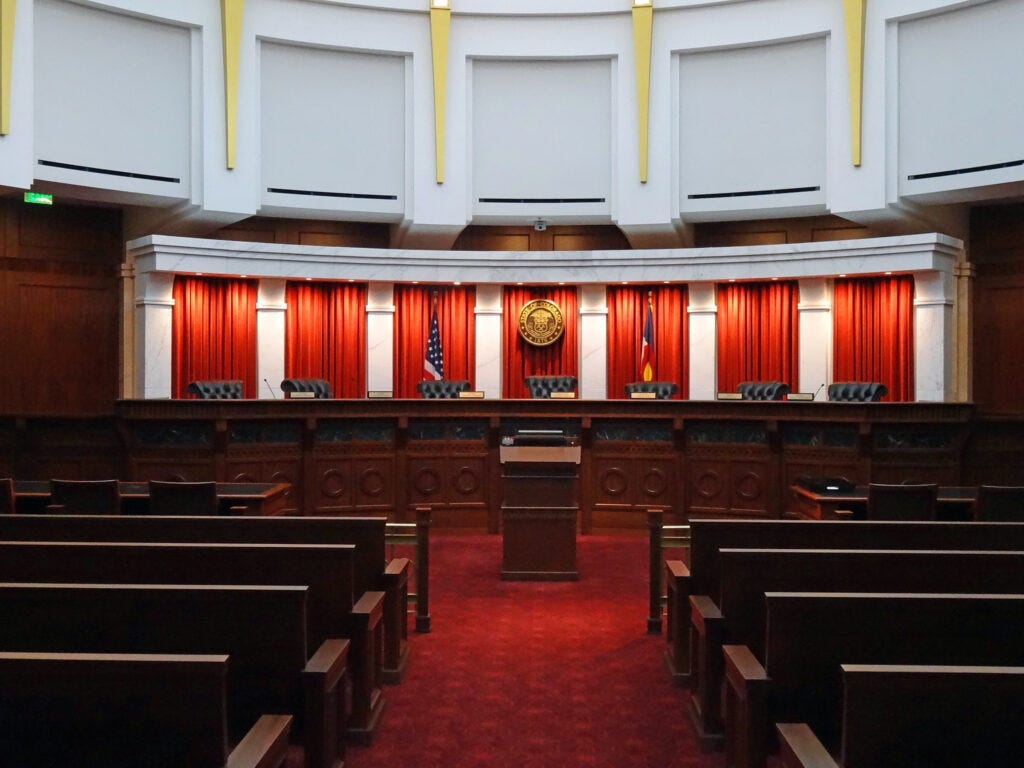
Colorado Supreme Court // Jeffrey Beall
Erin In The Morning is a reader-supported publication. To receive new posts and support my work, consider becoming a subscriber.
Today, the Colorado Supreme Court ordered Children’s Hospital Colorado to resume gender-affirming care for transgender youth, ruling 5-2 that the hospital discriminated against transgender youth patients when it shuttered its care program earlier this year in capitulation to Trump. The decision reverses a district court that had ruled against forcing the hospital to return to care and directs that court to issue a preliminary injunction restoring care while the case proceeds. Children’s Hospital Colorado was one of roughly 40 hospitals across the country that capitulated to Trump administration threats and ended their trans youth care programs. In its ruling, the state’s highest court held that the hospital’s fears of federal retaliation could not override Colorado’s civil rights protections for transgender people.
The case began in December, when Health and Human Services Secretary Robert F. Kennedy Jr. issued a declaration claiming that gender-affirming care for transgender youth was “neither safe nor effective” and warning that hospitals providing such care could be excluded from federal health care programs including Medicare and Medicaid. Children’s Hospital Colorado halted its program in January, and four transgender youth and their families sued under the Colorado Anti-Discrimination Act. A Denver district court judge found that the families would likely prove they had been discriminated against and that their children faced irreparable harm, but denied them relief anyway, reasoning that forcing the hospital to resume care could provoke catastrophic federal retaliation. As we reported in April, the families appealed directly to the Colorado Supreme Court. Meanwhile, the Kennedy declaration was blocked in court for several violations of law.
In Monday’s decision, the court rejected the hospital’s central defense: that it had not discriminated against transgender youth but had simply declined to offer one category of treatment. The justices found that distinction meaningless, noting that the hospital continued to provide the very same medications, puberty blockers and hormone therapy, to cisgender youth while denying them to transgender patients. “Even without analyzing the disparate treatment between transgender and cisgender youth, CHC’s policy to suspend providing medical gender-affirming care explicitly discriminates against patients because of their gender identity,” the court wrote. “Gender-affirming care is inextricably intertwined with gender identity,” ruling that ceasing providing care was discrimination against transgender people and therefore illegal under state law.
The majority was equally direct in rejecting the hospital’s argument that it had merely been following the Kennedy Declaration. “Although CHC acted reluctantly and expressed no animus toward transgender patients, the action it chose to take in response to the Kennedy Declaration specifically targeted transgender youth patients,” the court wrote. “The Kennedy Declaration may have influenced CHC’s decision, but it doesn’t absolve CHC of responsibility.”
The most consequential portion of the ruling addressed whether federal threats could be allowed to override state civil rights law. The district court had reasoned that ordering the hospital to resume care would compel it to violate federal law. The Colorado Supreme Court flatly rejected that framing. “The trial court’s concern about opposing the public interest by ordering CHC to ‘violat[e] . . . federal law’ is also misplaced,” the court wrote. “Why? Because the Kennedy Declaration isn’t federal law.” The justices also refused to weigh the harm to transgender youth against the broader hospital population in raw numerical terms, a comparison the district court had used to side with the hospital. “We conclude that a Trinidad-style strict numerical comparison of affected individuals isn’t appropriate when the individuals seeking injunctive relief are part of a protected class and seeking an injunction because of discrimination based on that protected class,” the majority wrote. “Were it otherwise, minority groups would always lose. But that is not the law. On the contrary, that’s precisely why we have protected classes.”
The court found that the actual harm to transgender youth far outweighed the hospital’s speculative fears, describing in stark terms what the loss of care had done to the plaintiffs. “Petitioners and other transgender youth who sought such care from CHC were suddenly abandoned during a precarious time,” the court wrote, noting that the children had “experienced depression, and in at least two instances, suicidal ideation.” The justices detailed the case of one plaintiff, Danielle Doe, whose family had moved from Texas to Colorado for its protections for transgender people. “After learning that CHC could no longer provide her care, Danielle was hospitalized at CHC for a depressive episode,” the ruling states. “She wrote her mother a letter that expressed suicidal ideation, stating, ‘If I don’t see you again, I love you.’” By contrast, the court found the hospital’s feared exclusion from federal programs “speculative,” noting that no exclusion could occur without notice, hearings, and opportunities for judicial review, and that a federal court in Oregon had since declared the Kennedy Declaration unlawful and barred HHS from enforcing it.
Two justices dissented. Justice Brian Boatright, joined by Justice Carlos Samour, argued that the hospital had acted not because of its patients’ gender identity but because it faced “the risk of losing hundreds of millions of dollars in federal funding, which would threaten the viability of its entire hospital system.” The majority was unpersuaded, holding that a “reluctant” act of discrimination compelled by a “third party” remains discrimination under Colorado law. With the decision, Children’s Hospital Colorado joins a growing number of hospitals, including Rady Children’s Hospital in San Diego and Children’s Minnesota, that have moved to restore gender-affirming care after initially halting it under federal pressure. The ruling also answers the question many public officials have been grappling with in terms of state anti-discrimination law: whether vague federal threats, unaccompanied by any law or court order, are enough to nullify a state’s civil rights protections. The Colorado Supreme Court’s answer was firmly: no.
A full copy of the ruling can be found here:
2026 05 18 Opinion
617KB ∙ PDF file
Erin In The Morning is a reader-supported publication. To receive new posts and support my work, consider becoming a subscriber.
From Erin In The Morning via This RSS Feed.
12
14
Under guise of “protecting children,” Christian nationalists weaponize gender, exploit division to serve bourgeois interests
(redphoenix.news)
cross-posted from: https://hexbear.net/post/8537717
cross-posted from: https://news.abolish.capital/post/50351
John M. | Red Phoenix correspondent | Colorado–
Lurking in the deepest bowels of Colorado, a coalition calling itself Protect Kids Colorado has mobilized to push three ballot initiatives onto the Nov. 2026 ballot, each draped in the rhetoric of child protection but rooted in the reactionary impulses of the ruling class. This campaign exemplifies a deeper contradiction within capitalist society: the selective outrage of Christian nationalist factions who proclaim to safeguard “girls in sports” from transgender participation, framing it as a defense of biological purity and fairness. Yet, this same moral fervor evaporates when confronting the systemic exploitation embedded in the capitalist order.
Led by anti-LGBTQ+ “activist” Erin Lee, the group submitted over 165,000 signatures for Initiative 110, which seeks to ban surgeries on minors aimed at altering biological sex characteristics, and to prohibit public funding for gender-affirming care. More than 170,000 signatures backed Initiative 109, mandating that schools and athletic associations define sports teams by physical anatomy at birth, effectively barring transgender girls from competing in girls’ sports. A similar number supported Initiative 108, which would ramp up penalties for human trafficking of minors.
These measures, if passed, would not only restrict transgender youth from essential healthcare and fair participation but would also enforce rigid, state-sanctioned definitions of gender that serve to police bodies in service to outdated hierarchies.
Similar initiatives are proliferating across the U.S., with over 700 anti-trans bills tracked in 41 states for 2026, including bans on sports participation, healthcare, and bathroom access, highlighting a coordinated assault by bourgeois interests to divide the working class. In Missouri, ballot measures seek to enshrine bans on gender-affirming care for minors alongside abortion restrictions, using trans youth as pawns to simultaneously undermine reproductive freedoms.
Efforts in Washington, Maine, and Nevada also aim to put trans sports bans directly to voters, reflecting the ruling class’ strategy to legitimize discrimination through electoral theater, to the symphony of inflammatory, unscientific, and sensationalist disinformation campaigns via the media.
Rep. Marjorie Taylor Greene (R-Ga.), a leading Christian Nationalist, stands with her fans from Moms for Liberty-Wisconsin in front of the Capitol. (Moms For Liberty-Wisconsin)
These groups, often aligned with MAGA ideology, rally against transgender girls as existential threats while turning a blind eye—or worse, offering defenses—for capitalist pedophiles whose crimes are shielded by wealth and power. Consider the parade of high-profile figures in bourgeois circles, from financiers like Jeffrey Epstein to political elites entangled in abuse scandals, where accusations of child exploitation are dismissed as “fake news” or reframed as consensual indiscretions. The ruling class’ apparatus, including media conglomerates and legal systems, routinely minimizes these atrocities, allowing predators to evade accountability through settlements, NDAs, and influence peddling.
Capitalism thrives on the commodification of bodies, particularly those of the vulnerable, turning human trafficking and exploitation into profitable industries that bolster the accumulation of capital for the few. The hypocrisy is stark: Republicans accused of shielding pedophiles in the Epstein case, with Democrats charging that GOP refusal to release files protects the elite, while MAGA figures like Trump have been linked to Epstein yet face no reckoning from their base. Right-wing conspiracies like QAnon obsess over fictional pedophile rings among liberals, diverting attention from real abuses by their own, such as Capitol rioters convicted of child abuse who heckled police for “protecting pedophiles.”
Christian nationalists, who denounce transgender rights as anti-biblical, conveniently ignore their own defenses of abusers, exposing the selective application of “morality” to maintain patriarchal control. The hypocrisy intensifies when examining the so-called “pro-life” stance of these reactionaries.
While they decry abortion as murder and push for draconian bans that strip women and girls of bodily autonomy, their policies accelerate the immiseration of the working class. MAGA forces, under the banner of family values, have systematically dismantled reproductive rights, gutted social safety nets, and opposed measures like paid family leave or affordable childcare, ensuring that forced births trap women in cycles of poverty and dependence.
This isn’t about life, it’s about control. In a system where labor power is extracted for profit, women’s rights are subordinated to the needs of capital reproduction. The bourgeois state enforces this through legislation that prioritizes fetal personhood over living workers, all while corporate overlords reap the benefits of a desperate, underpaid workforce. The proclaimed sanctity of life clashes with the reality of capitalist death—through wars, environmental devastation, and healthcare denial—that claims millions annually.
The post-Roe era has deepened inequities, with abortion bans costing the U.S. economy $173 billion annually, lowering women’s earnings, education, and health outcomes, particularly for Black women and the poor, while increasing poverty and single parenthood. Overruling Roe has not been “pro-life” but a continuation of government control over women’s bodies, eroding their autonomy and futures. Pro-life rhetoric, including claims of “feminism,” masks this assault, portraying restrictions as protective while dishonoring women’s dignity and rights.
Compounding this is the complicity of the Democratic Party, which postures as a progressive counterweight but capitulates at every turn. Facing an electorate manipulated by misinformation and economic anxiety, Democrats have increasingly thrown the transgender community under the bus, offering tepid defenses or outright concessions to gain votes from a misinformed public. Rather than mounting a robust pushback against these anti-trans measures, they prioritize electoral pragmatism, echoing centrist appeals that dilute class struggle into identity politics.
This betrayal stems from their role as the liberal wing of the bourgeoisie, managing capitalism’s crises without challenging its foundations. By allowing reactionary narratives to dominate, framing transgender rights as a wedge issue, they divert attention from the real antagonists: the exploiters who profit from division. The working masses, fragmented along lines of gender, race, and sexuality, are pitted against one another, obscuring the class antagonism that unites them against the owners of production.
Post-2024 election losses, Democrats have openly blamed their support for trans rights, with figures like Reps. Seth Moulton and Tom Suozzi arguing the party went “too far left,” splintering over issues like sports bans and DEI, and retreating from defending trans people in order to avoid offending moderates. This “reshuffling” cedes ground to the far right, prioritizing the hunt for votes over solidarity, and failing to achieve either. Kamala Harris, the candidate who, as an Attorney General in California, pursued transphobic interpretations of criminal justice, and who downplayed the importance of protecting transgender rights in the 2024 election cycle, did not go “too far left” but abandoned the laboring and popular masses of America who have long struggled for change and progress.
At its core, these phenomena reflect the material base of capitalism shaping its ideological superstructure. Christian nationalism, with its patriarchal and nationalist trappings, functions as a tool to maintain social cohesion amid economic decay. By scapegoating transgender individuals, it channels working-class frustrations—born of wage stagnation, housing crises, and job insecurity—away from the capitalist culprits and toward marginalized groups. Initiative 108’s focus on human trafficking penalties, for instance, appears noble but serves as a smokescreen, ignoring how capitalism’s global supply chains and austerity policies fuel trafficking networks. True protection for children and women demands dismantling the profit motive that breeds exploitation, not performative bans that reinforce bourgeois morality.
The path forward lies in recognizing these contradictions and building solidarity among the oppressed. Workers, regardless of gender, sex, or sexual orientation, must unite to expose how such campaigns perpetuate ruling-class dominance, divide us via chauvinistic and sensationalist spectacles, and inspire nothing but dismay and demoralization amongst the organized working class. Only through collective action—striking at the heart of private property and imperial control—can we forge a society where rights are not commodities but universal realities. In Colorado and beyond, the fight against these initiatives is about much more than transgender inclusion: it’s a front in the broader war against capitalist hypocrisy.

From The Red Phoenix via This RSS Feed.
13
17
NYU Langone Releases Grand Jury Subpoena: Feds Want Names Of Every Trans Youth Care Patient
(www.erininthemorning.com)
cross-posted from: https://hexbear.net/post/8500566
cross-posted from: https://news.abolish.capital/post/49641
NYU Langone Health Site
Erin In The Morning is a reader-supported publication. To receive new posts and support my work, consider becoming a subscriber.
Earlier this week, Erin in the Morning reported that the Texas Northern District Court issued criminal subpoenas to multiple hospitals, demanding “information” on every minor to whom they provided gender-affirming care to since 2020. NYU Langone, located in and around New York City, has been the first and only institution to publicly disclose the receipt of such a subpoena thus far. On Wednesday, Langone released the subpoena full.
We have published the subpoena at the bottom of this article. Here’s what it says and what it means for Langone patients and families.
Langone sent a message via their patient portal Monday night that it was told to hand over the names of “providers and others who were involved in offering such care at NYULH in that timeframe.”
It also said the Department of Justice wanted “information” on trans patients that it served, but it did not elaborate further on what that means. The message from Langone said it “was one of several institutions” that received a grand jury subpoena from the U.S. Attorney’s Office in the Northern District of Texas.
While around two dozen institutions received subpoenas during ex-Attorney General Pam Bondi’s reign at the DOJ, these grand jury subpoenas are an escalation. Those issued by Bondi were civil in nature; these entail a criminal investigation, which introduces the prospect of jail time as both a punishment if someone is convicted of a crime and as a potential enforcement mechanism for the subpoena.
This newest revelation also shines a light on the increasingly common tactics of the Trump playbook: They cast a wide net and hope at least part of it will hold up in court.
Langone is located about 2,000 miles northeast of the Northern District of Texas, which is widely considered to be among the most conservative districts in the country. The choice to hold proceedings there was characterized by some experts as an abuse of the judiciary system.
“This is a blatant unlawful effort by the DOJ to intimidate providers of gender-affirming care to trans youth by engaging in judge and forum shopping,” Alejandra Caraballo, a Harvard Law instructor and trans legal scholar told Erin in the Morning, referring to the practice of bringing cases to districts that lawyers think will be most sympathetic to their cause.
Shannon Minter, the legal director of the National Center for LGBTQ Rights, told Sophie Hurwitz of Mother Jones that the subpoena is “a blatant attempt to harass and intimidate medical providers based on this administration’s ideological opposition to transgender people.”
“This,” Minter concluded, “is mafia-type behavior.”
However, hospitals, patients, and state actors can try to fight back. New York has rigorous shield laws that protect gender-affirming care patients and providers from out-of-state prosecution. It creates significant barriers to overreaching subpoenas, court proceedings, and law enforcement. How this applies to a federal case post-Trump is an emerging area of law, with many questions yet to be answered.
Moreover, a case from the Northern District of Texas is a particularly dire escalation, both because it is among the most hostile courts in the country towards transgender people, and because grand jury subpoenas are far harder to challenge than the administrative subpoenas that courts have quashed before.
But as seen with institutions like Rhode Island Hospital, Boston Children’s Hospital, and Children’s Hospital of Pennsylvania, some hospitals are finding ways to resist Trumpian attacks on care. State actors and patients themselves have also gone to court to combat federal encroachments on care and potential hospital capitulation—such as with Children’s Hospital Los Angeles and Rady Children’s Hospital, both of which are in California.
For this newest case, here’s what we know so far.
- **Doctors aren’t the only providers targeted by the subpoena.**The DOJ is requesting names of administrators, accountants, attorneys and even hospital volunteers involved in rendering gender-affirming care or billing for it through insurance.
Excerpts from the subpoena sent to NYU Langone.
- **In addition to the names of providers, the DOJ wants the names and medical histories of every trans youth patient who received gender-affirming care from Langone since 2020. The DOJ also asserted that “de-identified information” is insufficient.**The request explicitly asks for patients’ names as well as any communications and “documents” relating to their care. This may include patient charts, medical and psychiatric notes, and detailed accounts of a patient’s medical history. It likely also includes sensitive information on patients’ families, such as addresses, and it directly asks for parental consent forms signed by caretakers.
**The Langone subpoena targets communications with and documents about pharmaceutical companies, drug manufacturers, and the World Professional Association of Transgender Health (WPATH).**This isn’t surprising given the Trump Administration’s longheld assertion that “the gender industry,” as radical anti-trans activists call it, is some sort of wide-reaching apparatus tricking vulnerable children into needless medical procedures to turn a profit; further, it has fixated on WPATH, the premier organization for determining medical standards for trans people’s health care.
The Federal Trade Commission hosted an event last year, as Erin in the Morning reported, laying out how it planned to target medical institutions—like hospitals, clinics, professional organizations, and drug manufacturers—by accusing them of medical “fraud.”
- The subpoena interrogates matters of informed consent and any “medically unfavorable consequence” experienced by patients. This is emblematic of the administration’s wider efforts to gather data for the purpose of manufacturing scientific doubt about gender-affirming care—and empower those in the “detransitioner” political movement to sue their doctors, an endeavor that has mostly been unsuccessful thus far.
- **The subpoena latches on to the term “sex-rejecting procedures,” an unscientific dogwhistle pushed by gender conservatives to describe and undermine gender-affirming care.**The term was popularized by Robert F. Kennedy Jr.’s screed against pediatric gender care, but one thing that makes this subpoena unique is that it also targets “voice modifications”—which could refer to surgical procedures to modify a person’s voice, but written this broadly, could in theory apply to simple voice training. It also calls affirming mental health care, such as psychotherapy, a “sex-rejecting procedure” when offered to transgender minors.
What comes next?
In short: We can’t know for sure.
Other hospitals may send out notifications to patients about the receipt of a subpoena in the coming weeks. New York’s shield law requires providers inform patients about any such pursuits within 30 days. For states without shield laws, the waters are murkier; criminal investigations are often much more opaque than civil ones. To this day, the full list of hospitals who received Bondi’s slate of administrative subpoenas is still not publicly known.
However, as per Law Dork’s Chris Geidner, even DOJ lawyers have acknowledged that the purpose of these subpoenas is to bully and intimidate hospitals and “to stop trans minors from being able to obtain gender-affirming medical care.”
This is a far cry from the concerns about medical “fraud” being touted by Trump propaganda. As per Geidner, one DOJ lawyer said, “[T]he policy is that the executive branch wants to reduce or eliminate gender-related care to minors [...] That [is what] this investigation is about.”
Erin In The Morning is a reader-supported publication. To receive new posts and support my work, consider becoming a subscriber.
Nyu Gj Subpoena (1)
383KB ∙ PDF file
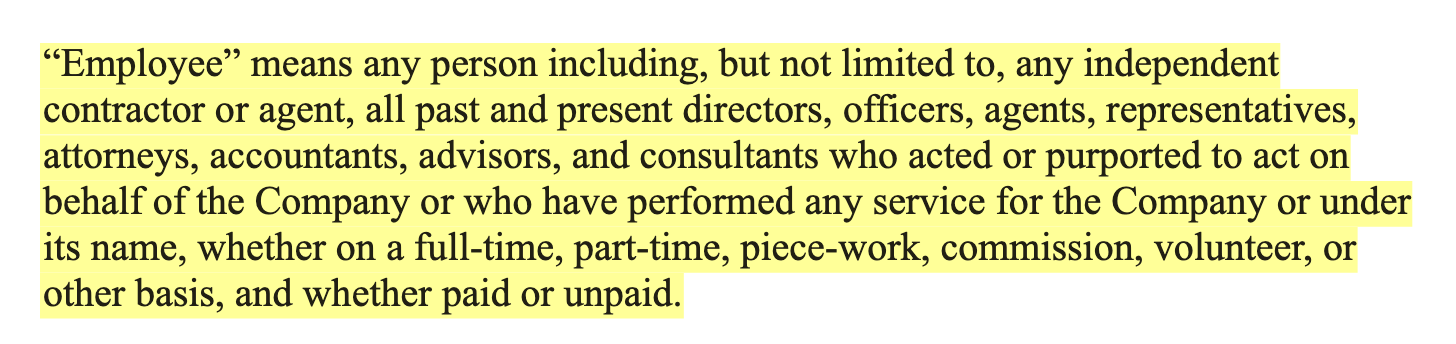

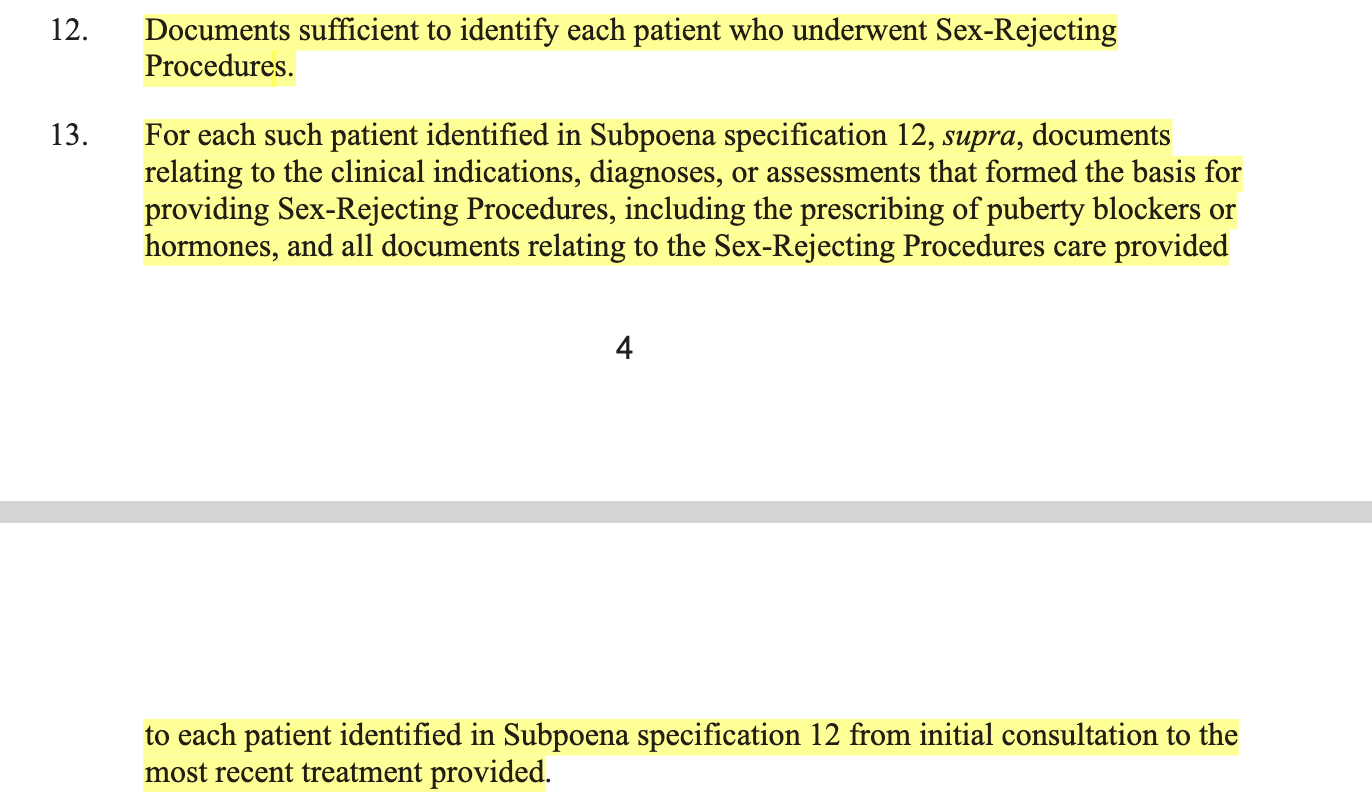
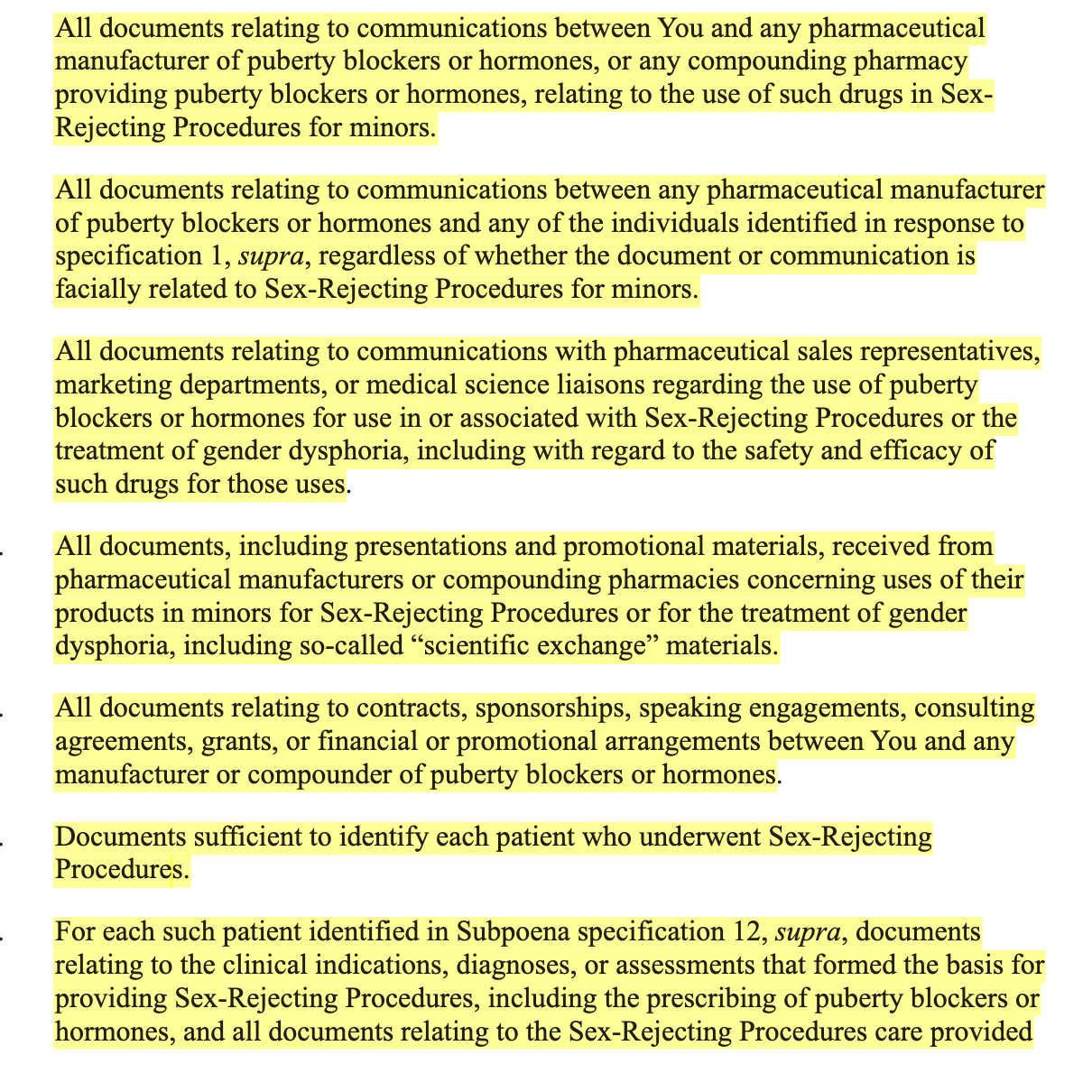

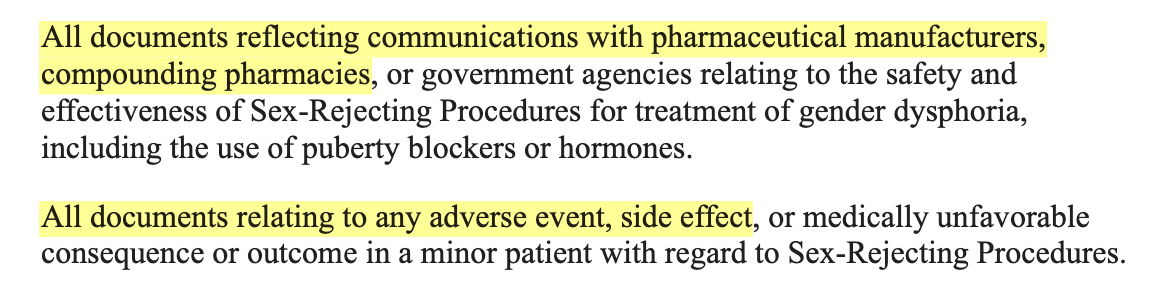
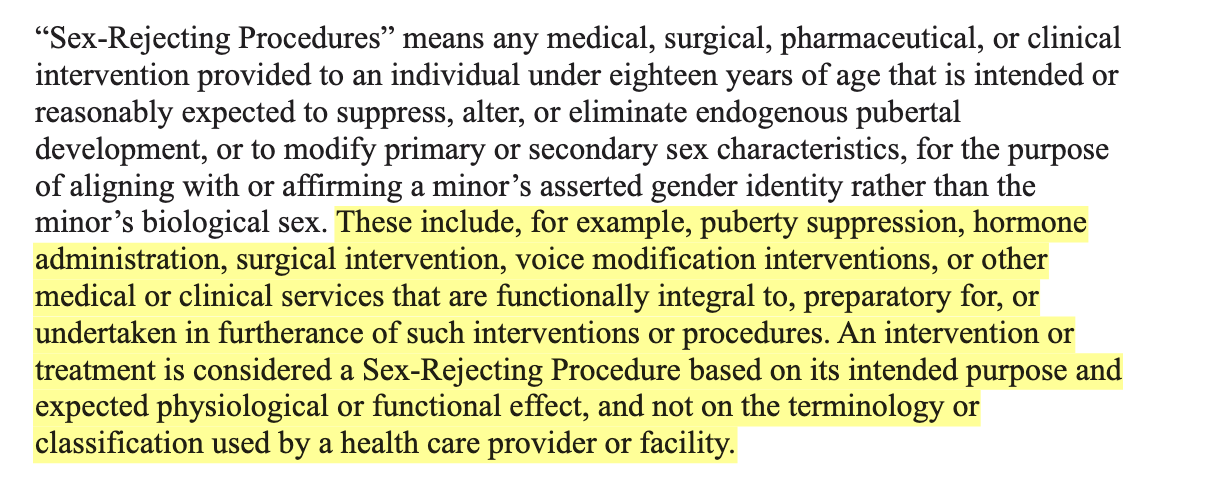
From Erin In The Morning via This RSS Feed.
14
43
Trans Youth Who Want Hormone Therapy But Can't Get It Face Twice Suicide Risk, Says National Survey
(www.erininthemorning.com)
cross-posted from: https://hexbear.net/post/8441411
cross-posted from: https://news.abolish.capital/post/48048
Photo by Delia Giandeini on Unsplash
On Wednesday, the Trevor Project released a massive survey of LGBTQ+ youth, with one of the largest subsamples of transgender people of any survey previously recorded. The survey, which questioned 16,667 respondents, included over 10,000 trans, nonbinary, and genderqueer respondents. The survey found harsh experiences among LGBTQ+ people and especially transgender people, including high rates of bullying and harassment, difficulty accessing healthcare, and nearly a third of respondents saying anti-LGBTQ+ policies had made them or their families consider moving to a different state. Among the most significant findings, however, was the impact of access to gender-affirming care on transgender youth: transgender and nonbinary young people who wanted hormones to support their gender transition but were unable to access them were nearly twice as likely to report a past-year suicide attempt compared to those who were currently taking hormones.
"Transgender and nonbinary youth who reported being unable to access hormones to support their gender transition or expression were nearly twice as likely to report a past-year suicide attempt compared to those who were currently taking hormones (15% vs 8%)," reads the report. The finding is consistent with a growing body of peer-reviewed research linking anti-trans policies to worsening mental health outcomes. A 2024 study published in Nature Human Behavior—the first to establish a causal link between anti-trans laws and suicide risk—found that state-level anti-transgender laws increased past-year suicide attempts among trans and nonbinary youth by as much as 72%, with the highest increases among those under 18. The CDC's own Youth Risk Behavior Survey has documented similarly elevated rates, finding that over half of transgender high school students seriously considered suicide and more than a quarter attempted it during the rise in anti-trans legislation. Taken together, the evidence points in one direction: restricting access to gender-affirming care is harmful for transgender youth.
Difficulty in accessing hormones and suicide risk
Importantly, the survey also showed that the vast majority of transgender youth do not have access to or are not taking hormones or puberty blockers. Among transgender and nonbinary respondents aged 13-17, only 10% reported taking hormones to support their gender transition. Among those 18-24, the number rose to 44%, still less than half. Just 3% reported taking puberty blockers. These numbers run counter to the political narrative that transgender youth are being rushed into medical intervention. The reality, according to the survey's own data, is that the overwhelming majority of transgender minors are not receiving hormones or puberty blockers at all.
For transgender youth who do have access to care, there is enormous anxiety over whether it will continue. Of the transgender and nonbinary youth currently taking hormones, 87% reported being concerned about losing access. Ninety percent of all LGBTQ+ youth said recent anti-LGBTQ+ laws, policies, and debates caused them stress or anxiety, and 94% of trans and nonbinary respondents answered likewise. Worse, 32% of LGBTQ+ youth said these laws and policies had made them or their families consider moving to a different state altogether. That finding is consistent with broader migration data: a Movement Advancement Project/NORC poll found 400,000 transgender people had relocated since the 2024 election alone.
The survey comes amid an unprecedented wave of attacks on transgender youth and their ability to access care. Over the last two years, the Supreme Court has greenlit a suite of anti-trans policies, including in United States v. Skrmetti, which upheld state bans on gender-affirming care for transgender youth. Several states, all Republican-controlled, have now banned such care. The Trump administration has gone further still, issuing the Kennedy Declaration to threaten hospitals' federal funding for providing care—a policy that caused more than 40 hospital systems to shut down their trans youth programs. Meanwhile, anti-trans pseudoscience groups are attempting to launder misinformation about care and push conversion therapy-like practices at major medical conferences. This survey cuts through the false claim by the far-right that their efforts are somehow protective of youth. Denying transgender youth who want hormones clearly does not help them, but rather, is associated with nearly double the rate of suicide attempts.
Gender-affirming care saves lives. A Cornell review of more than 51 studies found that such care significantly improves the mental health of transgender people. One major study reported a 73 percent drop in suicidality among trans youth who began treatment; another found a 40 percent reduction in actual suicide attempts in the previous year. Research published in the Journal of Adolescent Health in April 2024 showed puberty blockers sharply reduced depression and anxiety. Abroad, a German review backed by 27 medical organizations endorsed gender-affirming care for youth, and a recent French medical consensus did the same. The evidence has driven a historic resolution from the American Psychological Association—representing 157,000 members—formally condemning bans on trans care.
“Given the current climate in our country, it comes as no surprise that many LGBTQ+ young people are reporting high rates of anxiety, depression, and suicidality. Similar to previous research, this national survey demonstrates that LGBTQ+ youth experience these negative mental health outcomes not because of who they are, but because of how they are mistreated by others,” said Jaymes Black, CEO of The Trevor Project, in a press release. “These young people report they are being bullied, discriminated against, and debated about by politicians simply for being themselves. While many of these results are difficult to read, this year’s data point to a hopeful reality for LGBTQ+ youth in the U.S., too: When LGBTQ+ young people report they have welcoming and supportive communities, spaces, and people in their lives, their risk for attempting suicide lowers significantly. As adults and allies, this is our call to action: we must continue to vocally and visibly show the LGBTQ+ young people in our lives that they belong, exactly as they are.”
Erin In The Morning is a reader-supported publication. To receive new posts and support my work, consider becoming a subscriber.

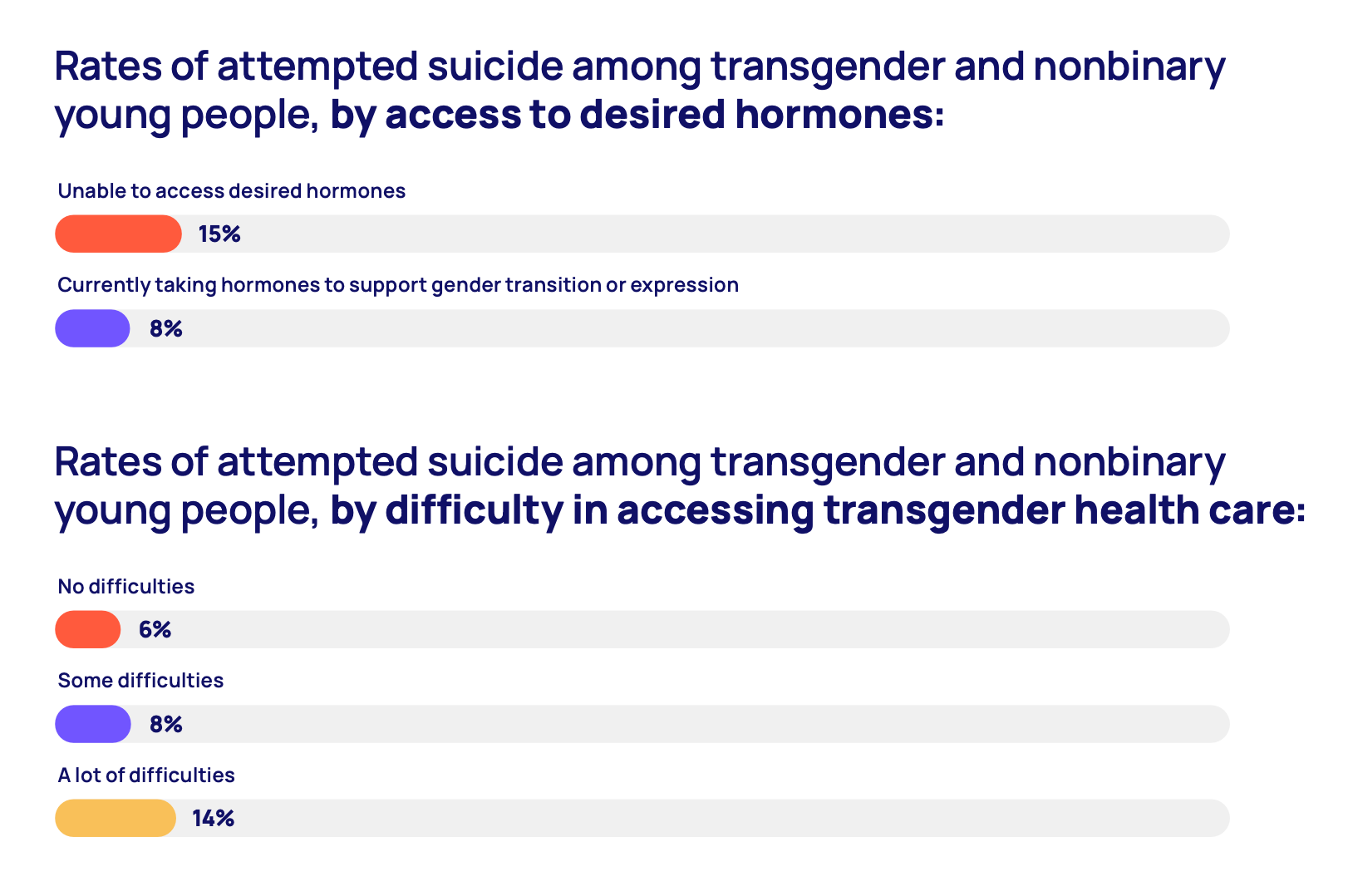
From Erin In The Morning via This RSS Feed.
15
37
Federal Judge Rules Trump Government Has Animus Towards Trans People, Blocks Org Subpoenas
(www.erininthemorning.com)
cross-posted from: https://hexbear.net/post/8479606
cross-posted from: https://news.abolish.capital/post/48379
Valerie Plesch / Bloomberg via NBC News
Erin In The Morning is a reader-supported publication. To receive new posts and support my work, consider becoming a subscriber.
Last night, Chief Judge James E. Boasberg of the U.S. District Court for the District of Columbia granted preliminary injunctions in two parallel cases—Endocrine Society v. FTC and World Professional Association for Transgender Health v. FTC—enjoining the Federal Trade Commission from enforcing civil investigative demands against the two leading medical organizations on transgender health. The judge ruled in both cases that the FTC likely violated the organizations' First Amendment rights and engaged in unlawful retaliation against them for their protected speech supporting gender-affirming care. Boasberg further found that the Trump administration and the FTC had pursued the organizations based on "extensive evidence of animus" and "wafer-thin justifications" for their demands. For now, the private communications, internal deliberations, and member information of these two organizations are protected from the Trump administration's escalating campaign of government censorship and retaliation against the medical institutions that support transgender people.
"On this preliminary record, with extensive evidence of animus and wafer-thin justifications lacking evidentiary support, [the Court] finds that WPATH is likely to demonstrate a causal link between its protected speech and the FTC's issuance of the CID,” said the judge in the WPATH ruling. In the parallel Endocrine Society ruling issued the same day, the judge went likewise found similar violations: "The Court finds the same systemic targeting of proponents of medical treatment for gender incongruence at work here. The Society is the latest casualty in some Executive Branch agencies' bid to investigate hospitals, medical providers, and charitable organizations that support transgender health. The CID's focus on academic and medical speech, combined with the FTC's paucity of logic or evidence pointing to a genuine investigation, confirms the conclusion that the CID was likely issued for a retaliatory purpose."
The cases center on Civil Investigative Demands—administrative subpoenas the FTC issued to both organizations in January 2026, demanding sweeping and unprecedented access to their internal operations. The FTC ordered the organizations to turn over decades of internal communications about their clinical guidelines on gender dysphoria, every educational and advocacy material, every financial record, and the names of every member who had ever helped develop claims about gender-affirming care—potentially thousands of people. The CID to WPATH alarmingly reached back to 1979, the year WPATH was founded. The CIDs are part of a sprawling Trump administration campaign to suppress speech about transgender people and crush the institutions that provide it: the Kennedy Declaration, which drove more than 40 hospital systems to shutter their trans youth programs before a federal judge vacated it as unlawful last month; CMS proposed rules that would bar Medicare and Medicaid-receiving hospitals from providing such care entirely; and DOJ subpoenas to hospitals across the country, which federal judges have repeatedly quashed as "smokescreens" for retaliation. The FTC's CIDs were the latest weapon in that campaign.
The organizations challenged the demands in federal court. Last night, they won. Boasberg ruled that the CIDs were retaliation against WPATH and the Endocrine Society for their protected speech in support of gender-affirming care, and that the FTC's campaign against them was rooted in extensive animus. Among the evidence the judge cited to show extensive animus towards transgender people was: Trump's executive orders denouncing gender identity as "subversive" and "false ideology" and labeling gender-affirming care "mutilation"; FTC Chair Andrew Ferguson's pre-appointment memo pledging to "fight back against the trans agenda" and investigate "the doctors, therapists, hospitals, and others" providing such care; senior FTC staff publicly accusing medical associations of "malpractice" and calling journalists covering trans issues "partisan morons"; and the FTC's July 2025 workshop "The Dangers of 'Gender-Affirming Care' for Minors," at which speakers called gender dysphoria "science fiction" and "the foundational fraud" and described their work as a "battle of good versus evil." The judge also noted that one workshop participant—who explicitly recommended investigating medical associations to make them "start losing members" and "lose revenue streams"—was subsequently hired by the FTC.
The judge also ruled that the CIDs were designed to chill protected speech regardless of whether the FTC ever pursued formal enforcement. "The CID and the accompanying threat of future enforcement sit as a Sword of Damocles suspended over Plaintiff's head," Boasberg wrote. "To mix weaponry metaphors, the Society alleges that the FTC is using its investigative demands as a cudgel, 'inflict[ing] concrete and ongoing injuries that suppress speech,' regardless of any later enforcement action." The judge grounded that conclusion in a recent D.C. Circuit ruling, Media Matters for America v. FTC, in which the appellate court blocked another retaliatory FTC subpoena—that one targeting the progressive media watchdog group over its reporting on advertisements appearing next to white nationalist content on Elon Musk's Twitter platform. Citing that precedent, Boasberg wrote that Congress would never have intended to give an agency "license to run roughshod over a party's First Amendment rights." With that, he blocked the FTC from enforcing the subpoenas against WPATH and the Endocrine Society while the cases proceed.
"WPATH welcomes the Court's decision to grant our request for a preliminary injunction against this unlawful and retaliatory investigative demand by the FTC. We are hopeful that this preliminary injunction will prevent further harm to the First Amendment rights of WPATH and its members. For more than 50 years, WPATH has been committed to developing guidelines informed by established scientific standards, expert consensus, and patient-centered values. WPATH's dedication to this mission and the patient population it serves remains unwavering," WPATH said in a emailed statement Thursday evening.
"The D.C. District Court ruling is an important victory that recognizes medical guidelines are a valued resource that allow doctors to support patients in making decisions about their care. This ruling sends a powerful message that government efforts to pressure the medical and scientific community to abandon evidence-based practices are not permissible. In addition to affirming the Endocrine Society's First Amendment right to speak freely on matters of public health, the court recognized the chilling effect the government's actions have on the Society's work and the harm to public interest. This decision is a helpful step in ensuring the Endocrine Society can continue to advance endocrine health and patient well-being by providing clinicians with medically sound, evidence-based information," the Endocrine Society said in its own statement to the Advocate.
A third parallel case—brought by the American Academy of Pediatrics, which received its own CID from the FTC on the same day as WPATH—remains pending before Judge Christopher R. Cooper, another Obama-nominated judge on the same D.C. District Court.
You can find the WPATH and Endocrine Society rulings here:
Endocrine Society Memorandum Opinion
308KB ∙ PDF file
Wpath Memorandum Opinion
199KB ∙ PDF file
From Erin In The Morning via This RSS Feed.
16
17
cross-posted from: https://hexbear.net/post/8444711
Hi everyone, I wanted to give another update after my appointment at the hematology and red blood cell department. Also I’m really so sorry that my posts are over appearing but I just don’t have anywhere to run to apart from you.
I am from seeing the doctor today and she told me she’s really worried about my blood results. I had more tests done today and from what I can remember, she said my CRP is high, my neutrophils are very low and my platelets are also still low. She explained a lot more to me but honestly I’ve been overwhelmed and struggling to process everything. I’m just tired of going to the hospital again and again but also happy that at least I can be able to access medication because it’s not the same as it was in South Sudan. I’m really grateful for Canada.
This is where things become really difficult for me because after all these tests, I’m supposed to start medication and not all of it is covered. Some medications are covered, some I still have to pay for myself and right now I truly don’t have the means.
I’m really trying to stay strong through all of this though I honestly still need support right now. Any help, support or sharing means more than I can explain.
Please consider supporting me through,
PayPay: Sahilqudra@gmail.com
Thank you so much for the kindness and support you’ve shown me already. I really appreciate

18
19
20
9
Hospitals Nationwide Caved to Trump on Trans Youth Care. Children's Minnesota Is One of the First to Bring It Back.
(www.erininthemorning.com)
cross-posted from: https://hexbear.net/post/8195377
cross-posted from: https://news.abolish.capital/post/40807
Childen’s Minnesota
Erin In The Morning is a reader-supported publication. To receive new posts and support my work, consider becoming a subscriber.
Some Minnesota families caught in the crosshairs of Trump’s war on trans kids can once again breathe a little easier, at least for now. Children’s Minnesota, a major regional hospital system, is reinstating the care it had paused on February 27 for transgender youth.
“The decision follows a federal court ruling that vacated a federal declaration attempting to restrict gender-affirming care,” a statement from the hospital, shared with Erin in the Morning, said.
“We are contacting patient families that were affected by the temporary pause in certain services. Offering science- and research-based health care to transgender and gender diverse youth is part of Children’s Minnesota’s vision of being every family’s essential partner in raising healthier children.”
Of the Gender Health program’s 700 active patients, less than 5% were directly and immediately impacted, the hospital said. In other words, the federal government’s crackdown targeted a program that was serving only a few dozen minors with these specific treatments.
The care pause only ever impacted puberty blockers and hormone replacement therapy. Children’s Minnesota never performed gender-affirming surgeries specific to trans patients under 18 and psychotherapeutic interventions were relatively unaffected.
“This pause was difficult and hard news for all of our patients,” the statement continued. “The temporary pause was a decision we did not want to make. It was a decision we had to make due to conditions at the time.”
On Dec. 18, Robert F. Kennedy Jr., Secretary of the Department of Health and Human Services issued a declaration that dubbed gender-affirming care for trans minors as medically unsound, and could therefore be restricted. However, the March ruling from Judge Mustafa T. Kasubhai found that Kennedy does not possess the legal or scientific authority to render an entire field of health care “not medicine.” Therefore, the Dec. 18 HHS declaration, which excluded providers of such care from participating in federal healthcare programs, was deemed unlawful.
Over 20 states filed a federal lawsuit in December, including Minnesota, against the Trump regime in response to the attacks on trans people’s health care.
Then, in April, the BMJ reported:
The coalition argued that the HHS declaration unlawfully sought to pressure providers by threatening their participation in federal health programmes including Medicare and Medicaid. Accepting this argument, Kasubhai said, “There’s a theme of break it and see what others will do” in the way that the HHS attempted to change national health policy on gender affirming care, using a public statement without allowing the necessary public consultation.
“That’s not a system or method committed to the rule of law,” Kasubhai added.
Now, Judge Kasubhai must decide “whether the federal government should be barred from using the declaration’s reasoning in any future action against hospitals, according to legal analysts,” Becker’s Hospital Review, an industry publication, reported on April 1. In other words, it’s weighing whether the declaration can be cited or used as evidence in a court of law in the future.
“That question, which could determine how much leverage the administration retains over healthcare organizations going forward, remains unresolved.”
Recently, the Department of Justice also sued the state of Minnesota over its trans-inclusive bathroom and sports policies in schools.
“We have been living in a world in Minnesota that is inclusive of LGBTQ people for a long time, and these issues have never been prevalent—it’s not been a problem until we had a federal government that decided that we had to eradicate these people,” said Rep. Leigh Finke, the first openly transgender member of the Minnesota Legislature and a founding member of its Queer Caucus, in an interview with Erin in the Morning earlier this month.
Pam Bondi, who had been leading the charge at the DOJ since Trump’s return to office, was fired from her position as the Attorney General on April 2. It’s not immediately clear who will take her place—or how they will maneuver the upcoming legal battles over trans rights coming down the pike.
Erin In The Morning is a reader-supported publication. To receive new posts and support my work, consider becoming a subscriber.

From Erin In The Morning via This RSS Feed.
21
14
Maryland Advances Bill That Would Protect Trans Students In "Any Program Or Activity"
(www.erininthemorning.com)
cross-posted from: https://hexbear.net/post/8137710
cross-posted from: https://news.abolish.capital/post/39721
Photo by Danielle E. Gaines.
Erin In The Morning is a reader-supported publication. To receive new posts and support my work, consider becoming a subscriber.
During the Trump administration’s time in power, transgender students have lost the ability to fight for their Title IX protections against schools that discriminate against them. Meanwhile, the Supreme Court has greenlit the targeting of LGBTQ+ students repeatedly this term. Maryland, though, appears poised to push back with a new bill that is rapidly advancing through the state legislature. HB 649, which has already passed the House of Delegates 100-35, would significantly expand protections for transgender students across the state, giving them a private right of action to sue schools that discriminate against them in "any program or activity"—a phrase borrowed directly from Title IX that would explicitly protect participation in sports, admissions, and access to school facilities and programs statewide. The bill was heard in a Senate committee yesterday.
The bill states that "an educational institution may not exclude an individual from participation in, deny a person the benefits of, or subject an individual to discrimination within, any program or activity of the educational institution on the basis of race, color, national origin, ethnicity, ancestry, religion, sex, pregnancy, sexual orientation, gender identity, disability, age, or marital status" (emphasis added). The language is significant and expansive: the bill defines "educational institution" to include both public and nonpublic prekindergarten programs, elementary schools, secondary schools, institutions of postsecondary education, institutions of higher education, and any other educational program leading to a certificate, diploma, or degree—covering virtually every school in the state from pre-K through college.
The bill was brought at the request of Maryland's own Commission on Civil Rights. In its testimony, the Commission laid out the urgency in stark terms: the federal Office for Civil Rights, which has historically been the primary enforcement mechanism for students facing discrimination, has been gutted under the Trump administration. OCR complaints from Maryland residents surged to 130 in 2024—but after January 2025, the office effectively stopped processing them. Furthermore, when the administration does take action, it is against transgender students, not in favor of their rights. The ACLU of Maryland, which also testified in favor of the bill, noted that when the current president took office, many OCR complaints were dismissed without investigation. "With the dismantling of USDE and OCR, Maryland must fill the gap to ensure that the civil rights of all Maryland students are protected and upheld," the ACLU wrote.
The bill is notable for two reasons. The first is its use of the phrase "any program or activity" in its protection of transgender students. Maryland's existing nondiscrimination law, the 2022 Inclusive Schools Act, prohibits schools from "discriminating against” students based on gender identity—but does not explicitly guarantee the right to participate in all school programs and activities. The current vague language can leave room for schools to argue that barring a trans student from a sports team or denying access to facilities does not constitute discrimination. Only a handful of states have closed this gap. California's landmark 2013 School Success and Opportunity Act explicitly guarantees transgender students the right to "participate in sex-segregated school programs and activities, including athletic teams and competitions, and use facilities consistent with his or her gender identity." Connecticut similarly requires "equal opportunity to participate in school activities, programs, and courses of study" regardless of gender identity. Maryland's HB 649, by adopting the Title IX formula—"exclude from participation in, deny the benefits of, or subject to discrimination within any program or activity"—would place the state among this small group.
Secondarily, the bill creates a private right of action. Under Maryland's current framework, a student alleging discrimination must depend on government agencies acting in their favor. HB 649 changes that. A transgender student experiencing discrimination in bathrooms, sports, dormitories, or any other school program would be able to sue the school directly in state court, without waiting for the state superintendent or the attorney general to act on their behalf. The National Women's Law Center Action Fund, which testified in support of the bill, called this pathway "critical for student survivors of sexual assault and LGBTQI+ students who may face greater hurdles in obtaining justice on federal civil rights claims." Any school that capitulates to Trump administration demands to roll back transgender protections may now face lawsuits directly from the students it harms, should this bill pass.
The bill has the support of Maryland's LGBTQ+ Caucus, which submitted a letter of support calling it a necessary step to close enforcement gaps in civil rights law. "For LGBTQ+ students, actionable nondiscrimination enforcement supports a safer school climate, better academic outcomes, and recognition and respect for gender diversity and sexual orientation as integral parts of students' identities," the caucus wrote. "Ensuring that LGBTQ+ students and educators are protected under state civil rights law helps educational environments become more inclusive, safe, and equitable for all."
The bill passed the House 100-35 on March 23 and has been referred to the Senate Education, Energy, and the Environment Committee, where it was heard yesterday. The Senate must act before the legislative session ends on April 13. If passed, the bill is likely to be signed by Gov. Wes Moore, who has signed the Trans Shield Act, the Trans Health Equity Act expanding Medicaid coverage for gender-affirming care, and declared Maryland a sanctuary state for transgender people.
Erin In The Morning is a reader-supported publication. To receive new posts and support my work, consider becoming a subscriber.
From Erin In The Morning via This RSS Feed.
22
57
Transgender Woman Defies Kansas's Extreme Bathroom Ban In Act Of Civil Disobedience At State Capitol
(www.erininthemorning.com)
cross-posted from: https://hexbear.net/post/8137444
cross-posted from: https://news.abolish.capital/post/39745
Topeka Capital Journal
Erin In The Morning is a reader-supported publication. To receive new posts and support my work, consider becoming a subscriber.
Samantha Boucher openly defied the state laws of Kansas when, in the presence of the Governor and the police, she walked into the bathroom in an act of civil disobedience.
Boucher is the founder and executive director of Trans Liberty and a transgender woman. The bathroom was in the Kansas statehouse. The morning was March 31st: the Transgender Day of Visibility.
The police showed her the way. Governor Laura Kelly, who Boucher encountered along the way, accepted a gracious thanks from Boucher. Kelly had tried to veto the bathroom ban bill that Boucher was now defying, but she was overridden by a heavily conservative state legislature.
“I think this would be extremely dangerous for a Kansan to do, but ... I’m more than happy to put myself at that risk if it means that somebody else doesn’t have to, because eventually someone would try this,” Boucher told the Topeka Capital-Journal. “I’m really interested to see what the attorney general chooses to do here.”
The Topeka Capital-Journal on Instagram: "A transgender activis…
Boucher’s modest protest transpired as the state crackdowns on trans people escalated: banning them from using bathrooms in public buildings that don’t match their sex assigned at birth, instituting a “bounty” to incentivize snitching on trans people who use the “wrong” restroom and institutions that don’t sufficiently sex-check people at the bathroom door, and most notably, revoking transgender people’s driver’s licenses if they don’t match their sex assigned at birth. Those caught with the “wrong” gender on their driver’s license could face criminal charges, making it the most extreme anti-trans ID law in the country.
None of this deterred Boucher. “I commend her for calling attention to state-sanctioned discrimination and for her bravery in challenging those who support such discrimination to put their votes into action,” Rep. Abi Boatman of Kansas’ 86th district in Wichita, told Erin in the Morning.
Boatman is one of a handful of transgender state lawmakers in the country; she is not legally allowed to use the women’s restroom in her own place of work at the Capitol, and she cannot drive to work with an ID that accurately depicts her gender.
Boucher left yesterday a free woman, but Kansas authorities are investigating the matter.
Others are not so lucky. Transgender and cisgender people alike have been caught up in the anti-trans panic—people have been harassed and filmed in the bathroom, accosted by police or security guards, physically assaulted, and arrested after using the restroom, even in states with no such “bathroom ban” on the books.
Some of these instances have been planned protests; others were unsuspecting patrons and private citizens simply using the restroom. That’s because these laws rely on piecemeal enforcement, vigilante bathroom police, self-censorship, and above all, fear.
The political landscape is especially dangerous for Black and brown trans people, who face disproportionate levels of violence and police brutality.
As Boucher approached the restrooms on the second floor, she encountered Governor Laura Kelly, who was attending an unrelated event. Boucher told the Governor what she was about to do.
“In regard to SB 244, I will use the restroom 3 times, triggering a misdemeanor,” Boucher said. “I appreciate your veto.”
Kelly commended her—and apologized. “I am very sorry that you and others have been put in this situation,” Kelly said.
According to the law, Boucher could face criminal charges as well as a $1,000 civil penalty.
Boucher was the first openly trans federal campaign manager, as per her social media. In 2019, she oversaw Democratic candidate Kimberly Graham’s Senate campaign in Iowa ahead of the June primaries. She is the founder and executive director of Trans Liberty, a trans equality PAC.
“What I hope to have accomplished here, and in whatever I become embroiled in as a result, is making sure that the nation doesn’t forget that this is happening here,” Boucher said as per local press reports. “This is unprecedented, and it cannot be allowed to stand.”
Erin In The Morning is a reader-supported publication. To receive new posts and support my work, consider becoming a subscriber.

From Erin In The Morning via This RSS Feed.
23
6
Romanian Court Forces State To Recognize Trans Man's Identity In Historic Ruling
(www.erininthemorning.com)
cross-posted from: https://hexbear.net/post/8129913
cross-posted from: https://news.abolish.capital/post/39411
ACCEPT Romania
Erin In The Morning is a reader-supported publication. To receive new posts and support my work, consider becoming a subscriber.
On Transgender Day of Visibility, a Romanian appellate court ordered the government to recognize a transgender man's gender identity on state documents—the first known court enforcement of a landmark 2024 ruling by the Court of Justice of the European Union. That ruling requires all member states to recognize legal gender changes obtained elsewhere in the bloc. The Bucharest Tribunal's decision is final and cannot be appealed. While the ruling directly applies only to transgender people who obtained gender recognition documents in another EU country, it sets a significant precedent in a nation that ranks dead last among all 27 EU member states on LGBTQ+ rights, according to ILGA-Europe's 2025 Rainbow Map.
The case centers on Arian Mirzarafie-Ahi, a transgender man with dual British and Romanian citizenship who was born in Romania and moved to the United Kingdom in 2008. Arian began his transition in the UK in 2016 and obtained a gender recognition certificate in 2020, while the UK was still treated as an EU member state during the Brexit transition period. Romania's own gender recognition procedure was not a viable option—the European Court of Human Rights found in 2021 that the country had no "clear and foreseeable" framework for gender recognition and had forced transgender people into an "impossible dilemma" by requiring surgery that was either unwanted or unavailable domestically. ACCEPT Romania estimates fewer than 50 people have successfully changed their civil status documents in the country in the last 20 years.
When Arian attempted to register his UK gender change with Romanian authorities in 2021, they refused. He sued. The Romanian court sent the legal question to the Court of Justice of the European Union (CJEU) for a binding interpretation, and in October 2024, the CJEU ruled that Romania’s refusal violated EU law—holding that “gender, like a first name, is a fundamental element of personal identity” and that forcing a citizen to carry conflicting identities across member states was an illegal barrier to free movement.
Even after the CJEU's ruling, Romania resisted. When the case returned to domestic courts, three government agencies—the Cluj Personal Records Directorate, the Civil Status Service, and the General Directorate for Personal Records—appealed a lower court's order to comply. The Bucharest Tribunal rejected all three appeals on March 31, making the order final: Romania must recognize gender changes from other EU member nations.
"The legal process we accompanied Arian through over the past several years has, at last, reached a conclusion that does him justice. More than a personal victory, the ruling confirmed by the Bucharest Tribunal is a major step toward respecting the rights of all transgender people in Romania," said lawyer Iustina Ionescu in a press release by ACCEPT Romania. "Romanians who have obtained a final gender recognition decision in another member state will no longer need to go through Romania's arduous procedure. We call on the Ministry of Internal Affairs and the Ministry of Justice to adopt a clear, fast, and accessible procedure for changing documents for all Romanian transgender citizens—regardless of whether they have lived in other EU member states—as the European Court of Human Rights has required since 2021 in X and Y v. Romania." (Translated from Romanian.)
The ruling has significance well beyond Romania. Because the underlying CJEU decision is binding on all 27 EU member states, the Romanian court's enforcement serves as a practical test case for how the principle will be applied across the bloc. ILGA-Europe's Senior Strategic Litigation Advisor Marie-Hélène Ludwig called the decision "a victory for the many trans people in the EU who are still refused identity documents matching their gender identity and are forced to live with different identities when crossing borders," adding that since "Romania has resisted implementing the CJEU ruling in the Coman case for eight years, it is particularly important to see a Romanian court giving practical effects to a CJEU ruling." The organization said it is now monitoring implementation in other EU countries. Three member states—Hungary, Bulgaria, and Slovakia—have effectively banned legal gender recognition entirely through laws, court decisions, or constitutional amendments, all of which now run contrary to the CJEU's evolving jurisprudence.
The ruling does have significant limitations. It applies only to transgender people who obtained legal gender recognition in another EU member state—it does not help trans Romanians who have never left the country and remain trapped in Romania's domestic procedure, which the European Court of Human Rights condemned in 2021 but which remains unchanged. As the Reuters noted in its analysis of the underlying CJEU decision, "as the litigation in this case was focused on freedom of movement rights, it means the process for Romanian citizens seeking to change legal gender remains unchanged." Ionescu's statement directly addressed this gap, calling on the Romanian government to create a procedure for all transgender citizens "regardless of whether they have lived in other EU member states." ACCEPT has already begun distributing template legal forms for other trans people with cross-border documents to file their own requests.
Erin In The Morning is a reader-supported publication. To receive new posts and support my work, consider becoming a subscriber.

From Erin In The Morning via This RSS Feed.
24
25
view more: next ›