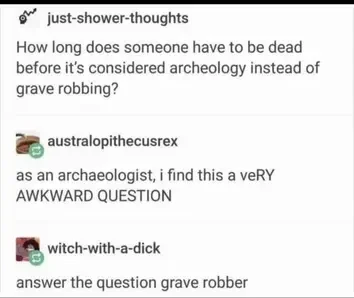
(real answer: modern archeology places a high value on retaining artifacts in the milieu they were produced or found in as much as possible, both for reasons of cultural sensitivity and to retain as much contextual information as possible about the artifacts in question. The main difference between 19th century archeology and traditional grave robbing was profit motive vs. ethnographic academic curiosity)
History Memes
A place to share history memes!
Rules:
-
No sexism, racism, homophobia, transphobia, assorted bigotry, etc.
-
No fascism (including tankies/red fash), atrocity denial or apologia, etc.
-
Tag NSFW pics as NSFW.
-
Follow all Piefed.social rules.
-
History referenced must be 20+ years old.
Banner courtesy of @setsneedtofeed@lemmy.world
OTHER COMMS IN THE HISTORYVERSE:
- !historymusic@quokk.au
- !historygallery@quokk.au
- !historyruins@piefed.social
- !historyart@piefed.social
- !historyartifacts@piefed.social
- !historyphotos@piefed.social
But that doesn’t answer the question. How long do they wait before digging up remains in a graveyard, for example?
Honestly, by the time most grave allotments expire, they're probably due for interest by some body with a remarkably specific archeological discipline.
You grave robber.
some
body
Long enough that nobody knew it was a cemetary/burial site until they started unrelated digging for unrelated purposes.
It's always (and always has been) grave robbing.
uh
WTF this isn't the post I replied to!
it’s medical research, not grave robbing