this post was submitted on 16 Oct 2026
625 points (95.8% liked)
Linux
68249 readers
207 users here now
From Wikipedia, the free encyclopedia
Linux is a family of open source Unix-like operating systems based on the Linux kernel, an operating system kernel first released on September 17, 1991 by Linus Torvalds. Linux is typically packaged in a Linux distribution (or distro for short).
Distributions include the Linux kernel and supporting system software and libraries, many of which are provided by the GNU Project. Many Linux distributions use the word "Linux" in their name, but the Free Software Foundation uses the name GNU/Linux to emphasize the importance of GNU software, causing some controversy.
Rules
- Posts must be relevant to operating systems running the Linux kernel. GNU/Linux or otherwise.
- No misinformation
- No NSFW content
- No hate speech, bigotry, etc
Related Communities
Community icon by Alpár-Etele Méder, licensed under CC BY 3.0
founded 7 years ago
MODERATORS
you are viewing a single comment's thread
view the rest of the comments
view the rest of the comments
Thanks for that explanation. Are you saying that if I rebuild the exact same code on the same machine I could get different results for a given compiler? I think this would render solutions like docker useless. Could you elaborate?
Yes you can get a different result. Compilers are designed to be deterministic, but a build is more than the compiler. Usually the bytes differ but the behavior is identical.
Docker is far from being reproducible!
It works on my machine ≠ reproducible. But reproducible will make it works on your machine.
Using a compiler does not guarantee you to get byte-perfect output each time, especially not on different machines.
Yes, that is a great explanation. Thank you.
That is, of course, the whole point of docker (making sure the results of compiling are identical). I totally get the different machines giving slightly different results. This is not really in the same realm of the dramatically different output a LLM will give though.
No the goal of Docker is not to make sure the results of compiling are identitcal. It is to make it work on your machine, there is some nuance to it.
This is more the goal of something like nixpkgs (NixOS).
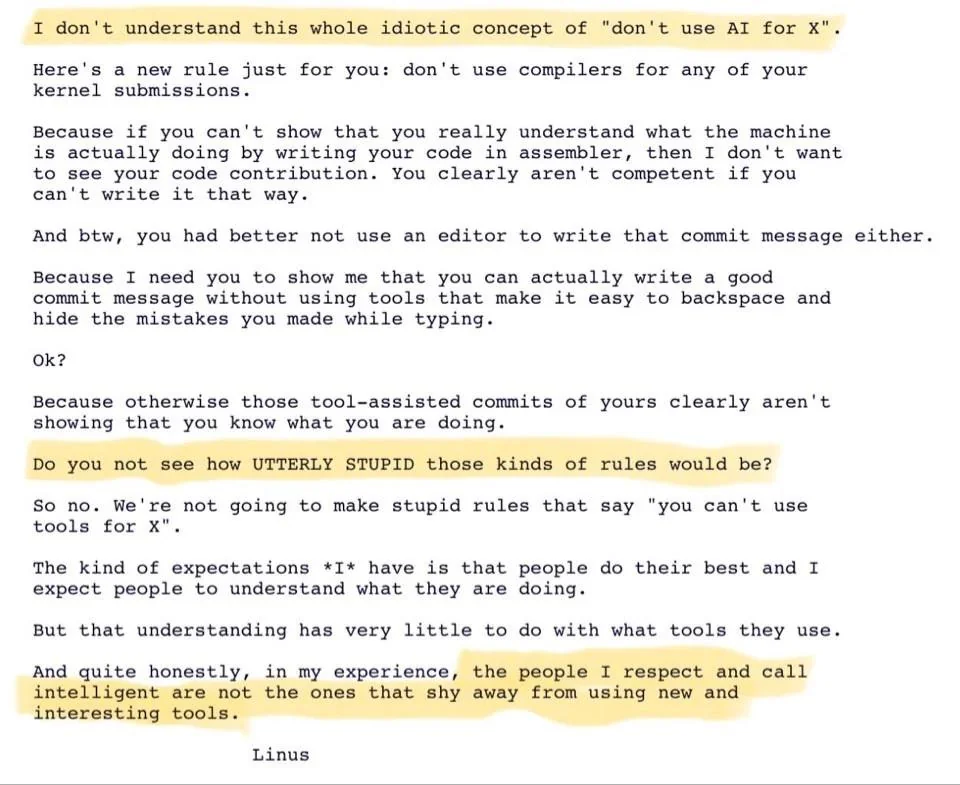
Yes this is not same realm but my point was that eve if LLM would give you different results each time the result is transparent and editable. Also developers tools evolve and Linus have more technical knowledge to use this tool in a way that will gave him satisfying result than me or a junior dev with 1.5 years of experience. He was against LLM generated code a few years ago, not because he hated on AI but because this tool was giving him unsatisfiying results. If compilers were not working 50% of the time he would probably write everything in assembly. LLM models and their coding harness cannot be compared to what they were 2 years ago. And most of the devs are using them. Will that transform bad devs into good ones? Probably not. Does that mean that LLM generated or assisted code is the way to go? Not necessarly. But it means that it's a tool that find its use in the majority of development teams and thus that they find it quite useful.
There is some issues with it and I'm not here to deny them. Whether they are social, environmental, capitalist, monopolist, learning. Like every new disruptive tool we use them in ways we won't in the future and I think it's similar with AI.
Talk about misleading. The differences are timestamps and metadata, and some compilers have flags to let you zero out timestamps and force it to produce a bit-for-bit identical file every time.