this post was submitted on 16 Oct 2026
624 points (95.7% liked)
Linux
68239 readers
501 users here now
From Wikipedia, the free encyclopedia
Linux is a family of open source Unix-like operating systems based on the Linux kernel, an operating system kernel first released on September 17, 1991 by Linus Torvalds. Linux is typically packaged in a Linux distribution (or distro for short).
Distributions include the Linux kernel and supporting system software and libraries, many of which are provided by the GNU Project. Many Linux distributions use the word "Linux" in their name, but the Free Software Foundation uses the name GNU/Linux to emphasize the importance of GNU software, causing some controversy.
Rules
- Posts must be relevant to operating systems running the Linux kernel. GNU/Linux or otherwise.
- No misinformation
- No NSFW content
- No hate speech, bigotry, etc
Related Communities
Community icon by Alpár-Etele Méder, licensed under CC BY 3.0
founded 7 years ago
MODERATORS
you are viewing a single comment's thread
view the rest of the comments
view the rest of the comments
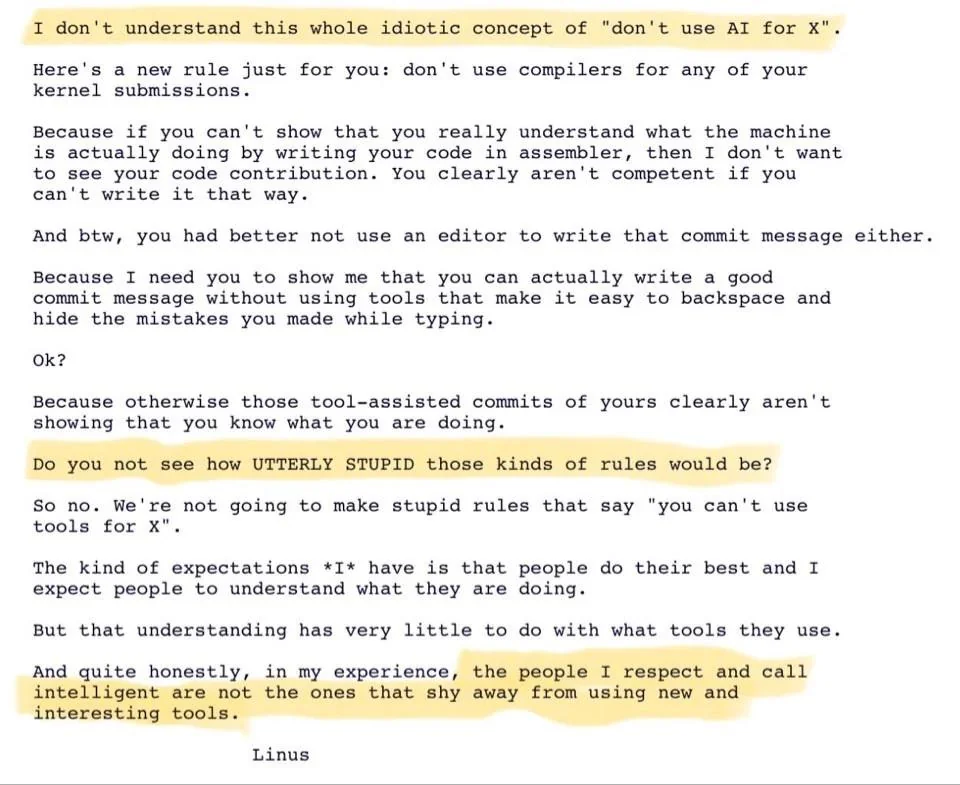
The other practical side of this is enforceability.
Lets say Linux banned all use of VSCode in contributions, this second. And any Microsoft tools. No exceptions. And it makes sense, because there is an evil blatantly anti-linux entity behind it... What are people gonna do?
Keep using it anyway, and just not disclose it.
This is why linux doesn't tell people what tools they can and can't use. Practically, they can't police what tools people use, just what they contribute. Just like (to a reasonable degree) they don't try to police people who contributes to the kernel, but instead judge them by their contributions. Other contributors don't have to like those tools or contributors, but that is how a project like this must operate.
Much of open-source development relies on the honor system. There is likewise no way to tell, just by examining code, that it was not plagiarized.
Honor that needs to be enforced is not honor. It is something less.
It relies on legality, not honor. E.G. with GPL, or code with a proprietary license. It's the threat of losing their job, getting sued or whatever that discourages plagarism.
Non-point elements removed to help you focus.
Ah I get your point now. Yes, ultimately both policies would rely on honor.
I'd argue plagiarism is different, though. If a codebase stipulates 'don't plagiarize,' that's... common morality. Not many contributors are going to argue 'well, I want to plagiarize.' They wouldn't advertise it in any project they contribute to.
Dictating what tooling to use is different. That's going to fall under 'personal choice' for more contributors. And they may feel compelled to hide tool use for that particular project, when they would otherwise show its use publicly in others.
In other words, forbidding tools like, projects runnings be telling contributors to forgo something they're used to using public. That's going to trigger more lack-of-disclosure and rule-breaking from devs that otherwise wouldn't do that.