
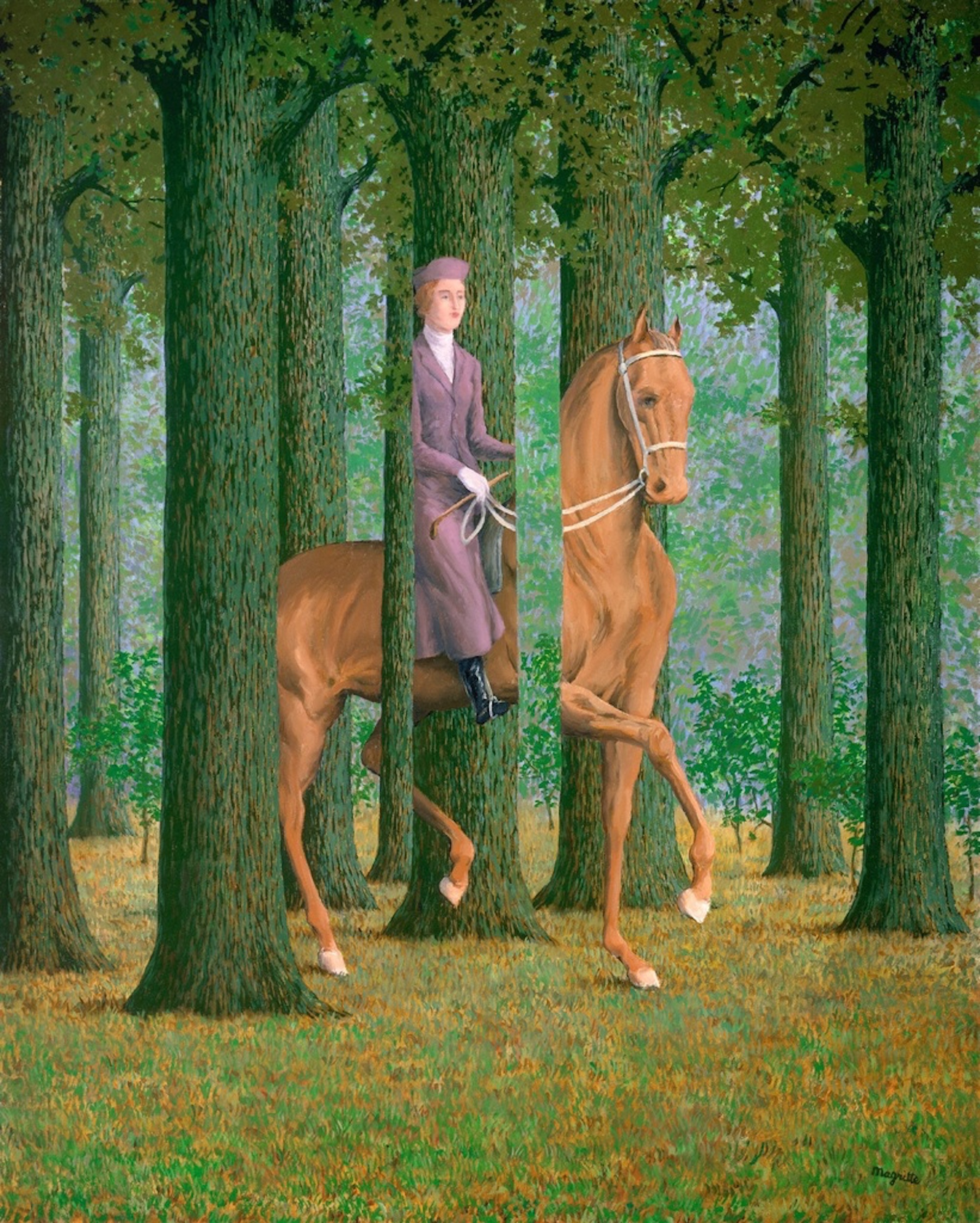
Artist: René Magritte
Year: 1965
Medium: Oil on canvas
The Blank Signature (Le blanc-Seing) is a 1965 painting by the Belgian surrealist painter René Magritte. The work is part of the collection of the National Gallery of Art in Washington, D.C. It was one of Magritte’s last works before his death in 1967. The painting depicts a woman on horseback riding through a forest. Due to an optical illusion employed by the artist, the image is partially fragmented, although at first glance the viewer may perceive it as a coherent whole. The woman and the horse are simultaneously in front of, between, and behind the trees. Her right arm is partially hidden behind a tree that, upon closer inspection, is located in the background. One possible interpretation is that the merging of the forest with the horsewoman suggests a unity of humanity and nature. But as is usually the case with Magritte, the work primarily raises questions, a sense further heightened by the enigmatic title. The painter himself believed that his works required no specific interpretation; every viewer can interpret the work in their own way. He also noted that art critics sometimes saw more—or something entirely different—in his works than he himself had consciously intended.

I know the feeling. I used to have a study hall in the library, and I often spent it perusing big art books, and got to know the main artists and masterpieces pretty well.
In college, I took my first school trip to NYC to see the King Tut exhibit, and we also went to MOMA, where I saw Guernica for the first and only time. I had read about it a lot, and had seen it in books many times, but I wasn't prepared for its overwhelming size. It was FAR bigger than I expected, and it made a serious impact on me. In books, or on the Internet, all art is more or less the same size, the size of the page, or the screen. Guernica and a Vermeer are literally the same size, until you see them on a wall and realize that the Guernica is meant to punch you in the face, while the Vermeer is a tiny perfect jewel.
Since that trip in the early 80s, I try very hard to see the local art museum whenever I travel. Some have been surprisingly great (Rochester), some have been beyond awful (Mobile), but I've learned something about art from all of them.
And I still get surprised. I took my son to the Dali Museum in St Petersburg when he was in middle school, and didn't really know who Dali was. I was shocked at the incredible size of many of his most iconic works. They were huge, and filled with detail from corner to corner. Truly incredible.
As for my son, he had the same reaction that you and I had, and was transformed by seeing real art LIVE, where you can bask in the size, the colors, the magnitude of the experience of standing in front of an original work by a legendary, iconic artist. To this day, he will NEVER say no to an art museum.
I was glad to see someone talking about the same sort of experience with art.
That's the beauty of art. That transformative, powerful response to the creation of our fellow humans. I wish that all art could be just as powerful at coffee table book size, but even if it were, I think that seeing it in person, with the right lighting and space to move around a piece allows so much deeper am experience that it still wouldn't displace museums and galleries.
When I saw Van Gogh's Starry Night in person, I could get close enough to see, and even photograph his Iconic brushstrokes. You can't get that in a book.
Gods! I would sell a testicle to see van Gogh's stuff in person
Go to NYC and go to the Met and MOMA, and you'll see lots of them, many of them iconic, as well as great pieces by Monet, and others.