this post was submitted on 02 Aug 2026
461 points (98.3% liked)
me_irl
8241 readers
587 users here now
All posts need to have the same title: me_irl it is allowed to use an emoji instead of the underscore _
founded 3 years ago
MODERATORS
you are viewing a single comment's thread
view the rest of the comments
view the rest of the comments
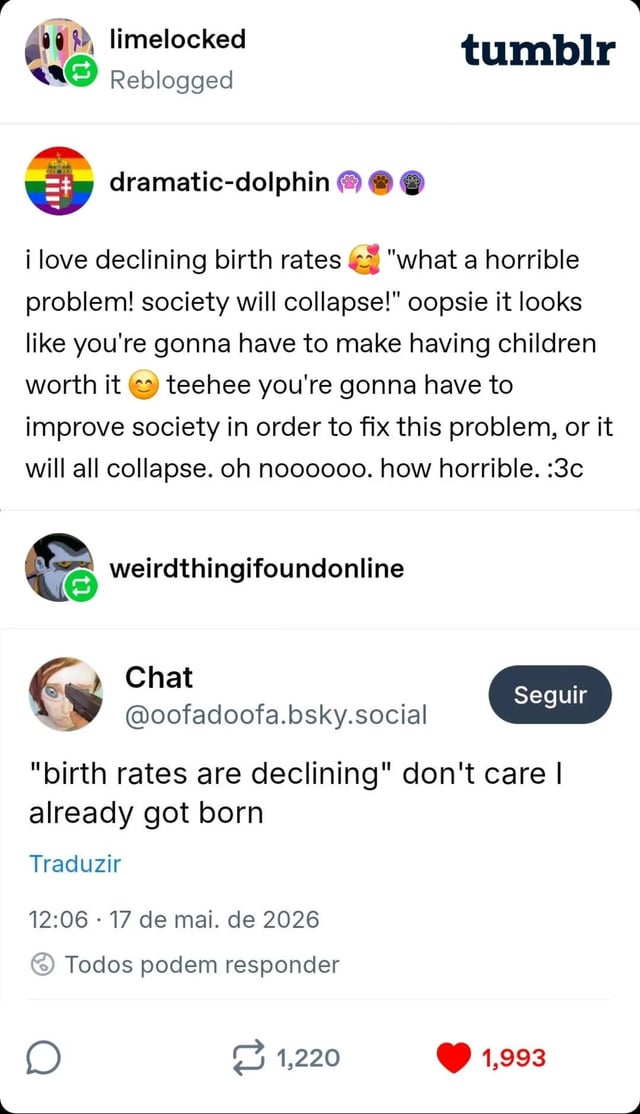
Some people cannot fathom the concept of limited resources. They think you can increase human population exponentially forever and it'll just work out somehow
We could easily support our current population and quite a bit more if we actually respected and shared our resources responsibly.
Hell, we could increase exponentially forever if we wanted. The universe is practically infinite
No. The physics does not allow this. Physics does allow interstellar travel and colonization. However, the resources required are immense. To transport a single human being between star systems would require more energy than it would take to keep them alive in decadent luxury for centuries. We're talking hard limits of physics here. Sure, you can imagine this will be solved by some magical technology outside the known laws of physics, like a perpetual motion machine, but you could then just as easily imagine using that magical technology to keep people alive back at home.
Interstellar colonization would be a wonderful idea, but simply as a means of backing up life. And spreading life through the universe has value in and of itself. It's a wonderful thing to yearn for.
But interstellar travel has absolutely zero utility as a means of addressing population growth.
Oh, and you can only have so many humans living in any given volume of space before the raw output of their body heat cooks them all alive. Regardless of your tech, there are only so many humans you can cram into a volume the size of the solar system.
uhh, yeah, travel takes a whole lot of resources, but you'd only need to transport very few elements around, like a seed of a tree. and when you land on a new planet, you have more resources to utilize and go on. so your image is too limited here.
Please read the thread carefully. You're fundamentally misunderstanding the context of this discussion. We aren't talking about interstellar travel in general. We're talking specifically about the utility of using interstellar travel as a means of keeping exponential growth going forever.
The species can keep growing by extending out to the stars, but an individual star system can't. Eventually your star system reaches a maximum population. In the age of European imperialism, Europe shipped its excess population off to settler colonies Australia and the Americas. That will never be possible between star systems. In the 1800s, Britain could lower its resource demand by sending people off to the Americas. It took far more resources to keep a person alive for their lifetime than it did to send someone across the ocean. But you save no net resources by shipping someone off to Alpha Centauri. Sol will not be able to solve an overpopulation problem by shipping people off to distant Suns. And it's not a matter of how much cargo you bring with. The energy required to move just your body across interstellar distances dwarfs what is required to keep you alive for many lifetimes.
So, no, population cannot grow forever. Eventually Sol will have to stabilize its birth rates, or it will have a problem. Starting new seed colonies around distant stars can probably be done. But it won't allow the population or economy of a single star system to keep growing forever. With interstellar colonization, you're not expanding your civilization to multiple star systems, you're budding off new independent civilizations around those distant Suns.
A seed is actually a perfect metaphor for interstellar colonization. A tree can throw a seed to the wind to make new trees far away, but those seeds don't help that original tree grow any bigger.
yeah and since alls we need is the vaccum of space to thrive its definately doable.
Yep, but it would take careful planning. Like, actually listen to the smart people who know how to design a long-term sustainable system, rather than just chasing profit at all costs.
It's not even that hard to do, just let people do the right thing. Every researcher that says "we could fix this", we automatically assume that voice will be ignored at best or crushed at worst, but it doesn't have to be this way.
Exxon mobil knew climate change would have devasting effects decades ago. But it wasnt profitable within their lifetimes to admit that or do anything about it
I think this is a monumentally bad argument. Statistically, you are typing this from a computer or smartphone, with internet access, and are probably part of the segment of humanity that consumes the most resources (as am I). You are saying that if we want to have 15, 20, 30 billion people, we can all just live like the most impoverished people in the world and it will be fine.
It's a quality vs. quantity problem. Maximizing human numbers means we must have very low per-person consumption to minimize impact. Maximizing quality of life means we can all eat/travel/live/consume how we want and the environmental impact will still be low (but with fewer people). I think that's far more desirable.
EDIT: to distill down the argument further - you support voluntarily decreasing your standard of living, so that we can grow the population more, for the benefit of.... ? Creating lives that have not yet been born and can't care?
Whatever you want, I personally do not want a decrease in my standard of living, and especially not to feed the capitalist machine that requires growth at all costs. I presume, if faced with a real and present choice of the same kind, most people would choose to uphold their standard of living instead of sacrificing, only so that more billions of people can be born. When is it enough? Do we really NEED 8B+ people? I wouldn't mind living in a world of <1B people where everyone has luxury and plenty without destroying the planet in the process. We can't get there, but the principle still holds. Put resources into solving the problem of elder care, and just let the population decline naturally.