27
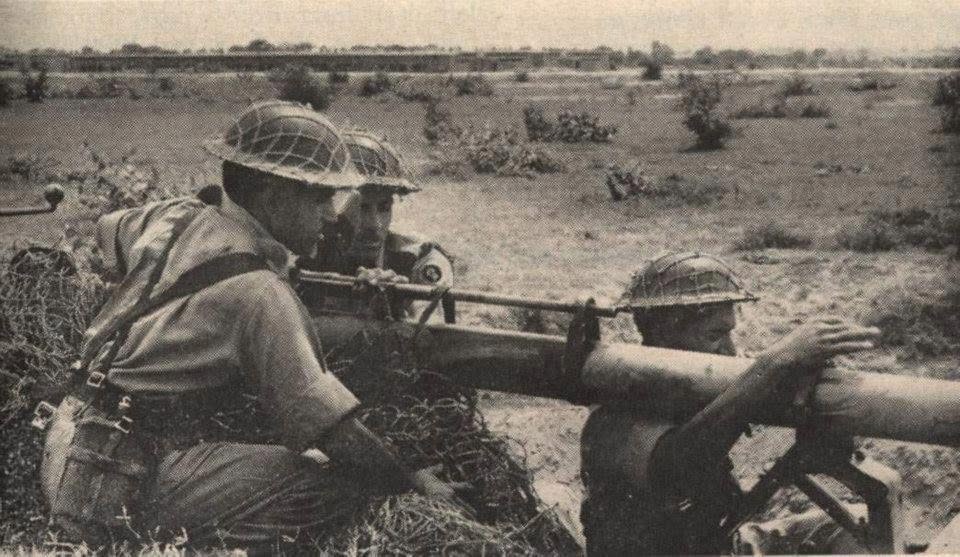
Pakistani troops manning a 106mm recoilless rifle during the Indo-Pakistani war of 1965
(media.piefed.social)
HistoryPhotos is for photographs (or, if it can be found, film) of the past, recent or distant! Give us a little snapshot of history!
Rules
Related Communities:
Handy!
And I realised just now my faulty thinking-- I'd associated "rifles" with long, personal guns, but rifling can evidently be applied to a large range of gun barrels, even up to massive ones like battleship guns and beyond, I guess.
If I understand correctly, the "recoilless" aspect of the rifles above is achieved by firing a counter-gas emission at the time of main firing. And maybe the sheer mass & length of the barrel helps with that as well?
Here is a complete round of ammunition for the M40 recoilless rifle, which the Pakistani weapon is a direct liscened copy of. Firing it works similarly to a conventional small arm.
There is a primer which sets off the propellant inside the casing which builds up pressure and pushes the projectile forward. With recoilless rifles, the difference is that the casing also has many holes in it which vent out some of the pressure that would otherwise go to propelling the projectile.
That vented pressure goes out of escape ports in the back. That vented pressure pushes the rifle forward at the same time that the recoil from the projectile's pressure is pushing it back, leading to essentially no recoil.
Recoilless weapons are common. Larger ones can be mounted on lightweight vehicles with no danger of the recoil knocking the vehicle over. The M40 being the American example, and the Soviet SPG-9 as a counterpart.
Other commonly seen recoilless weapons are the Carl Gustav, which has a different venting arrangement but follows the same principles.
The AT-4 which is a simplified, smoothbore derivative of the Carl Gustav.
Even the RPG-2 is a smoothbore recoilless weapon rather than a rocket launcher.
The RPG-7 uses a recoilless firing method to expel its rounds, which are then normally assisted by rocket motors that kick in when the projectile is already in flight, leading to many of the rounds for RPG-7s to be considered rockets (based on who is doing the classifying) however rounds like the OG-7 lack a rocket motor and are fired entirely by the expelling charge which also makes them recoilless projectile rounds.
Don't tell me-- you're interested in military equipment, aren't you? :P
Anyway, great comment deserving of its own post. Thanks for explaining, and I'm sure I picked up a little bit, here and there. 🙂