this post was submitted on 12 May 2026
879 points (98.6% liked)
Atheist Memes
7153 readers
109 users here now
About
A community for the most based memes from atheists, agnostics, antitheists, and skeptics.
Rules
-
No Pro-Religious or Anti-Atheist Content.
-
No Unrelated Content. All posts must be memes related to the topic of atheism and/or religion.
-
No bigotry.
-
Attack ideas not people.
-
Spammers and trolls will be instantly banned no exceptions.
-
No False Reporting
-
NSFW posts must be marked as such.
Resources
International Suicide Hotlines
Non Religious Organizations
Freedom From Religion Foundation
Ex-theist Communities
Other Similar Communities
!religiouscringe@midwest.social
founded 2 years ago
MODERATORS
you are viewing a single comment's thread
view the rest of the comments
view the rest of the comments
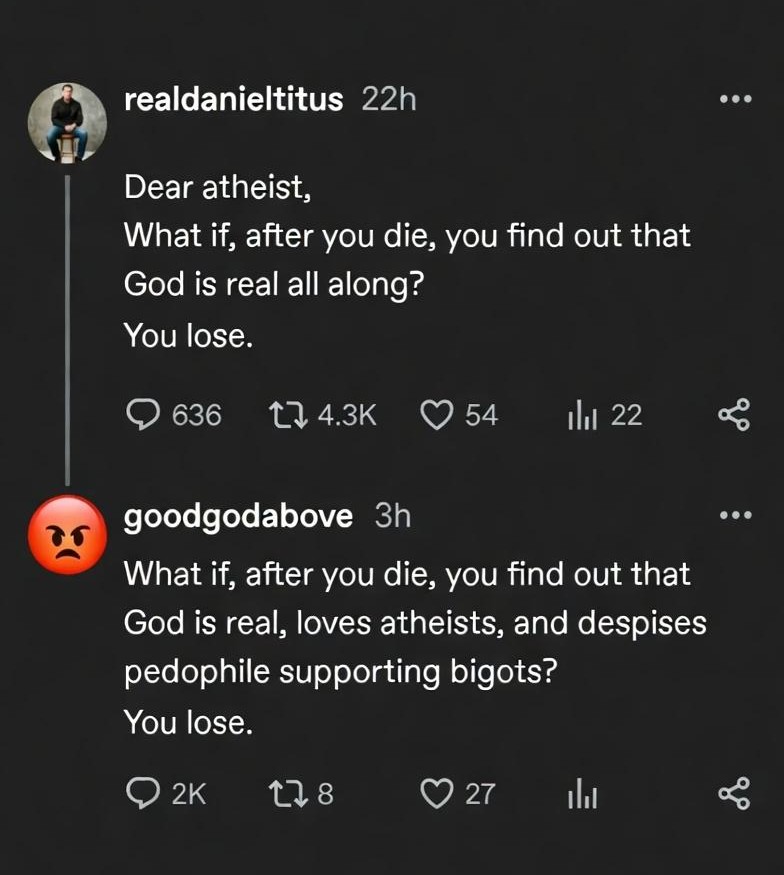
Pascals Wager was already stupid in the 17th century, it hasn't really improved in the 350 years since then. Why do we need to rehash this still.
The broad existential question was interesting. It's part of a conversation about tail risks and cost-benefit calculations that you can apply to much more than just religion.
What I find more interesting about Pascal's Wager, from a theological perspective, is the logical consequence. Namely, that you're obligated to find some kind of theological average between all known religious practices to maximize your own personal safety. And that theological average largely boils down to generic positive aphorisms -
Shit we should already know about and are inclined towards anyway. When you take a holistic view of religious studies, it peels away the pastiche and reveals the common truths of human existence. And Pascal's Wager, as a thought experiment, helps navigate people to this point from an abstract logical framework.
I think it falls under "those who don't know history are doomed to repeat it". Each one thinking their the first to come up with this scenario (or act like it, after they saw it online, tv, movie...) likely doesn't hold education (specifically history, philosophy, science, etc) in high regard.
"It's easier to fool someone than to convince them that they've been fooled."
People tend to develop biases when they are young and reinforce them when they get older.
If you cut across someone's bias, they tend to see that as your attempt to trick them. And they fall back on a body of knowledge/experience that contradicts your efforts. If you encounter someone without bias, it is easy to seed a bias through presentation of slanted perspectives and cherry-picked information when you are their primary source of truth. But if your audience reflexively distrusts you, it is comparatively difficult to reshape their beliefs. You tend to have more luck playing on their distrust of you.
As an example, if you have someone who is racist and fearful of young, strong, black men, it is relatively difficult to tamp down that anxiety when around a person like this who they find intimidating. It is comically easy for a person that fits the description - but who is otherwise cheerful, passive, and pleasant - to intimidate the bigot with idle threats or make a fool of them by playing against their presumptions.