Fuck Cars
A place to discuss problems of car centric infrastructure or how it hurts us all. Let's explore the bad world of Cars!
Rules
1. Be Civil
You may not agree on ideas, but please do not be needlessly rude or insulting to other people in this community.
2. No hate speech
Don't discriminate or disparage people on the basis of sex, gender, race, ethnicity, nationality, religion, or sexuality.
3. Don't harass people
Don't follow people you disagree with into multiple threads or into PMs to insult, disparage, or otherwise attack them. And certainly don't doxx any non-public figures.
4. Stay on topic
This community is about cars, their externalities in society, car-dependency, and solutions to these.
5. No reposts
Do not repost content that has already been posted in this community.
Moderator discretion will be used to judge reports with regard to the above rules.
Posting Guidelines
In the absence of a flair system on lemmy yet, let’s try to make it easier to scan through posts by type in here by using tags:
- [meta] for discussions/suggestions about this community itself
- [article] for news articles
- [blog] for any blog-style content
- [video] for video resources
- [academic] for academic studies and sources
- [discussion] for text post questions, rants, and/or discussions
- [meme] for memes
- [image] for any non-meme images
- [misc] for anything that doesn’t fall cleanly into any of the other categories
Recommended communities:
view the rest of the comments
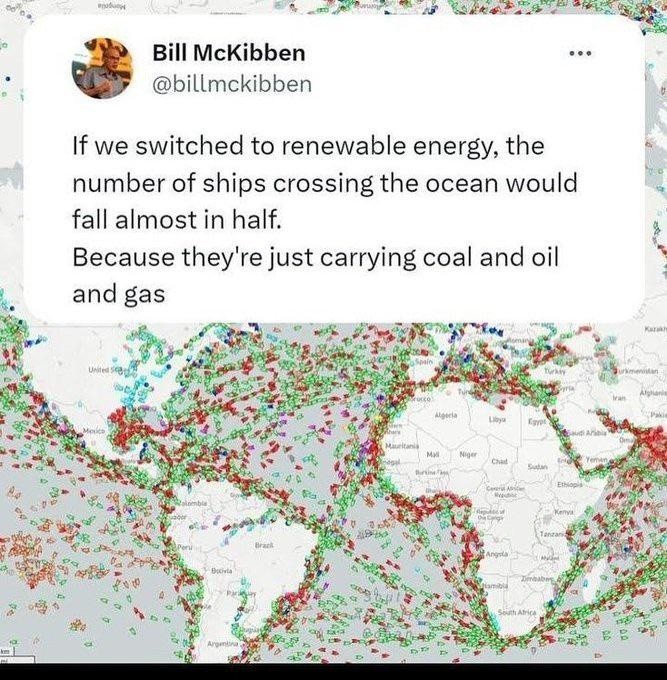
Going back to sails is a cool idea, but I don’t see how it’s viable, nor will batteries be. We’re going to need to settle on some sort of sustainable liquid fuel for a few uses like shipping and aviation.
Maybe this is even some good that can be driven by militaries
It was viable enough in the 1800s.
Yeah ... aviation in particular will probably be mainly fossil fuels for a long time to come, because it really needs energy density.
The solution there is just for people to fly less. (Which could be partially accomplished by having fast electric train routes.)
It was viable in the 1800s because it was the best method available. We don't use it today because it ultimately costs more. A wind-powered company would have to compete against others using extremely energy-dense fuels that enable hundreds of times more cargo (between increased speed and increased capacity) for the same time and money.
So, in other words, it's perfectly viable ... just not economically viable.
That's a failure of our economy, not of the technology. Perhaps if all the externalities of fossil fuel emissions were included in the cost of fossil fuel shipping (say, with massive taxes on fossil fuels to fund environmental efforts and carbon capture), that would change the balance.
That's like saying, "So it's perfectly possible ... just not physically possible." If you cannot afford to do something, then you can't do it. It's freaking tautological.
"Can't afford it" is very, very different than "not physically possible".
If our economic system changed, then it could be perfectly viable again.
If the only reason oil is being extracted is to power aviation, the cost of fuel, and hence of flying, will be higher and the volume of flights will go down accordingly. Win/win for everyone but the oil and tourist industries.