Fuck Cars
A place to discuss problems of car centric infrastructure or how it hurts us all. Let's explore the bad world of Cars!
Rules
1. Be Civil
You may not agree on ideas, but please do not be needlessly rude or insulting to other people in this community.
2. No hate speech
Don't discriminate or disparage people on the basis of sex, gender, race, ethnicity, nationality, religion, or sexuality.
3. Don't harass people
Don't follow people you disagree with into multiple threads or into PMs to insult, disparage, or otherwise attack them. And certainly don't doxx any non-public figures.
4. Stay on topic
This community is about cars, their externalities in society, car-dependency, and solutions to these.
5. No reposts
Do not repost content that has already been posted in this community.
Moderator discretion will be used to judge reports with regard to the above rules.
Posting Guidelines
In the absence of a flair system on lemmy yet, let’s try to make it easier to scan through posts by type in here by using tags:
- [meta] for discussions/suggestions about this community itself
- [article] for news articles
- [blog] for any blog-style content
- [video] for video resources
- [academic] for academic studies and sources
- [discussion] for text post questions, rants, and/or discussions
- [meme] for memes
- [image] for any non-meme images
- [misc] for anything that doesn’t fall cleanly into any of the other categories
Recommended communities:
view the rest of the comments
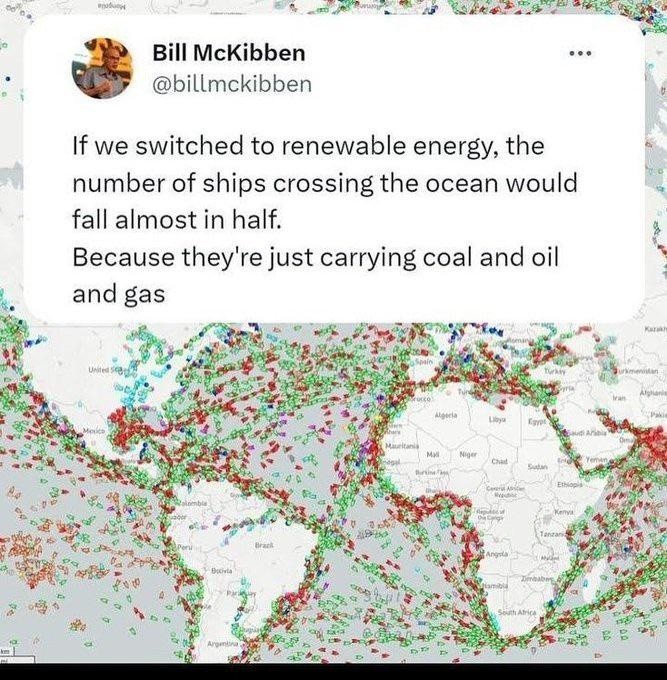
Once per installation per x years. While battery and solar replacement seem like a long time, the massive scale needed for a global buildout will require a continuous stream of shipping. It’s not free and will never be locally produced everywhere. Obviously a couple orders of magnitude less shipping, but energy related shipping is not disappearing entirely.
Actually I’d like to see someone do that math, out of curiosity. In a world with all renewables, does energy related shipping drop from 40% to 1%? 0.1%?
So, for estimation purposes, that's essentially no shipping compared to the present fossil-fuel situation.