this post was submitted on 10 Feb 2026
342 points (89.6% liked)
memes
19953 readers
2373 users here now
Community rules
1. Be civil
No trolling, bigotry or other insulting / annoying behaviour
2. No politics
This is non-politics community. For political memes please go to !politicalmemes@lemmy.world
3. No recent reposts
Check for reposts when posting a meme, you can only repost after 1 month
4. No bots
No bots without the express approval of the mods or the admins
5. No Spam/Ads/AI Slop
No advertisements or spam. This is an instance rule and the only way to live. We also consider AI slop to be spam in this community and is subject to removal.
A collection of some classic Lemmy memes for your enjoyment
Sister communities
- !tenforward@lemmy.world : Star Trek memes, chat and shitposts
- !lemmyshitpost@lemmy.world : Lemmy Shitposts, anything and everything goes.
- !linuxmemes@lemmy.world : Linux themed memes
- !comicstrips@lemmy.world : for those who love comic stories.
founded 2 years ago
MODERATORS
you are viewing a single comment's thread
view the rest of the comments
view the rest of the comments
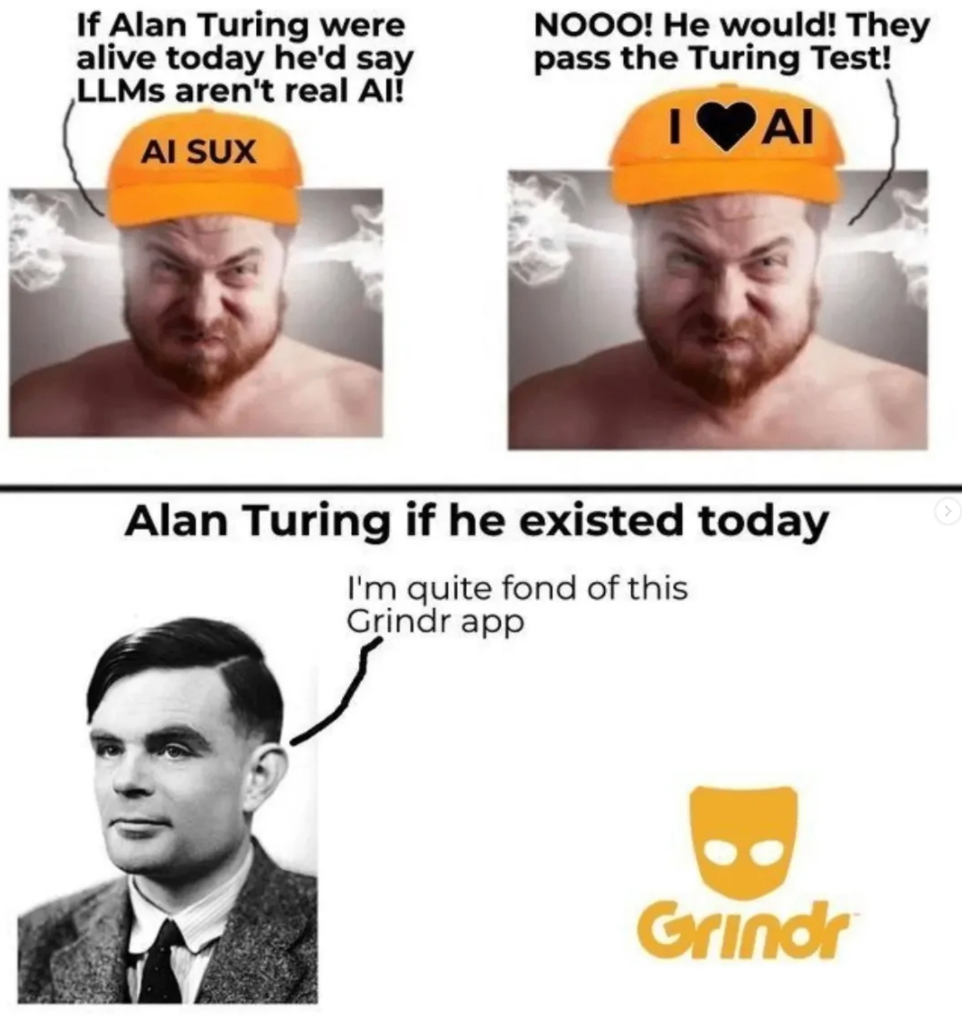
TBF most people don't understand his concept of a Turing Test. The test was an in-person interview with no set questions or time limit, simply a human expert taking as long as they needed to determine humanity.
Also if you look at the technology of his time, there was no reason to think there'd be this huge explosion of information enough that you'd be able to just stitch a hundred million books and petabytes of online forums' worth of text together into a statistical next token predictor.
In his time there were maybe at most 4 million publications in all of existence (extrapolating from https://www.clrn.org/how-many-books-have-been-published-in-history/ ) which finger-in-the-air estimate would be ~2Tb; a tiny fraction of what's on the internet now. Even if he'd anticipated the invention of the transistor and microchip technology, the brain he was imagining still would have had to be able to reason in the traditional way; an LLM trained entirely on Project Gutenberg would not come close to passing the Turing Test no matter how many parameters you built it with. To Turing, passing as human would have meant possessing a capacity of reason beyond assigning probability values to a list of potential autocompletes based on what's in all the other texts.
Fr, one of the best examples of this is if you take a classic riddle and add some minor change to it then LLMs will find it suddenly impossible to solve.
My favorite is making up a nonsense idiom for an llm to tell me the meaning of.
"What does it mean when someone says 'he's not your grandma but she can fix a canoo?'"
You're absolutely right!