381
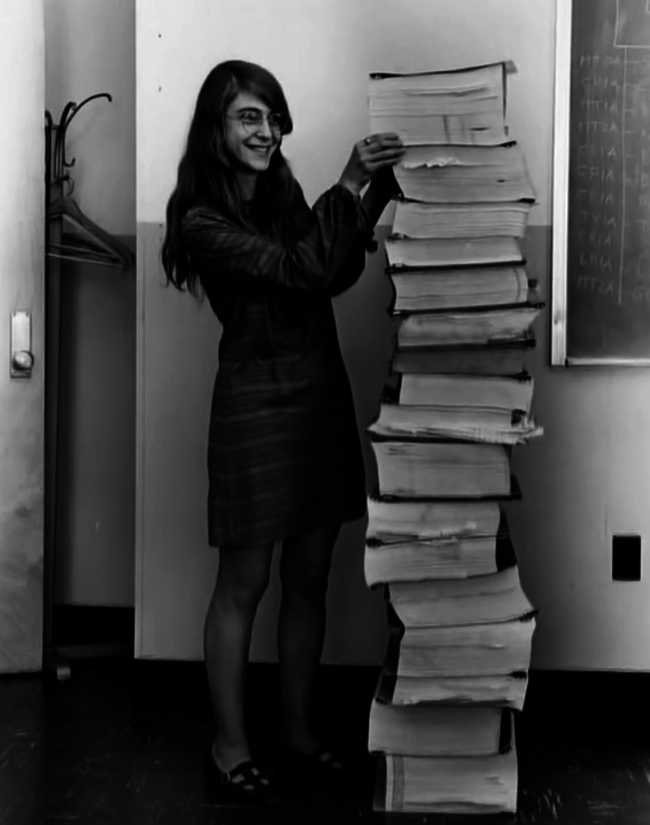
Computer scientist Margaret Hamilton with the extensive amount of code she and her team wrote to guide the NASA mission to the Moon, USA, 1969
(media.piefed.social)
HistoryPhotos is for photographs (or, if it can be found, film) of the past, recent or distant! Give us a little snapshot of history!
Rules
Related Communities:
They can't replicate many things straight from the blueprints because nobody produces those parts anymore. But take the AGC (Apollo Guidiance Computer) and the earthly counterparts: they can be replaced by modern technology. Like some guys recently did, they were working with a telemetry module that sent data from the rocket back to the earth. They did not have the earthly counterpart of it anymore, a wall of cabinets with electronics to receive and decode the data. They just replaced that wall of cabinets with a script running on a Raspberry Pi.
Oh that would be a really fun experience. If the code is available anywhere I'd love to turn it into Rust.
It is!
https://github.com/chrislgarry/Apollo-11
Note that it wasn't saved digitally, so this is reconstructed from paper and might have transcription errors
Well
There goes my Saturday
There are teams out there doing reconstruction of the AGCs. I mean, they have real ones there and try to figure them out. The most sophisticated "computer chips" on that thing are basic logic chips: 10 pins, two for power and ground (12V, IIRC), and 2x4 pins for three-input NOR gates. They used them for everything: building flip-flops for registers, adders, and other stuff to for a kind-of 16-bit computer.
There is loads of documentation out there on the net.