this post was submitted on 22 Nov 2025
233 points (100.0% liked)
History Memes
2381 readers
5 users here now
A place to share history memes!
Rules:
-
No sexism, racism, homophobia, transphobia, assorted bigotry, etc.
-
No fascism (including tankies/red fash), atrocity denial or apologia, etc.
-
Tag NSFW pics as NSFW.
-
Follow all Piefed.social rules.
-
History referenced must be 20+ years old.
Banner courtesy of @setsneedtofeed@lemmy.world
OTHER COMMS IN THE HISTORYVERSE:
- !historymusic@quokk.au
- !historygallery@quokk.au
- !historyruins@piefed.social
- !historyart@piefed.social
- !historyartifacts@piefed.social
- !historyphotos@piefed.social
founded 11 months ago
MODERATORS
you are viewing a single comment's thread
view the rest of the comments
view the rest of the comments
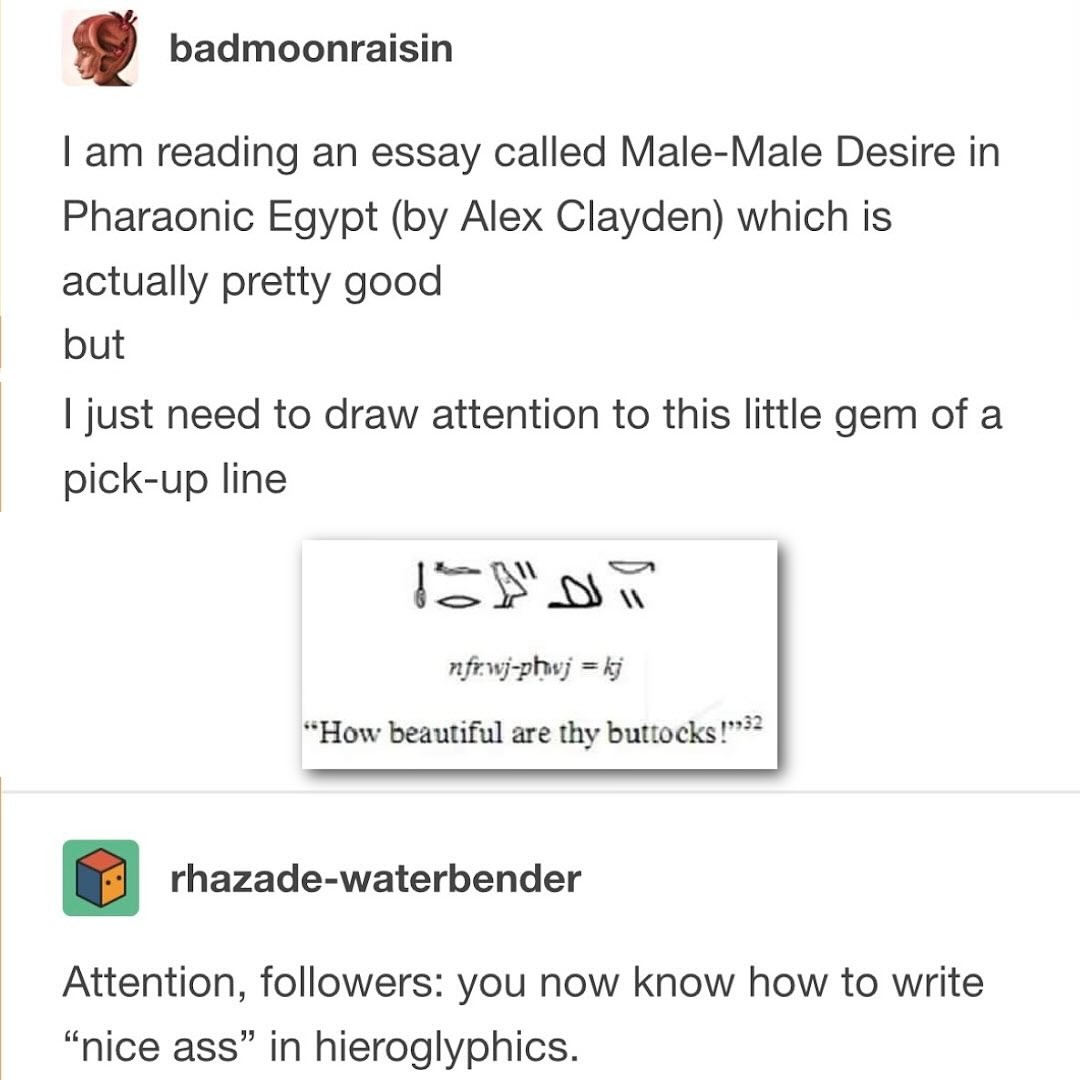
The paper is supposedly from 2012. Is it like a standard that academic texts translating ancient languages use the oldest possible form of the destination language or do people just do that to denote that the source is old?
I feel like there's a good argument that the more valid translation is the one that uses modern words and grammar.
There are a variety of reasons to use archaic terms like 'thy'. One is, legitimately, just stylization, something even academics are not immune to.
However, archaic terms like 'thy' are sometimes used in place of politenesses that have no direct English equivalent - some languages have pronouns which are, specifically, respectful or formal (such as the Spanish 'usted' - likewise translated by Hemingway, not an academic but a respected writer, in For Whom The Bell Tolls as 'thee' and 'thou').
I know nothing about Ancient Egyptian, but this could be either.
Vaguely related thought because I was reminded of this earlier: legend has it that German chancellor Helmut Kohl once told a foreign dignitary from an English-speaking country, in English: "You can say you to me." Which is at least weird in English but the German equivalent is perfectly cromulent because we have two words for "you": he was trying to signal friendship by offering the more familiar, friendly one.
Absurdly, a "correct" translation for what he was trying to say would've been: "Thou canst say thou to me."
(Worth noting that the story is apocryphal - although there's a cherished tradition of German politicians failing miserably at English)
"Ich bin ein Berliner"
It's weird how they turned into formal words. Weren't they familiar forms and "you" was formal?