this post was submitted on 19 Feb 2025
857 points (99.2% liked)
Programmer Humor
29749 readers
319 users here now
Welcome to Programmer Humor!
This is a place where you can post jokes, memes, humor, etc. related to programming!
For sharing awful code theres also Programming Horror.
Rules
- Keep content in english
- No advertisements
- Posts must be related to programming or programmer topics
founded 2 years ago
MODERATORS
you are viewing a single comment's thread
view the rest of the comments
view the rest of the comments
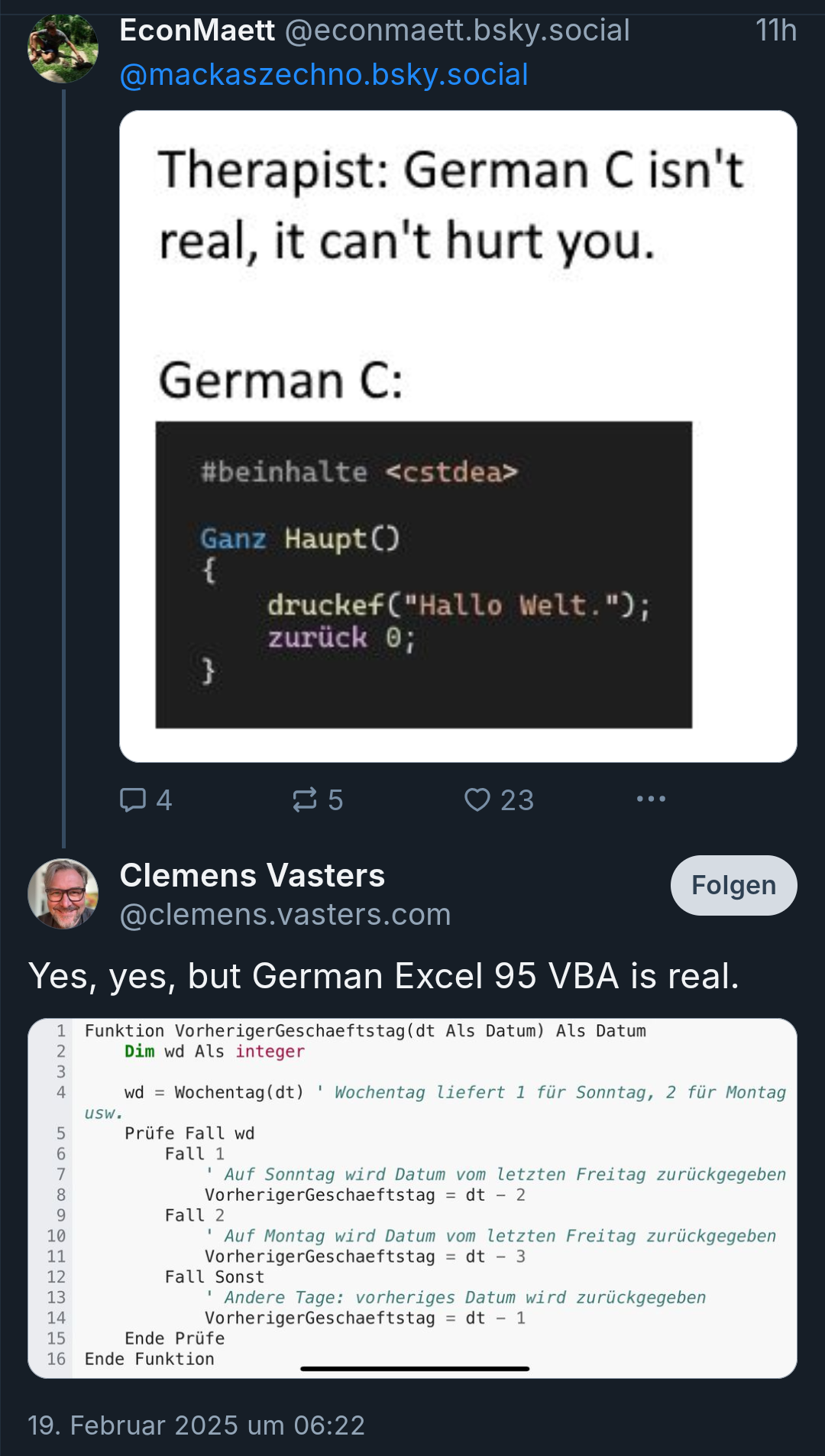
https://github.com/michidk/rost
Too bad that's based on macros. A full preprocessor could require that all keywords and names in each scope form a prefix code, and then allow us to freely concatenate them.
PETA isn't going to like all those
fürloopsFür is short for fuer. The umlauts are tiny "e" on top of the letters
That’s how umlauts historically evolved, but nowadays I wouldn‘t say ü short for ue, but its own letter (even though you still can write it as ue if you don’t have it available on your keyboard or whatever)
Well, my point is that it's not considered a u, and Austrian and Swiss don't use it.
Also, fun fact, some romance languages like French and Brazilian Portuguese have an identical diacritic to umlaut but it's different. It's meant to mean the vowel is separate (like in the word naïve)
We call it tréma. Aka diaeresis. It explicitly tells you to pronounce two vowels near each other separately.
A typical use is to indicate a normally silent vowel must be read out. For example "maïs" (MA-EE-S') is completely different from "mais" (MAY).
in Brazillian portuguese it had a completely different meaning, and it was used for disambiguation of the pronounciation of some words, in short "gue" in portuguese can make a ghe (gh as in ghost) or a gue (gu as in guatemala), a similiar thing happens with "que", this umlaug looklike was meant to make clear that the "u" was to be pronounced, so we had spellings like "freqüencia"
That's exactly the other meaning I described. In Portuguese it was/is used to separate the vowels so they are not pronounced together.
It's true that u and ü are very different things in German orthography, but it must be some bizarre misunderstanding that ü wouldn't be used in Austria or Switzerland, the largest city in Switzerland is even named Zürich in German (Züri in Swiss German).
TIL thanks !
I like the branch names auch
Bruh why does it feel more natural in German.