Hey! I worked at a place that made microgreens a while ago, so I might have some input to share:
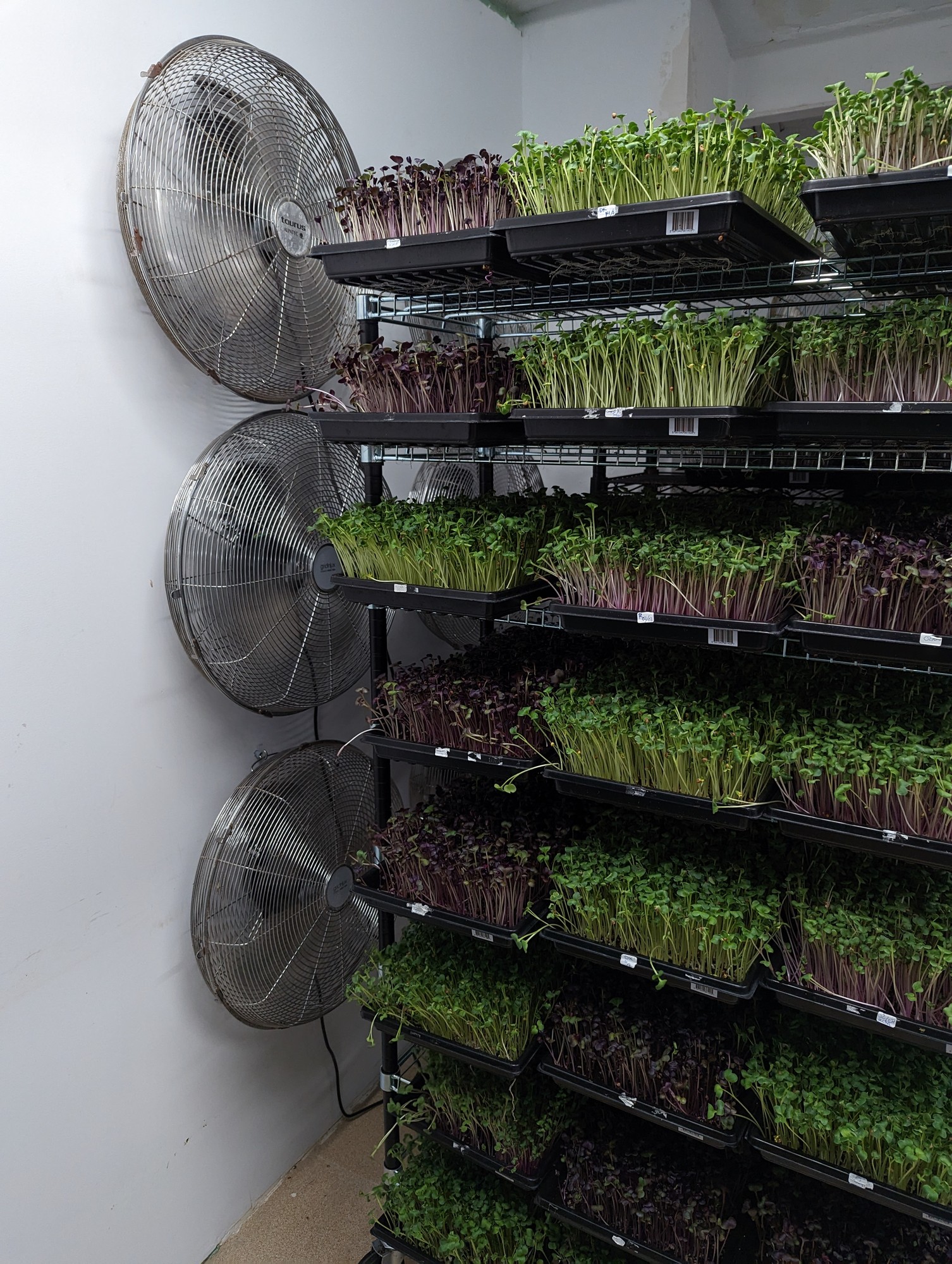
What helped us keep rotting minimal was, before starting to cut them, let them dry out in front of some fans for a while, not until completely dry/essiccated, but just until, when passing your hand through them, you don't get it wet/damp anymore.
below, a picture I still have of some grown daikon, purple and pink radish microgreens drying out, all to be cut for the day's deliveries:
After cutting them, we used big airtight plastic boxes to store them, but every ~3cm height of microgreens, we layered in some paper towels to keep absorbing moisture even when put inside the fridge. We could use them as-is for the day, or as stock for the next couple days' worth of orders, in which case we spread them out and let them air dry a bit (near a fan if necessary, but not directly in front of it) before individually boxing them up in smaller single use plastic boxes for the delivery.
It was not unusual to use friday afternoon's cuttings for monday morning's deliveries, and with the air dry step, the condensation formed inside the fridge was almost a non-issue. (we would still get the occasional bad batch that stank after just a day, but that's just the mold lottery for you)
We did all kinds of other microgreens too, btw, so feel free to ask anything :)
We never used hydrogen peroxide on radish, it was resistant enough on its own and we grew so much of it that a peroxide spray would cost way too much in both materials and man hours. We reserved it for the more delicate crops, like kale and red chard, where we would mist them with a diluted solution on seeding, when they were done sprouting, and any time they started to look wilty, but interestingly never before the harvest. I'm not sure if we just never thought about it or if it was detrimental, but it never seemed to be necessary.
For the really extremely sensitive plants, like basil, we sprayed them with a chitosan solution, a biopesticide which helps plants grow stronger and fight off fungal infections. Be careful if you want to try this though, get the "vegan"/artificially produced chitosan, because most of it is made from the shells of shrimp/crustaceans, which is a common allergy in some people. It is, of course, extremely expensive, even when used in diluted solutions like ours (5g/1L), so you should really keep it for other crops.
Side tangent aside, it certainly can help if you do the peroxide spray, but I'm worried that you're adding even more extra moisture, and without the drying step in front of a fan it could make them wilt faster (dry them!!! I know I'm hammering this point but if you're gonna take anything from this is to try drying them before cutting/harvesting)
I'm not sure how the paper clamshells work and interact in this, I don't have any experience with them as we unfortunately used single use plastic boxes for everything, but I'm sure you can figure something out. One tip I might have is, like we did, to cut and put them into large plastic airtight tupperware boxes with the paper towels every 3cm and blah blah... (what I said in my first message, I should really practice writing shorter texts and getting to the point :D ), and then putting them into the paper clamshells just before the delivery. The tupperware box, which stays with you, is then of course washable and reusable.