AmbitiousProcess
Is it Focal Golf?
Would look something like this, but... green, of course.


You could also check out this post on Atari Archive, this video by them too, and this collection of software you could search through using Ctrl + F and then "Golf". There's a lot of possible matches there.
There doesn't really seem to be a lot of actual playable options or even recordings of a lot of them, though.
To add to the security of the PIN and to prevent reading screen smudges you can enable an option so that the digits on the PIN pad are randomized each time it loads.
I can't believe I forgot to mention that! I use it myself, and while it can take a bit to get used to typing by actual numbers and not muscle memory, it's great for minimizing the risk of shoulder surfing.
Graphene also supports fully isolated user accounts.
And it supports stock Android's Private Space feature, too!
Yeah, Fairphone doesn't have a huge focus on security architecture, so a lot of GrapheneOS security features would not just be severely crippled, but would simply not be available at all.
Hey there, GrapheneOS user here!
They also allow you to get a new random MAC for every connection that you make (not sure whether this is very useful, as this can cause problems).
This can not only be turned off entirely in settings, but you can actually modify it on a per-network basis! For example, on my home network, I can tell it to use no randomized MAC at all, or a per-network randomized MAC, meaning it will choose a different MAC address than my normal one whenever I connect to my home network, but it will always be the same MAC on my home network, only changing on other networks.
They have their own reverse proxies that they use to talk to Google on your behalf when needed.
Which you can also disable if you don't want GrapheneOS to proxy any particular type of your data, and you'd rather it just go straight to Google instead for security reasons, even if you give up a little privacy.
Apparently, in the USA you can be compelled to provide a fingerprint or Face ID
BUT you cannot be compelled to provide a password/PIN.
Yep, however an important caveat is that if you're not a US citizen, you can still be compelled to give up your password or PIN, otherwise you'll be denied entry to the country. And, if you're a US citizen, you can have your phone seized and held for some time (i.e. months), even if you're then allowed entry to the country. (this is likely so the government can wait for an exploit to become known, or have more time to run a cracking algorithm that's computationally expensive)
GrapheneOS has a two-factor system where, after using your fingerprint, you still need to enter a PIN
Not enabled by default though! This can also be used within the OS itself. For example, I can set a PIN+Fingerprint access for my lockscreen, or PIN-only access, then still individually lock an app on my phone with a fingerprint without it also having to be enabled for my lockscreen. I'm unsure if that's supported on stock Android.
They also have a BFU state after reboot, which is the safest and requires you to enter your full passphrase
All phones have a BFU (before first unlock) state, and GrapheneOS doesn't require a passphrase unless you've set one, otherwise it's your PIN. Fingerprint unlock is disabled until after BFU though, so it requires essentially using a backup PIN even if you always use your fingerprint, at least for first unlock.
However, GrapheneOS is unique in that companies like Cellebrite, who sell the government hardware and software to crack people's phones and exfiltrate their sensitive data, have stated in leaked slides that they can't unlock GrapheneOS devices BFU, (if they're updated to at least security patches after 2022, which any GrapheneOS user reasonably should be) while they can crack stock Android devices BFU.
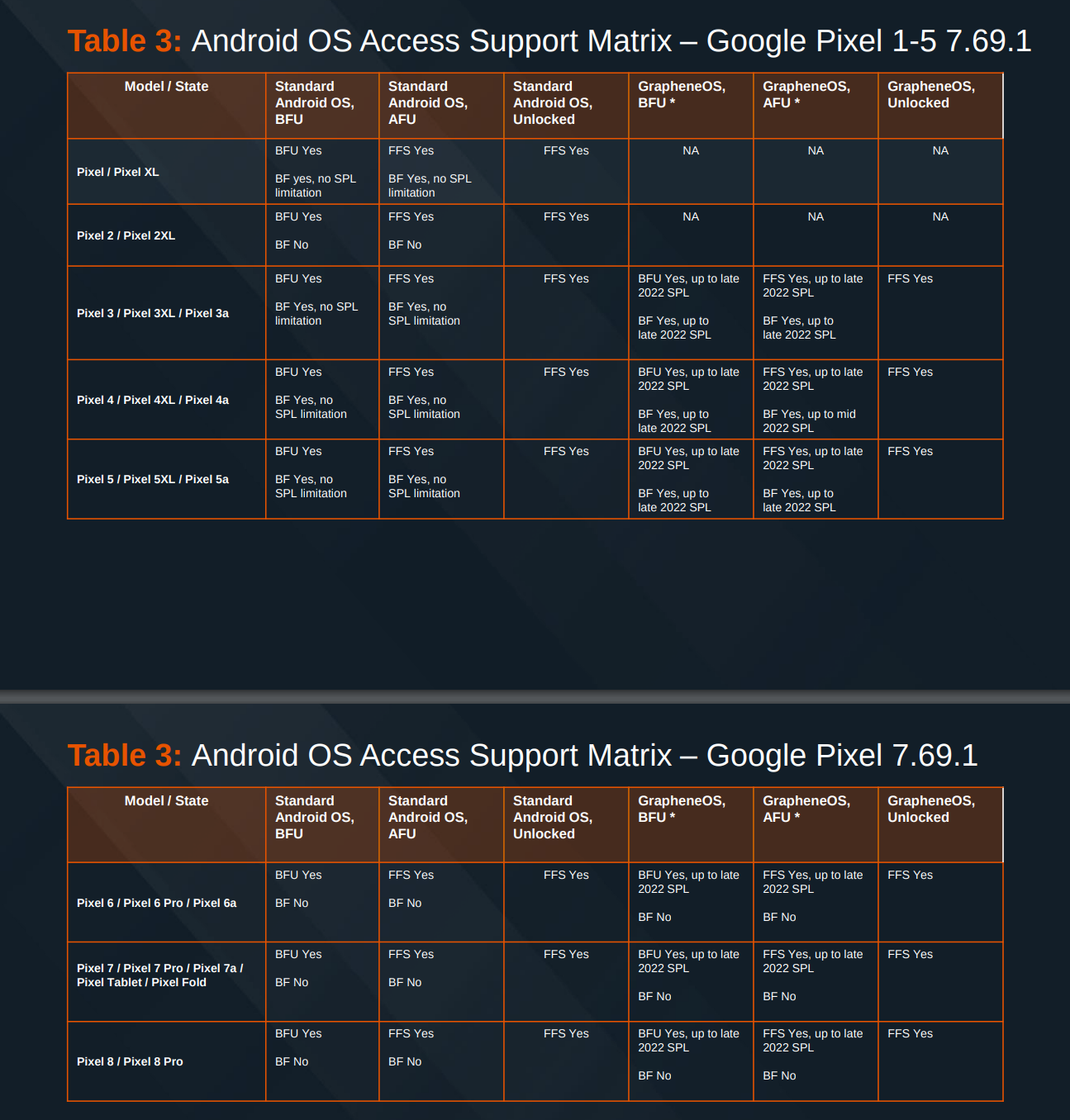
This is why I always make sure to fully shut down my phone before I go through airport security, for example. It's also possible to simply "Lockdown" the phone to disable biometrics again and require a PIN/Password like during BFU, but in that state the phone is not actually in a BFU state, so it's not fully protected.
even when WiFi/Bluetooth are “off,” stock Android can still scan in the background to improve location accuracy (by matching visible networks/devices against Google’s database). So basically, even with WiFi/Bluetooth off, Google still knows where you are. In GrapheneOS, this option is off by default.
There's a tiny bit more nuance to this. Your cell service will still be active even if you disable WiFi/Bluetooth, and that can still track you, even if it's not through Google's location services, since your carrier still gets pings from your phone.
GrapheneOS's airplane mode disables the cellular radio entirely, whereas some OEMs don't do that on their phones, even when you turn on airplane mode, meaning your cell provider could still triangulate your position regardless of if you have airplane mode on or off.
Also, GrapheneOS additionally supports a proxy service for more accurate GPS positioning, which can reduce the amount of data available to Google, even if you need more accurate positioning data using nearby networks.
Not a real quote, but funny nonetheless.
This article was posted January of this year.
In case anyone thinks this will bring any sort of immediate scrutiny, that should show you otherwise, given it's been nearly a year now with almost no coverage remaining in mainstream media or discourse.
They don't use local models yet, at least not for their existing AI chatbot sidebar feature. https://support.mozilla.org/en-US/kb/ai-chatbot
When you use a chatbot, you are agreeing to that provider’s privacy policies and terms of use. Each chatbot provider has their own terms of use and privacy policies. View the privacy policies and terms for providers in Firefox.
Some chatbots are more privacy-respecting than others.
True. I've found DuckDuckGo to still be pretty good though, especially for forum searches, at least in my experience.
I use Kagi now, which is even better, for me at least, but that's paid and I know most people aren't gonna shell out money every month for a search engine.
In my experience at least, there has not once been an instance where an LLM was able to find answers on Reddit more reliably than I could, and I've been using LLMs since before ChatGPT was even a thing. (though granted, most web-search compatible LLMs came later on)
I think it will probably be better than the average user, since a lot of people simply aren't that great at using search engines very effectively in the first place, but I wouldn't call the answers "practically impossible to find."
The problem is, it's not unobtrusive.
When I right click and I instantly get an option silently added to the list that sends data to an AI model hosted somewhere, which I've accidentally clicked due to muscle memory, it's not good just because there's also the option there to disable it. When I start up my browser after an update and I am instantly given an open sidebar asking me to pick an AI model to use, that's obtrusive and annoying to have to close and disable.
Mozilla has indicated they do not want to make these features opt-in, but opt-out. The majority of Mozilla users do not want these features by default, so the logical option is to make them solely opt-in. But Mozilla isn't doing that. Mozilla is enabling features by default, without consent, then only taking them away when you tell them to stop.
The approach Mozilla is taking is like if you told a guy you weren't interested in dating him, but instead of taking that as a "no." he took it as a "try again with a different pickup line in 2 weeks" and never, ever stopped no matter what you tried. It doesn't matter that you can tell him to go away now if he'll just keep coming back.
Mozilla does not understand consent, and they are violating the consent of their users every time they push an update including AI features that are opted-in by default.
For me it was Madalin Stunt Cars 2.
Played that shit all the time in the computer lab with my friends.