this post was submitted on 07 Apr 2026
20 points (91.7% liked)

Memes of Production

1475 readers
1311 users here now

Seize the Memes of Production

An international (English speaking) socialist Lemmy community free of the “ML” influence of instances like lemmy.ml and lemmygrad. This is a place for undogmatic shitposting and memes from a progressive, anti-capitalist and truly anti-imperialist perspective, regardless of specific ideology.

Rules:
Be a decent person.
No racism, sexism, ableism, homophobia, transphobia, zionism/nazism, and so on.

Other Great Communities:

founded 3 months ago
MODERATORS
 
top 6 comments
sorted by: hot top controversial new old
[–] PM_ME_VINTAGE_30S@anarchist.nexus 2 points 1 hour ago* (last edited 59 minutes ago) (1 children)

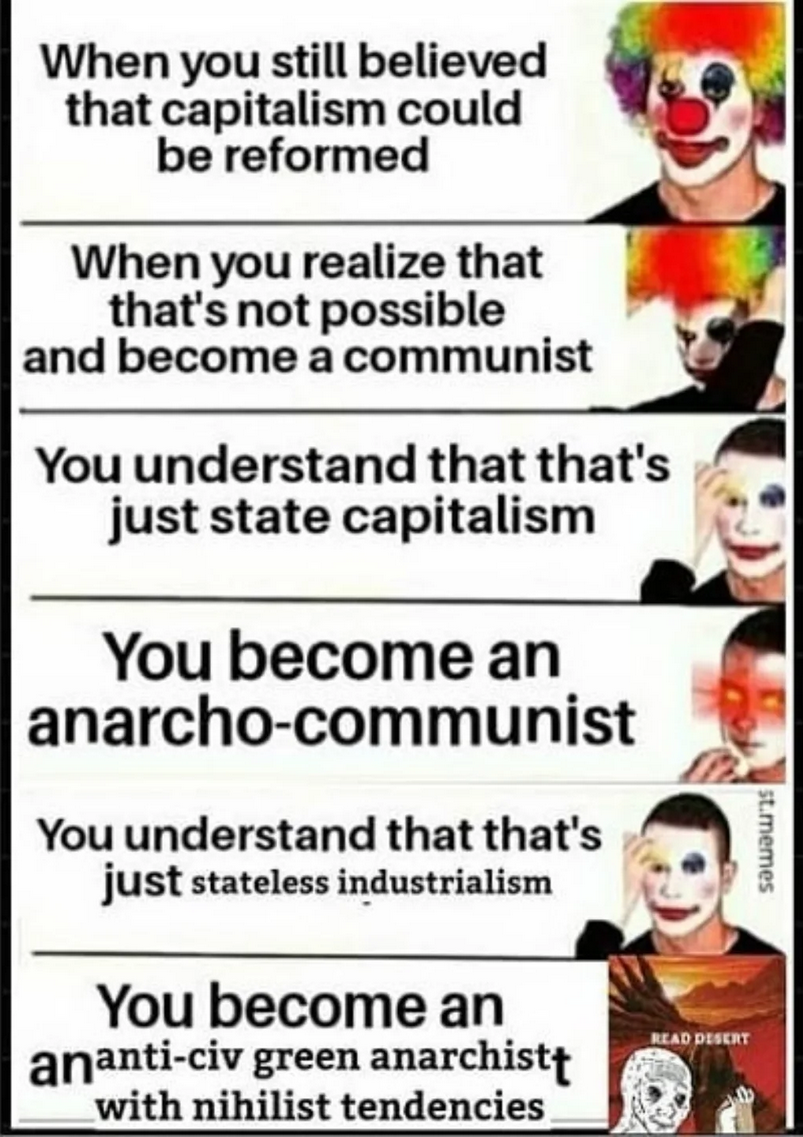
I mean I'm definitely biased as an engineering student, but I basically wanna do stateless anarchist industrial society, lmao. I think industrial technology can be incredibly liberatory if developed and used in horizontal, sustainable, ecologically respectful, and optional ways. E.g., precision medical devices, drug development, public mass transit, safe, reliable, and clean electrical power, electronic libraries, comfortable housing, the Internet, weather prediction, precision ecology, etc., under conditions of free association, equality, and worker-owned means of production.

I think that the "dirty" character of industry is a better reflection of the STEMlords that dominate the field than the real possibilities that industrial society can give us. Similarly its capitalist character is a consequence of who was in power (the capitalist class) when humanity figured out industrial technologies.

[–] Deceptichum@quokk.au 1 points 39 minutes ago* (last edited 29 minutes ago)

You can have technology and environment. We don’t need millions of factories across the planet spewing countless shit into the ecosystem.

Anti-Civ/Green Anarchy isn’t AnPrim where we go live as cave men with nothing, it’s reassessing our relationship with production and choosing sensible uses focused on minimising harm.

[–] PugJesus@piefed.social 2 points 1 hour ago (1 children)

Not the biggest fan of dying, personally.

[–] Deceptichum@quokk.au 0 points 1 hour ago (1 children)

Funny I don’t see any mention of that on there.

But don’t fret the pollution, microplastics, and global warming have all but guaranteed an early death for billions.

[–] PugJesus@piefed.social 1 points 1 hour ago* (last edited 40 minutes ago) (1 children)

Funny I don’t see any mention of that on there.

Anti-civ implies it weakly, Desert, which advocates for primitivism and accelerationism, implies it strongly.

But don’t fret the pollution, microplastics, and global warming have all but guaranteed an early death for billions.

I might be of the controversial opinion that those are also bad.

The question is, which is worse? The average life expectancy being reduced from ~75 to ~60 by unaddressed industrial concerns, assuming we continue to fail to address them (admittedly not an unfair position, considering that we haven't addressed them adequately so far)? Or the average life expectancy being reduced from ~70 to ~30 by the complete collapse of all modern technology and the regression to a subsistence lifestyle?

That is, of course, assuming we aren't including the necessary initial population collapse from ~8 billion or so people to less than 1 billion. That death toll might skew the averages a little lower.

Opposing one disaster does not require embracing another.

[–] Deceptichum@quokk.au 1 points 29 minutes ago* (last edited 15 minutes ago)

. . . Desert doesn’t advocate for primitivism or accelerationism? No offence, but it’s clear you’ve not read it.

There is no primitivism, the world is too damaged for such a life and there is no accelerating what it already happening. If anything it argues for the slow crash, where humans desperately clutch at survival and try to hold onto normal as long as possible.

Desert is about what happens during and after ecological collapse from climate change. It’s about the formation of hubs of holdout and people living in the edges of authority and dead ecology.

It’s about understanding that there is no global revolution to save us, that we won’t invent the super technology to undo the damage, and instead gives a hypothetical look at how people might survive and adapt to a new world from an anarchist and historical perspective.