this post was submitted on 28 Feb 2026
1 points (60.0% liked)
otherworldly
42 readers
11 users here now
Your hub for paranormal, conspiracy, urban explore and extraterrestrial. Have fun and be nice.
founded 2 weeks ago
MODERATORS
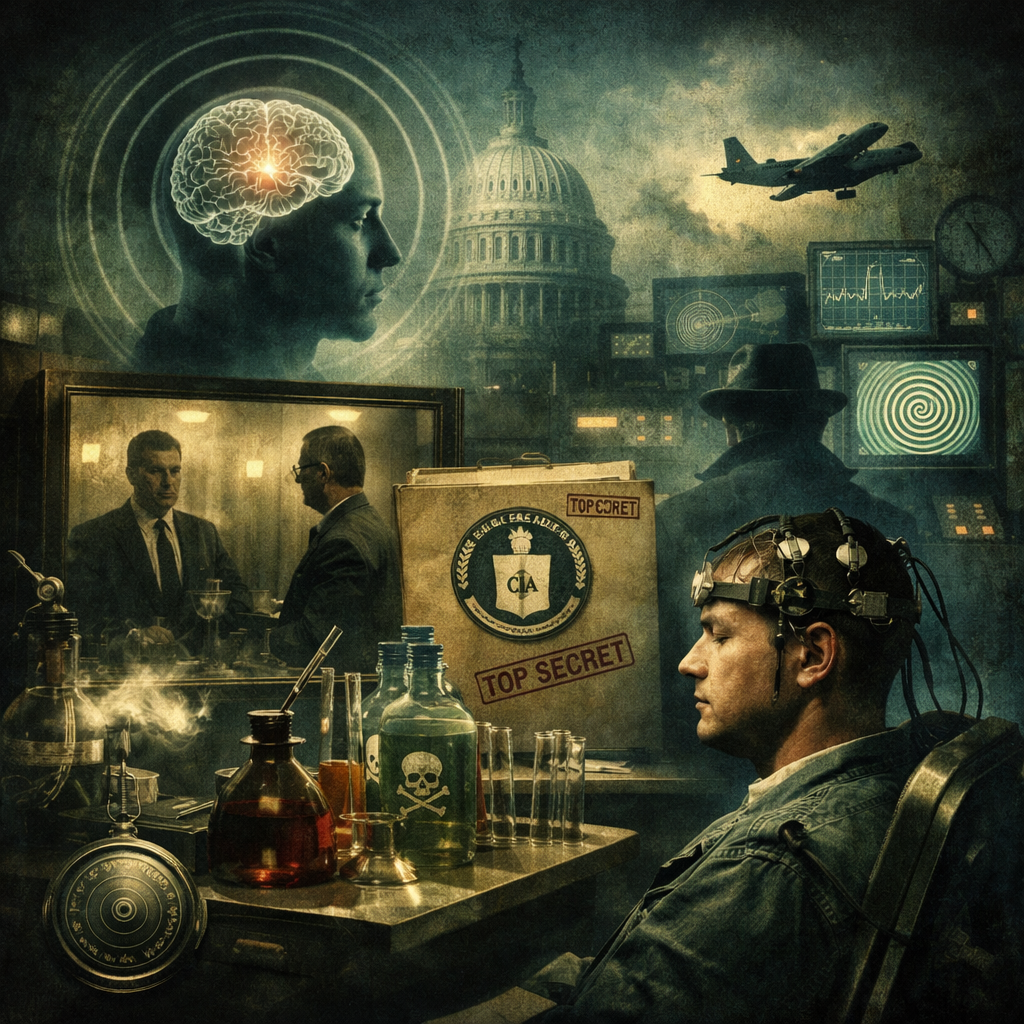
Project ARTICHOKE was a covert Central Intelligence Agency initiative formally established in August 1951 as a continuation and expansion of earlier behavioral research conducted under Project BLUEBIRD. Emerging at the height of early Cold War tensions, ARTICHOKE must be understood within a broader geopolitical atmosphere characterized by intense ideological rivalry, rapid militarization, and widespread fears of psychological warfare. American policymakers in the late 1940s and early 1950s believed that adversarial regimes—particularly the Soviet Union, the People’s Republic of China, and North Korea—were developing sophisticated techniques capable of altering belief systems, extracting secrets, and coercing behavior through psychological manipulation. The Korean War intensified these anxieties. Publicized confessions by American prisoners of war, some of whom appeared to cooperate with communist authorities, were interpreted domestically as evidence of systematic “brainwashing.” Whether these interpretations were empirically accurate or exaggerated by Cold War rhetoric, they profoundly shaped U.S. intelligence priorities. Within this context, ARTICHOKE emerged as an institutional attempt to investigate whether psychological control could be defended against, replicated, or weaponized.
Project BLUEBIRD, approved in 1950, initially focused on defensive objectives. CIA leadership sought to determine whether agency personnel could be conditioned to resist hostile interrogation and whether pharmacological or hypnotic techniques could enhance memory protection. Early memoranda reveal concern about safeguarding classified information and ensuring that captured operatives would not disclose sensitive material under duress. However, the line between defensive and offensive inquiry quickly blurred. By 1951, internal documentation shows that the program’s scope expanded to include the deliberate induction of amnesia, the exploration of behavioral modification through suggestion, and the evaluation of interrogation techniques designed to weaken resistance. The renaming of BLUEBIRD to ARTICHOKE in August 1951 symbolized this broadening mandate. Organizational responsibility shifted from the Office of Scientific Intelligence to the Inspection and Security Office, suggesting that behavioral research was becoming integrated into operational security planning rather than remaining purely exploratory science.
ARTICHOKE’s stated objectives, as later summarized in Senate investigations, included determining whether individuals could be induced to perform acts against their will, whether memory could be altered or erased, and whether interrogation effectiveness could be enhanced through the strategic use of drugs and hypnosis. The program’s internal communications frequently referenced “special interrogation” methods, a term encompassing pharmacological, psychological, and environmental techniques intended to increase suggestibility and compliance. Importantly, ARTICHOKE did not present itself internally as a quest for mystical mind control; rather, it was framed as pragmatic research into the limits of human resistance under stress and chemical influence. Nevertheless, some surviving memoranda reveal speculative ambitions that extended beyond conventional interrogation into the realm of deliberate behavioral programming.
Pharmacology formed a central pillar of ARTICHOKE research. Agency officials investigated barbiturates such as sodium pentothal, long colloquially described as “truth serums,” based on the belief that such depressants could lower inhibitions and facilitate disclosure. However, the limitations of barbiturates were well known even at the time; while they might reduce anxiety, they did not guarantee truthful responses and could increase confabulation. Consequently, ARTICHOKE personnel explored combinations of depressants and stimulants, hypothesizing that a stimulant such as amphetamine could counteract excessive sedation while preserving suggestibility. Surviving memoranda describe experimental procedures involving the administration of sodium pentothal followed by stimulant compounds, with hypnosis layered atop the drug-induced state. These combined approaches were referred to as “narco-hypnosis,” reflecting the belief that pharmacological disinhibition might deepen hypnotic responsiveness.
Hypnosis itself attracted sustained interest within ARTICHOKE. CIA officials consulted psychiatrists and psychologists to evaluate whether hypnotic induction could reliably produce compliance or memory modification. Hypnotic regression was studied as a means of eliciting past experiences, while post-hypnotic suggestion was examined for its potential to implant instructions triggered under specific conditions. Some memoranda discuss the possibility of creating amnesia barriers, whereby a subject would perform an action without conscious recall of its origin. Of particular historical note is a 1954 memorandum raising the question of whether an individual could be conditioned to carry out an assassination attempt involuntarily. Although no evidence indicates successful implementation of such conditioning, the memorandum demonstrates the speculative boundaries of ARTICHOKE inquiry. The program was not merely concerned with extracting information but also with assessing whether behavior itself could be externally directed.
ARTICHOKE also extended beyond laboratory-style experimentation into overseas operations. Declassified materials and later congressional testimony reveal that CIA teams traveled abroad to observe or participate in interrogations employing drugs and hypnosis. These activities frequently occurred in cooperation with allied intelligence services. The specific locations and numbers of subjects involved remain unclear due to incomplete records. While some documents reference volunteer participants under controlled conditions, other evidence suggests that at least some interrogations abroad may not have involved fully informed consent. The fragmented archival record complicates definitive assessment, but the possibility of coercive application has shaped subsequent ethical evaluations of the program.
The intellectual climate of the early 1950s further contextualizes ARTICHOKE. Behavioral sciences were undergoing significant transformation, with increasing interest in psychoactive substances, trauma psychology, and memory processes. Simultaneously, public discourse about communist “brainwashing” fueled perceptions that adversaries had mastered techniques of psychological conversion. American intelligence officials interpreted ideological reeducation in China and confessions in North Korea as evidence of systematic behavioral engineering. These interpretations were not always grounded in rigorous scientific analysis; nevertheless, they generated institutional urgency. The CIA sought not only to counter perceived hostile techniques but to ensure that it was not strategically disadvantaged in the psychological domain. ARTICHOKE thus reflects the intersection of emerging behavioral science and geopolitical fear.
In 1953, the CIA established Project MKULTRA, a far more expansive umbrella program encompassing numerous subprojects related to drugs, hypnosis, sensory deprivation, and interrogation techniques. ARTICHOKE overlapped with MKULTRA and was gradually absorbed into its broader structure. Many of the methods explored under ARTICHOKE continued under MKULTRA sponsorship, including experiments with hallucinogens such as LSD. Official CIA accounts later stated that ARTICHOKE ended in 1956, yet documentation after 1953 becomes sparse. The destruction of many MKULTRA-related files in 1973 under Director Richard Helms severely limits the archival record. As a result, historians must reconstruct ARTICHOKE primarily through surviving memoranda and retrospective Senate investigations.
Public awareness of ARTICHOKE emerged during the 1975–1976 investigations of the U.S. Senate Select Committee to Study Governmental Operations with Respect to Intelligence Activities, commonly known as the Church Committee. The hearings exposed the existence of BLUEBIRD, ARTICHOKE, and MKULTRA, revealing patterns of drug experimentation and interrogation research conducted without comprehensive oversight. Although MKULTRA attracted greater public attention due to its broader scope and documented use of LSD on unwitting subjects, ARTICHOKE was identified as a conceptual predecessor. Senate investigators emphasized the absence of clear legal frameworks governing such experimentation and highlighted the ethical implications of conducting behavioral research in secret.
The Church Committee’s findings underscored deficiencies in institutional accountability. Intelligence agencies operated under broad national security mandates, and behavioral experimentation was justified as a defensive necessity. However, the Senate concluded that oversight mechanisms were insufficient and that some experiments had likely violated ethical standards. The Nuremberg Code, established after World War II to regulate human experimentation, required voluntary consent and minimized harm. Whether ARTICHOKE consistently adhered to these principles remains uncertain due to incomplete documentation. Nevertheless, the ambiguity itself became a subject of criticism, reinforcing calls for greater transparency and legal constraint in intelligence operations.
Historiographically, ARTICHOKE presents formidable challenges. The destruction of records, heavy redaction, and reliance on internal memoranda complicate efforts to determine scope and effectiveness. No reliable evidence indicates that ARTICHOKE achieved consistent or replicable behavioral control. Instead, the surviving record suggests exploratory experimentation marked by inconsistent results and speculative ambitions. The program appears to have generated more questions than answers regarding the limits of pharmacological and hypnotic influence. Scholars have therefore interpreted ARTICHOKE less as a successful mind-control initiative than as an institutional response to perceived psychological threats.
The legacy of Project ARTICHOKE lies in its demonstration of how national security fears can expand the boundaries of permissible research. It reflects a period when behavioral science was viewed as a strategic frontier and when secrecy insulated experimentation from public scrutiny. By examining ARTICHOKE, historians gain insight into the dynamics of Cold War intelligence culture, the interplay between science and policy, and the ethical risks inherent in clandestine experimentation. Although the program did not produce verified breakthroughs in involuntary behavioral control, it contributed to a broader institutional framework that culminated in MKULTRA and shaped subsequent debates about government authority and human rights.
In sum, Project ARTICHOKE was an early CIA initiative focused on pharmacological and hypnotic techniques intended to influence cognition and behavior. It emerged from Cold War anxieties about brainwashing and psychological warfare, evolved from Project BLUEBIRD, overlapped with MKULTRA, and operated in a context of limited oversight. Its historical significance rests not on demonstrated success but on what it reveals about the convergence of security imperatives, emerging behavioral science, and ethical ambiguity during one of the most volatile periods of the twentieth century.
Links
Below are authoritative sources and archival materials relevant to Project ARTICHOKE and its broader context:
U.S. Senate (Church Committee) Records • Senate Select Committee to Study Governmental Operations with Respect to Intelligence Activities (1975–1976) – Hearings and reports on MKULTRA, BLUEBIRD, and ARTICHOKE https://www.intelligence.senate.gov/resources/intelligence-related-committees/church-committee
Declassified CIA Documents • CIA FOIA Electronic Reading Room (search “Project ARTICHOKE” or “Project BLUEBIRD”) https://www.cia.gov/readingroom/
National Security Archive (George Washington University) • Declassified memoranda referencing ARTICHOKE and narco-hypnosis https://nsarchive.gwu.edu/
U.S. National Archives (NARA) • Intelligence records collections, including Cold War CIA materials https://www.archives.gov/research
Inspector General Report on MKULTRA (1963, declassified portions) • CIA Inspector General’s Survey of MKULTRA (relevant overlap with ARTICHOKE) Available via CIA Reading Room or National Security Archive
Church Committee Final Report (Book I & Book II excerpts) • Government Printing Office (archival PDF copies available via official government archives)
If you’d like, I can format this in formal academic bibliography style (Chicago, APA, or MLA).
there doesn't seem to be anything here