this post was submitted on 17 Feb 2026
251 points (99.6% liked)

History Memes

2368 readers
2 users here now

A place to share history memes!

Rules:

  1. No sexism, racism, homophobia, transphobia, assorted bigotry, etc.

  2. No fascism (including tankies/red fash), atrocity denial or apologia, etc.

  3. Tag NSFW pics as NSFW.

  4. Follow all Piefed.social rules.

  5. History referenced must be 20+ years old.

Banner courtesy of @setsneedtofeed@lemmy.world

OTHER COMMS IN THE HISTORYVERSE:

founded 11 months ago
MODERATORS
 
all 18 comments
sorted by: hot top controversial new old
[–] PugJesus@piefed.social 34 points 1 month ago (1 children)

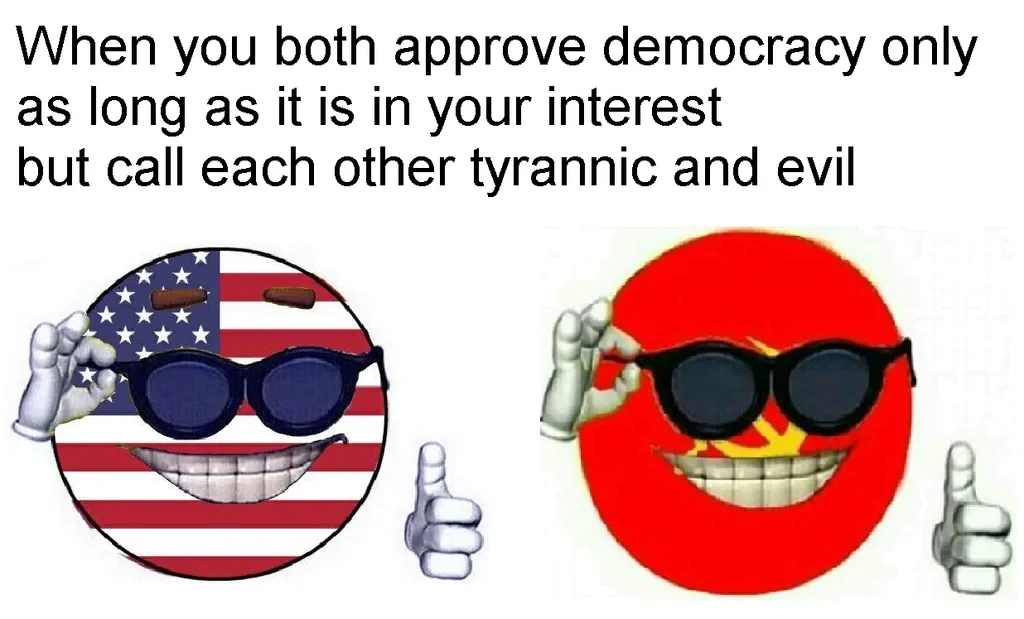
Explanation: For those who are unaware, during the 1950s-1980s, the USA and USSR engaged in what is generally called the Cold War wherein both sides played very 'ugly' games of realpolitik, even by the already-low moral standards of international politics, in order to make sure that as many countries were ruled by "Good Tribe" and against "Bad Tribe" as possible.

Both the USA and USSR claimed to be fighting for democracy. The USA's claim had more validity at first glance, as the USSR was a single-party state which ran mostly single-candidate elections; while the US, for all of its flaws, did run elections with genuine competition. However, in terms of affecting foreign affair policy, this had only a small effect at best. The USA was largely happy to support brutal, genocidal dictators who scoffed at the notion of elections, just as the USSR was.

[–] Auster@thebrainbin.org 2 points 1 month ago (2 children)

On that point, wasn't 1984 the book initially forbidden on both countries?

[–] PugJesus@piefed.social 14 points 1 month ago (1 children)

Not to my knowledge. The (largely real) artistic freedom offered by the USA was actually a major propaganda tool the US government used.

[–] Auster@thebrainbin.org 3 points 1 month ago (1 children)

By the way, this false notion of freedom, it feels like it had been planted since at least the cold war. As more and more problems come to light, as a journalist from my country, Alexandre Pittoli, would say, "we thought we had (freedom), until we needed it". But as another countryman, analyst Diogo Forjaz, would say, those that would benefit from those issues miscalculated the power of the internet.

[–] rumschlumpel@feddit.org 6 points 1 month ago* (last edited 1 month ago)

I feel like the internet is rapidly on the way to lose its freedom-promoting advantages. Just another avenue for authoritarian propaganda and control. And even before that, it's not like the internet's lawless state in the early 2000s and 2010s were the hayday of left-of-center governance in most western countries.

[–] Sgt_choke_n_stroke@lemmy.world 1 points 1 month ago (1 children)
[–] rumschlumpel@feddit.org 9 points 1 month ago* (last edited 1 month ago)

In the US, it gets removed from libraries, but that's not quite the same as banning it. No one is going to kick down your door, search your house, confiscate the book and possibly throw you in prison (or worse) for owning it. Might change soon, though.

[–] LemmyBruceLeeMarvin@lemmy.ml 2 points 1 month ago (1 children)

Was it in Cuba's interest to help stop Apartheid in South Africa by fighting in Angola?

[–] PugJesus@piefed.social 8 points 1 month ago (1 children)

"Was it in Cuba's interest to assist the foreign affairs policy of its patron on whom their economic survival entirely depended?"

Yes. Next question.

[–] LemmyBruceLeeMarvin@lemmy.ml 3 points 1 month ago (1 children)
[–] PugJesus@piefed.social 1 points 1 month ago (1 children)

How?

... because their economic survival depended on the maintenance of a 'useful' relationship with the overlord polity. How much simpler can I phrase it? Do I need to make it a children's book for you to understand?

[–] LemmyBruceLeeMarvin@lemmy.ml 2 points 1 month ago (1 children)
[–] PugJesus@piefed.social 1 points 1 month ago (1 children)

... would you like to share with the class at what price, relative to market price, the Soviet Union paid for Cuban sugar?

[–] LemmyBruceLeeMarvin@lemmy.ml 1 points 1 month ago (1 children)

Soooooo.... Cuba helped stop apartheid in south Africa so they could sell sugar to the Soviet union? I guess they send doctors to poor neighborhoods in south America so they can, uh, sell rum?

[–] PugJesus@piefed.social 1 points 1 month ago

Soooooo…. Cuba helped stop apartheid in south Africa so they could sell sugar to the Soviet union?

Cuba assisted an authoritarian regime in Angola in destroying its opposition, including other leftists, because strengthening the hand of its bloc and maintaining positive relations with their overlord was key to its own survival, yes.

I guess they send doctors to poor neighborhoods in south America so they can, uh, sell rum?

... those doctors who are paid by the national governments of their host country at much higher rates than they receive in Cuba, but wherein the Cuban government seizes most of that pay for the government coffers?

That's what charity looks like to you? Hiring out your own professionals who are contractually restricted from seeking independent work, and then pocketing the vast majority of money they earned? You really are a regular capitalist, aren't you? Rockefeller would be proud.

[–] ruuster13@lemmy.zip 1 points 1 month ago (1 children)

It's a privilege to even consider the moral framework in which a country's government operates. All animal life is more used to brutality and domination over diplomacy. The risk in OP's arguments - and the modern left generally - is that we expect moral perfection of government. We can see and imagine an idealistic "Star Trek" future, and it makes perfect sense to you and me, but it's not the current reality. In order to continue progressing, we have to slow down and examine the primal drives of conservatism. These impulses will tear down any and all system if it no longer helps conservative-leaning people feel safe and secure in a changing existence.

[–] rumschlumpel@feddit.org 5 points 1 month ago

I didn't think that expecting a nominally democratic government to not support dozens of genocidal dictators was a particularly high bar.