There's a joke here somewhere about how you should master your boot record
this post was submitted on 24 Jan 2026
80 points (100.0% liked)
Technology
84597 readers
3950 users here now
This is a most excellent place for technology news and articles.
Our Rules
- Follow the lemmy.world rules.
- Only tech related news or articles.
- Be excellent to each other!
- Mod approved content bots can post up to 10 articles per day.
- Threads asking for personal tech support may be deleted.
- Politics threads may be removed.
- No memes allowed as posts, OK to post as comments.
- Only approved bots from the list below, this includes using AI responses and summaries. To ask if your bot can be added please contact a mod.
- Check for duplicates before posting, duplicates may be removed
- Accounts 7 days and younger will have their posts automatically removed.
Approved Bots
founded 2 years ago
MODERATORS
I heard he tried to boot from the white album but there were some bugs in it.
The version that finally worked must have been Number nine. Number nine. Number nine. Number nine
I wish I had the kind of time and money required for effing around like this.
Knowledge saves time, this dude is probably a good hardware engineer already
This should be a fun little detail in a movie or something like that, but booting is just loading data, and doing that from analog media is nothing new.
edit: tbf, the author points that out, too. It's just a little joke.
Nah, the data just sounds better on vinyl. Especially if you use valves instead of silicon transistors.
If you don't use 1000 eur gold plated RCAs, it just doesn't sound right...
I heard if you play the record backwards it boots you into Windows ME.
Edit: don't see the problem anymore.
Maybe your system clock is out of sync? And it's from 2020/2022. I guess it's fine to just copy it over then.
Booting from a vinyl record
Most PCs tend to boot from a primary media storage, be it a hard disk drive, or a solid-state drive, perhaps from a network, or – if all else fails – the USB stick or the boot DVD comes to the rescue… Fun, eh? Boring! Why don’t we try to boot from a record player for a change?
©
64 512 byte DOS boot disk on a 10″ record, total playing time 06:10 on 45 rpm


Update February 2022: Click here to observe the very same vinyl ramdisk booted on an IBM PCjr!
So this nutty little experiment connects a PC, or an IBM PC to be exact, directly onto a record player through an amplifier. I made a small ROM on-chip boot loader that operates the built-in “cassette interface” of the PC (that was hardly ever used), which will now be invoked by the BIOS if all the other boot options fail, i.e. floppy disk and the hard drive. The turntable spins an analog recording of a small bootable read-only RAM drive, which is 64K in size. This contains a FreeDOS kernel, modified by me to cram it into the memory constraint, a micro variant of COMMAND.COM and a patched version of INTERLNK, that allows file transfer through a printer cable, modified to be runnable on FreeDOS. The bootloader reads the disk image from the audio recording through the cassette modem, loads it to memory and boots the system on it. Simple huh?
The vinyl loader code, in a ROM
(It can also reside on a hard drive or a floppy, but that’d be cheating)
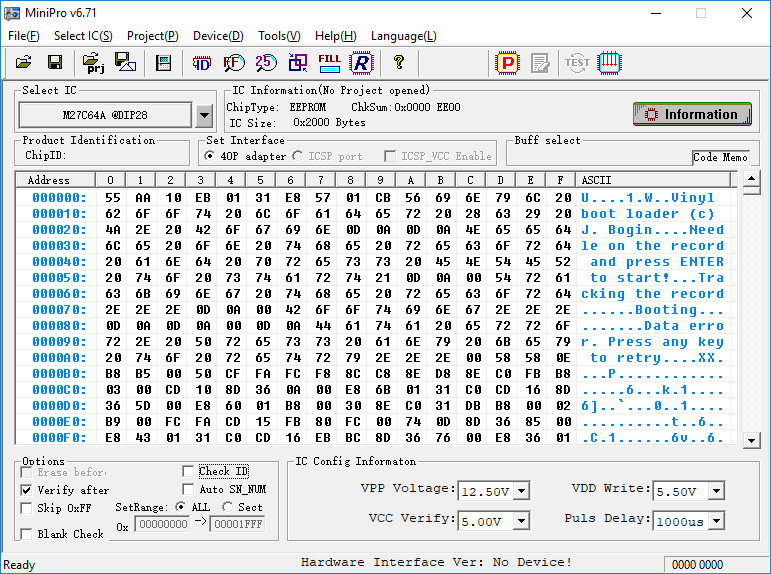
And now to get more technical: this is basically a merge between BootLPT/86 and 5150CAXX, minus the printer port support. It also resides in a ROM, in the BIOS expansion socket, but it does not have to. The connecting cable between the PC and the record player amplifier is the same as with 5150CAXX, just without the line-in (PC data out) jack.\
The “cassette interface” itself is just PC speaker timer channel 2 for the output, and 8255A-5 PPI port C channel 4 (PC4, I/O port 62h bit 4) for the input. BIOS INT 15h routines are used for software (de)modulation.
The boot image is the same 64K BOOTDISK.IMG “example” RAM drive that can be downloaded at the bottom of the BootLPT article. This has been turned into an “IBM cassette tape”-protocol compliant audio signal using 5150CAXX, and sent straight to a record cutting lathe.
Vinyls are cut with an RIAA equalization curve that a preamp usually reverses during playback, but not perfectly. So some signal correction had to be applied from the amplifier, as I couldn’t make it work right with the line output straight from the phono preamp. In my case, involving a vintage Harman&Kardon 6300 amplifier with an integrated MM phono preamp, I had to fade the treble all the way down to -10dB/10kHz, increase bass equalization to approx. +6dB/50Hz and reduce the volume level to approximately 0.7 volts peak, so it doesn’t distort. All this, naturally, with any phase and loudness correction turned off.
Of course, the cassette modem does not give a hoot in hell about where the signal is coming from. Notwithstanding, the recording needs to be pristine and contain no pops or loud crackles (vinyl) or modulation/frequency drop-outs (tape) that will break the data stream from continuing. However, some wow is tolerated, and the speed can be 2 or 3 percent higher or lower too.
Bootloader in a ROM; being an EPROM for a good measure


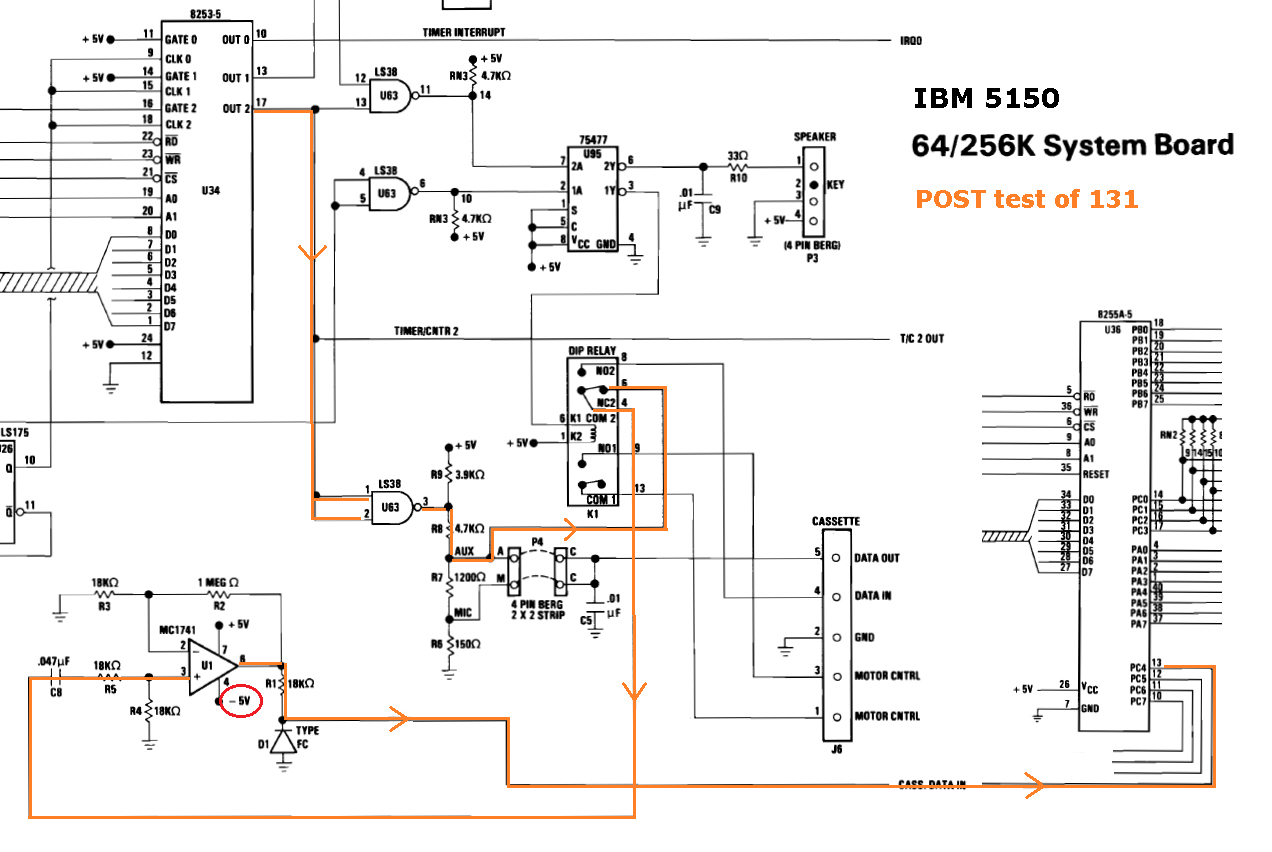
And that’s it! For those interested, the bootloader binary designed for a 2364 chip (2764s can be used, through an adaptor), can be obtained here. It assumes an IBM 5150 with a monochrome screen and at least 512K of RAM, which kind of reminds me of my setup (what a coincidence). The boot disk image can be obtained at the bottom of the BootLPT/86 article, and here’s its analog variant, straight from the grooves 🙂
I had the same problem
Seems ripe for a Grandmaster Flash remix.