
Donghak Peasant Rebellion Begins (1894)
Wed Jan 10, 1894
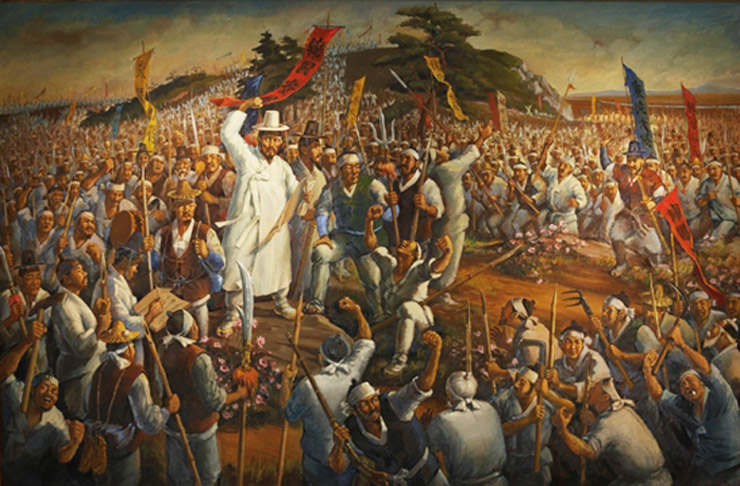
On this day in 1894, the anti-colonial Donghak Peasant Rebellion began with the "Gobu Uprising", where 1,000 peasants stormed the county of Gobu, freeing prisoners, occupying government buildings, and causing the county ruler to flee.
The Donghak Peasant Rebellion was an uprising that took place in late Joseon-era Korea during the 1890s. "Donghak" refers to a religious movement, founded in 1860, which preached for social equality and the uplifting of the peasantry. Choe Jeu was executed by the state in 1864.
Amidst a backdrop of growing foreign influence in Korea (which would eventually lead to colonization by Japan), Donghak peasants rebelled against oppression by feudal rulers. The uprising began in the county of Gobu in Jeolla province, where the magistrate had extorted vast amounts of wealth and forced the peasants to build a reservoir.
On January 10th, 1894, approximately 1,000 peasant rebels gathered at an empty horse ranch, from which they split off into two separate armies where they successfully destroyed three of Gobu's four gates, occupied government offices, and set about destroying prisons and freeing the people held in them.
As rebels successfully defeated government forces, unrest would spread across the country, and the panicked Joseon dynasty called for Chinese Qing dynasty for support. Doing this, however, aggrieved the Japanese government, which was competing with China for influence over Korea.
Japan invaded Korea, occupying Seoul, triggering the First Sino-Japanese War. Following a temporary truce, the peasant rebellion would resume in October, this time directed towards the Japanese occupation.
The Japanese proved successful in defeating the uprising, however, continuing to quell rebels through 1895. Korea would become increasingly absorbed into Japan's sphere of influence before official annexation in 1910.
- Date: 1894-01-10
- Learn More: en.wikipedia.org, www.jeongeup.go.kr.
- Source: www.apeoplescalendar.org