this post was submitted on 16 Dec 2025
22 points (100.0% liked)

HistoryPhotos

1430 readers
141 users here now

HistoryPhotos is for photographs (or, if it can be found, film) of the past, recent or distant! Give us a little snapshot of history!

Rules

  1. Be respectful and inclusive.
  2. No harassment, hate speech, or trolling.
  3. Foster a continuous learning environment.
  4. No genocide or atrocity denialism.
  5. Photos MUST be at LEAST 10 years old, and ideally over 20. We appreciate that we are living through events which will become history, but this is ultimately not a comm for news or current affairs, but events which have occurred some time in the past.

Related Communities:

founded 9 months ago
MODERATORS
 
top 8 comments
sorted by: hot top controversial new old
[–] pageflight@lemmy.world 5 points 4 months ago

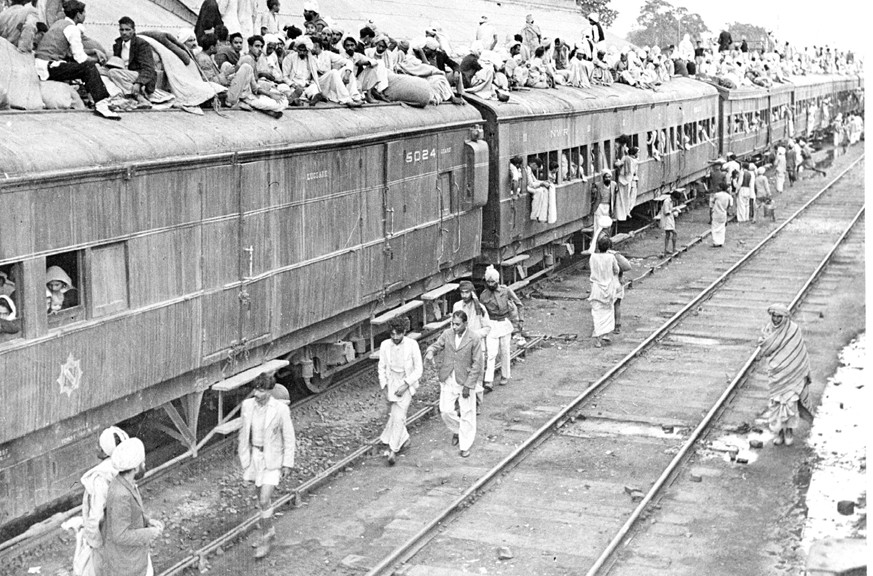
Turning to Wikipedia:

The partition of India in 1947 was the division of British India into two independent dominion states, the Union of India and Dominion of Pakistan. The Union of India is today the Republic of India, and the Dominion of Pakistan is the Islamic Republic of Pakistan and the People's Republic of Bangladesh. The partition involved the division of two provinces, Bengal and the Punjab, based on district-wise non-Muslim (mostly Hindu and Sikh) or Muslim majorities. It also involved the division of the British Indian Army, the Royal Indian Navy, the Indian Civil Service, the railways, and the central treasury, between the two new dominions. The partition was set forth in the Indian Independence Act 1947 and resulted in the dissolution of the British Raj, or Crown rule in India. The two self-governing countries of India and Pakistan legally came into existence at midnight on 14–15 August 1947.

[–] Ininewcrow@piefed.ca 2 points 4 months ago (1 children)

This is the kind of thing that happens when white people become afraid, angry or jealous

[–] PugJesus@piefed.social 5 points 4 months ago* (last edited 4 months ago) (1 children)

Not just white people, unfortunately, in this case. The partition was demanded by both Hindu and Muslim nationalists of the time, and it was a Hindu nationalist who assassinated Gandhi (who was opposed to the partition).

[–] Ininewcrow@piefed.ca 3 points 4 months ago (1 children)

The English didn't exactly make it very easy, negotiable, comfortable or convenient for either side ... plus they were the ones who arbitrarily drew territorial lines and didn't make it easy for anyone to negotiate. Almost as if the English wanted it all to fail from the start.

The English had a play toy that they owned for a long time but when it was finally taken away from them, they decided to just burn and break their toy rather than let the other kids enjoy it.

[–] PugJesus@piefed.social 6 points 4 months ago (2 children)

I mean, you aren't completely wrong here - the British absolutely fucked up India for their own profit, and when they realized they were going to lose control, tossed aside all their responsibilities (that they had forcibly seized from the people living there in the first place) aside with all the care and gentleness of a bored toddler. They stripped India (the subcontinent) to the bone in terms of government institutions, ran them as ethnic British enclaves as much as they could, and harvested India's wealth even as its people starved. The British contribution is definitely not marginal to the partition.

But at the same time, the core issue of the partition is a long-running one in the history of the Indian subcontinent, a legitimate issue of the past thousand years. While I'm sure the Brits felt smug seeing all of their intentionally-flimsy institutions collapsing sabotaging people who had 'ungratefully' thrown off the yoke of the British Empire, the Brits had the most success with "Divide and Rule" in demographics which would not end up nearly as problematic for Pakistan or India. The artificiality of the divisions, after all, was the point - they could be sustained and withdrawn according to the needs (or whims) of the British Empire.

The division between Hindu and Muslim, on the other hand, was much more... deeply rooted.

The end territorial lines that were negotiated were largely according to plebiscites by the people living in the relevant areas - something which caused a great deal of violence as each side attempted to Yugoslav each other out of the area. :/

I have many gripes with Gandhi, but I absolutely agree with him that India should never have been divided. It solved nothing, prevented very little violence, and both weakened and morally degraded both polities for all future affairs.

[–] sga@piefed.social 1 points 3 months ago (1 children)

The division between Hindu and Muslim, on the other hand, was much more… deeply rooted.

yes and no. I am an indian and feel that i know enought to comment. to put it mildly, india as a country kinda never existed before british (many indian nationalists would hate me for this). if you think of italy post roman empire, all you imagine is lots of small kingdoms, many of which believe in pope, and their is some "italian-ness", but corsica or milan or rome or some other city was independent practically. India was that. before 1000AD, there were hindu kingdoms, but hinduism being poly-theist, there are multiple gods, and most kingdoms had their prefered gods, and they would fight for usual reasons (resources, resources, reesources, and sometimes ego), and even would destroy other's temples, despite both being same "relegion". then delhi sultanate happened, and then mughals, and arguably the closed to todays geographical boundaries of subcontinent closely resembled that of peak mughal empire, but even then they could never get to south-western or southern parts of india, or even the eastern section. was their tension between muslims and hindus - yes, but it was for religious reasons (duh, what do i even want to say) - hindus worship idols, muslims forbid that, muslims are mono-theist, hindus are not. but there were hindus as chief leaders in muslim ruler's courts, and hindu rulers would most likely hate there neighbouring hindu kingdom more than a far away muslim one.

It was britishers who mostly exploited hindus and muslims, and there is always the fringe 10% religious extremist in both groups, who wanted power for themselves, and for that their best bet was supporting partition. fun fact - they both even collaborated in some elections - who in their ideals hated the other's guts. it is always politics. the then biggest party - INC, never supported partition, as recent as 1945, which had both muslim and hindus. it was the acts of extremists who caused riots, which resulted in hatred, but even then, it was not a universal thing. mostly restricted to small regions, roughly close to modern borders. I am purposefully not name calling leaders from either side, one to support my case by hiding how extremists acted, but mostly because it does not help. british did not want to ever even make 2 countries, they wanted 3 plus some independent kingdoms, that way, each country would be small, and they wanted indian countries to be english dominion (much like french overseas territories today - where they would be under the crown, but more independent on internal stuff). And extremists almost immediately agreed. it was inc who fought that and argued for 1 independent country. in the end it just could not happen, because extremists won.

TL;DR - it is not that deeply rooted anger, not 1000 year old, or 500 year old - 100-150 year old, and mostly because of british and extremist. rest 95% would never even care as long as other group agreed to not eat certain meats.

[–] sga@piefed.social 2 points 3 months ago

if you have time (and lots of it) - read freedom at midnight (it is 1000 pages or something. i have read its abriidged versions, and will probably read the full version at some point)

[–] BakerBagel@midwest.social 0 points 4 months ago

Hindus and Muslims coexisted in the sub-continent well enough before the Brits arrived. There was always tension, same as anywhere else that has millions of people of different ethnicities living together, but the Brits applied the typical divide and conquer technique of all colonial powers and spent 2 centuries prying at those religious divides. There's a reason that the most famous building in India was built by a Muslim.