
this post was submitted on 01 Dec 2025
91 points (100.0% liked)

Working Class Calendar

1600 readers
26 users here now

!workingclasscalendar@lemmy.world is a working class calendar inspired by the now (2023-06-25) closed reddit r/aPeoplesCalendar aPeoplesCalendar.org, where we can post daily events.

Rules

All the requirements of the code of conduct of the instance must be followed.

Community Rules

1. It's against the rules the apology for fascism, racism, chauvinism, imperialism, capitalism, sexism, ableism, ageism, and heterosexism and attitudes according to these isms.

2. The posts should be about past working class events or about the community.

3. Cross-posting is welcomed.

4. Be polite.

5. Any language is welcomed.

Lemmy

founded 2 years ago
MODERATORS
 

Rosa Parks Refuses to Move (1955)

Thu Dec 01, 1955
Image


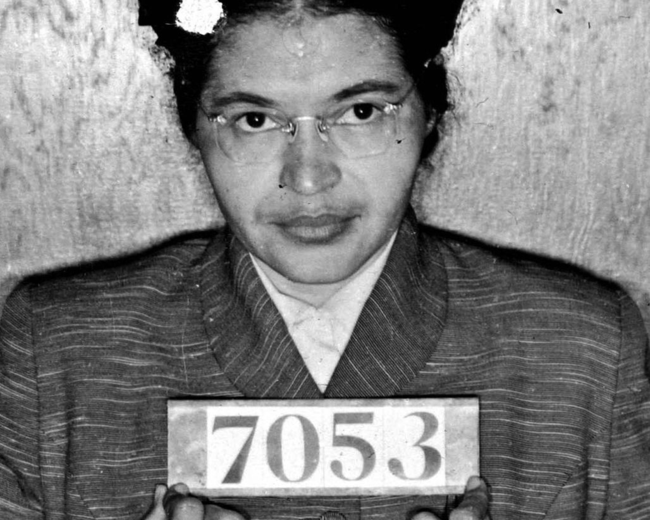
On this day in 1955, civil rights activist Rosa Parks rejected a bus driver's order to relinquish her seat to a white passenger in Montgomery, Alabama. Although the NAACP bailed her out of jail, both Parks and her husband lost their jobs.

Parks was not the first person to resist bus segregation, nor was it the first time she herself refused to accommodate the bus laws. As early as 1943, Parks exited the bus rather than to give up her seat and continue riding. Parks said "My resisting being mistreated on the bus did not begin with that particular arrest. I did a lot of walking in Montgomery."

The National Association for the Advancement of Colored People (NAACP), for whom Parks worked as a secretary, believed that she was the best candidate for seeing through a court challenge because she was perceived as a responsible, mature woman with a good reputation. Accordingly, the NAACP bailed her out of jail after her arrest.

Due to economic sanctions used against activists, Parks lost her job at the department store, and her husband quit his job after his boss forbade him to talk about his wife or her legal case. Parks was convicted in a local trial within a week of her arrest, and the appeals process was greatly slowed by the state government of Alabama. From the economic pressure of the Montgomery Bus Boycott, eventually the city conceded and reversed its segregation bus laws.


top 2 comments
sorted by: hot top controversial new old
[โ€“] jjagaimo@sh.itjust.works 13 points 1 week ago* (last edited 1 week ago) (1 children)

History has been rewritten or selectively taught to obscure the fact that she was part of a larger movement and was trained on how to react and chosen for the role because she was the best fit

It was not some random act of resistance but a collective action coordinated by many. It is a deliberate effort to decrease the chances that a similar effort arises today

When Parks was arrested in 1955, local leaders were searching for a person who would be a good legal test case against segregation. She was deemed a suitable candidate, and the Women's Political Council (WPC) organized a one-day bus boycott on the day of her trial. The boycott was widespread. Many Black Montgomerians refused to ride the buses that day. After Parks was found guilty of violating state law, the boycott was extended indefinitely, the Montgomery Improvement Association (MIA) organizing its own community transportation network to sustain it. Parks and other boycott leaders faced harassment, ostracization, and legal obstacles. The boycott lasted for 381 days, finally concluding after segregation on buses was deemed unconstitutional in the court case Browder v. Gayle.

She was chosen as the face of the movement after she had gotten arrested. She was chosen over another young woman who had gotten arrested for the same thing but was deemed less sympathetic because she was a teen mom, who probably inspired parks to resist.

While the boycott and legal defense was definitely a collective action coordinated by a large organization, parks sitting on the bus that day was not coordinated / ordered by the NAACP, many in the leadership were surprised parks had gotten arrested as she was typically soft spoken. Parks sitting that day was her choice, a choice inspired by many people in the movement she was part of, but ultimately she's the one who did it with no guarantee of backing from the NAACP or the community, and I think that shows her bravery even more.