
this post was submitted on 03 Oct 2026
524 points (99.6% liked)

Traditional Art

7306 readers
120 users here now

This is a community dedicated to showcasing all types of traditional medium art.

Traditional means a physical medium. This includes acrylic, pastel, encaustic, gouache, oil and watercolor paintings; Ink illustrations; Pencil and charcoal sketches; Etchings; Lithographs; Wood prints; pottery; ceramics; metal, Wire and paper sculptures; Tapestry; Weaving; Quilting; Wood carvings, Armor Crafting and more.

It EXCLUDES digital art: anything made with Photoshop, Clip Studio Paint, Krita, Blender, GIMP or other art programs, or AI art.


RULES

1- Do not post Digital or AI art.

2- NSFW content is allowed but it must be tagged.

3 - Extreme NSFW content like gore, graphic imagery, fetishistic works and straight up porn is not allowed.

3- [Change as of 4/12/2026] Posts may be art images, or articles about traditional art. Article posts MUST be tagged [ARTICLE].

4 - The post title should contain the title of the artwork or the name of the artist or ideally both if available. If there is further information about the artwork you want to convey, do it in the body of the post or in the comments.

5 - You can post your own art but keep in mind not to spam. An [OC] tag in the title of your post is recommended.

6 - Avoid extraneous objects and post only the art.

7 - Be civil to other community members.

8 - Keep on the topic of art in the comments. Extreme tangents or arguments will be removed.

founded 3 years ago
MODERATORS
 

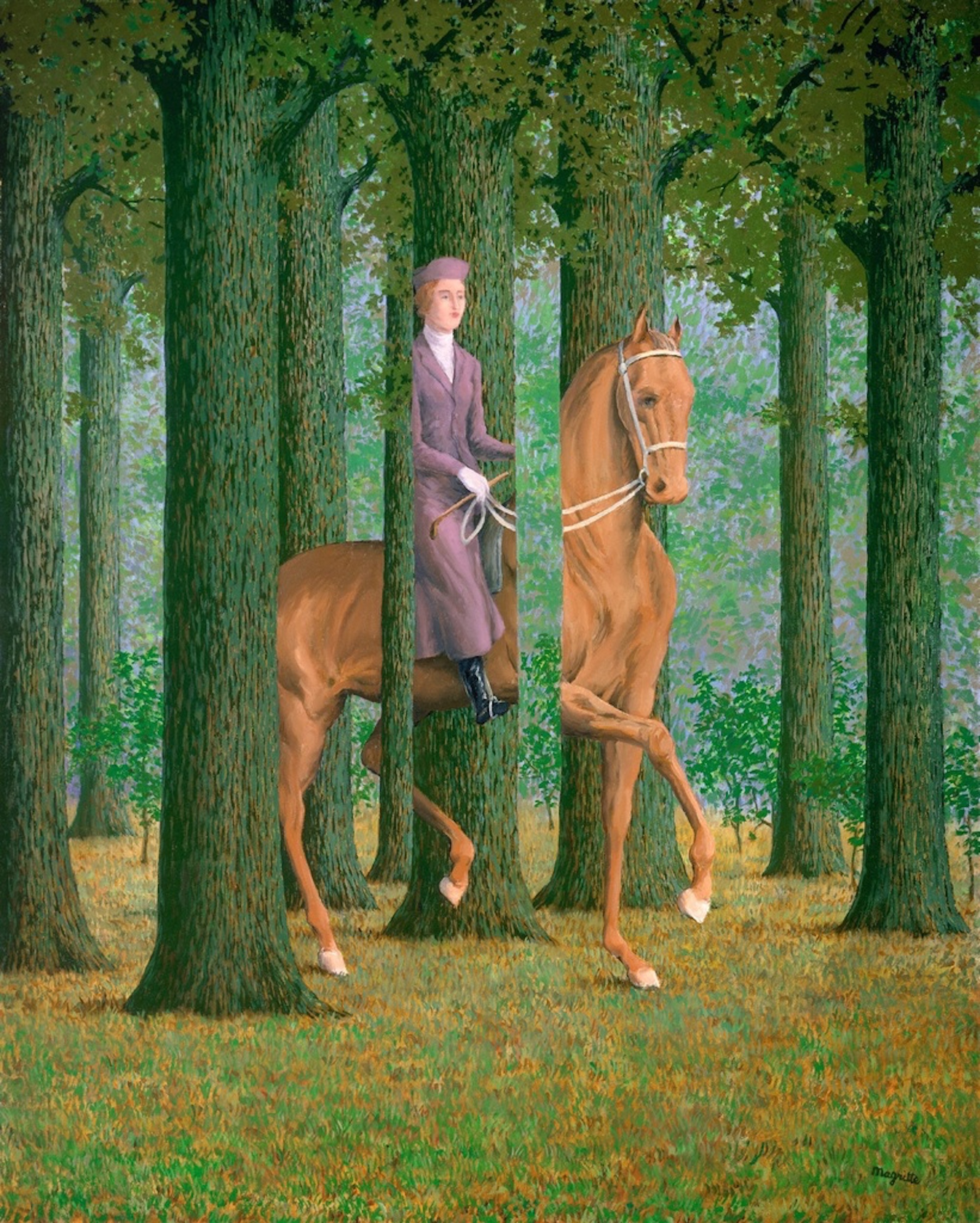
Artist: René Magritte

Year: 1965

Medium: Oil on canvas

The Blank Signature (Le blanc-Seing) is a 1965 painting by the Belgian surrealist painter René Magritte. The work is part of the collection of the National Gallery of Art in Washington, D.C. It was one of Magritte’s last works before his death in 1967. The painting depicts a woman on horseback riding through a forest. Due to an optical illusion employed by the artist, the image is partially fragmented, although at first glance the viewer may perceive it as a coherent whole. The woman and the horse are simultaneously in front of, between, and behind the trees. Her right arm is partially hidden behind a tree that, upon closer inspection, is located in the background. One possible interpretation is that the merging of the forest with the horsewoman suggests a unity of humanity and nature. But as is usually the case with Magritte, the work primarily raises questions, a sense further heightened by the enigmatic title. The painter himself believed that his works required no specific interpretation; every viewer can interpret the work in their own way. He also noted that art critics sometimes saw more—or something entirely different—in his works than he himself had consciously intended.
Source (translated)

Image Source

you are viewing a single comment's thread
view the rest of the comments

Fuck, this is good