this post was submitted on 21 Aug 2026
689 points (96.2% liked)
Cool Guides
6615 readers
194 users here now
Rules for Posting Guides on Our Community
1. Defining a Guide Guides are comprehensive reference materials, how-tos, or comparison tables. A guide must be well-organized both in content and layout. Information should be easily accessible without unnecessary navigation. Guides can include flowcharts, step-by-step instructions, or visual references that compare different elements side by side.
2. Infographic Guidelines Infographics are permitted if they are educational and informative. They should aim to convey complex information visually and clearly. However, infographics that primarily serve as visual essays without structured guidance will be subject to removal.
3. Grey Area Moderators may use discretion when deciding to remove posts. If in doubt, message us or use downvotes for content you find inappropriate.
4. Source Attribution If you know the original source of a guide, share it in the comments to credit the creators.
5. Diverse Content To keep our community engaging, avoid saturating the feed with similar topics. Excessive posts on a single topic may be moderated to maintain diversity.
6. Verify in Comments Always check the comments for additional insights or corrections. Moderators rely on community expertise for accuracy.
Community Guidelines
-
Direct Image Links Only Only direct links to .png, .jpg, and .jpeg image formats are permitted.
-
Educational Infographics Only Infographics must aim to educate and inform with structured content. Purely narrative or non-informative infographics may be removed.
-
Serious Guides Only Nonserious or comedy-based guides will be removed.
-
No Harmful Content Guides promoting dangerous or harmful activities/materials will be removed. This includes content intended to cause harm to others.
By following these rules, we can maintain a diverse and informative community. If you have any questions or concerns, feel free to reach out to the moderators. Thank you for contributing responsibly!
founded 3 years ago
MODERATORS
you are viewing a single comment's thread
view the rest of the comments
view the rest of the comments
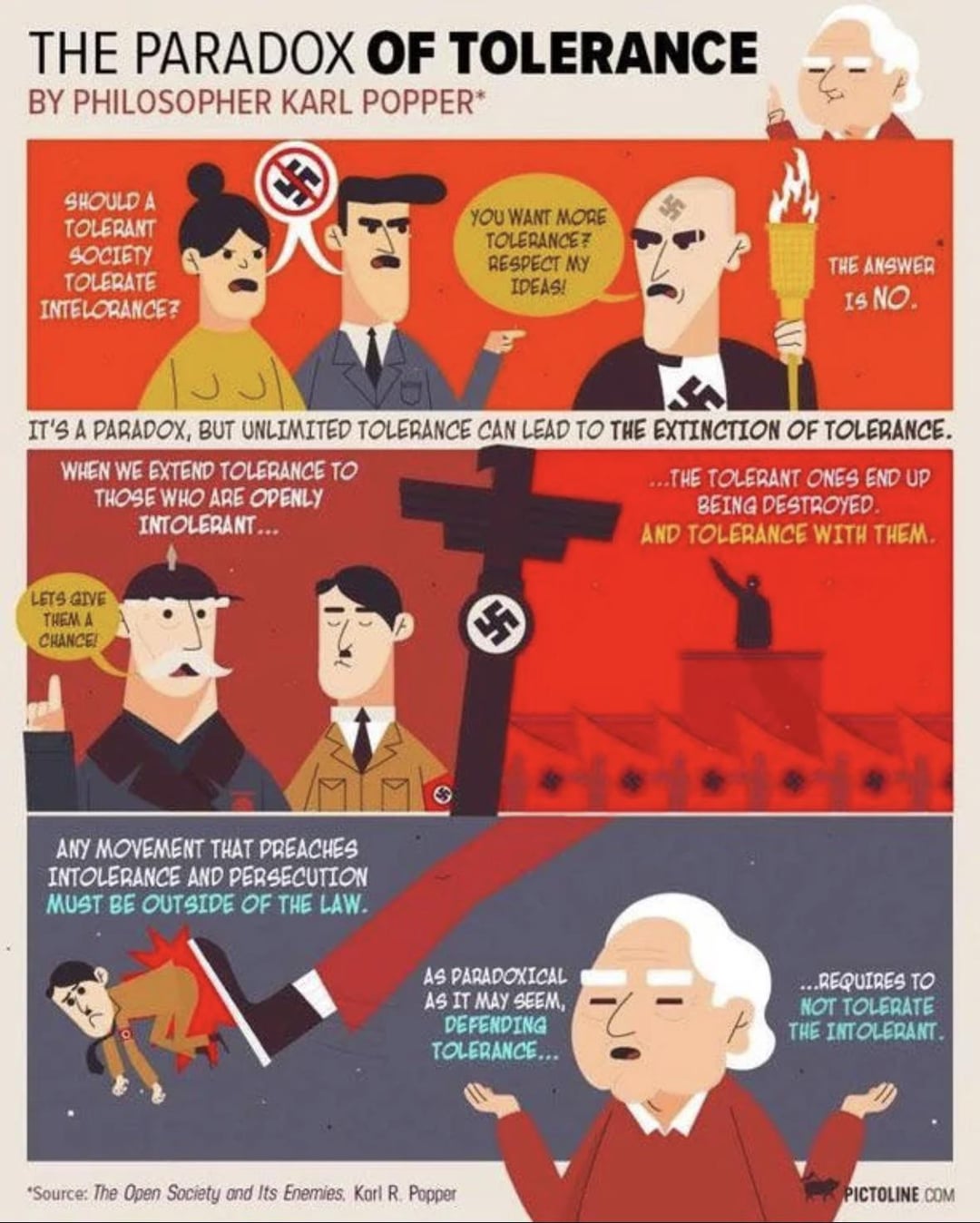
This is the operative statement to which I'm referring. If the party to which Popper is referring is not "answering arguments" with "fists and pistols," Popper is not making an affirmative case for suppression.
To be clear, he's not making an absolute statement either. He's not saying, "we may only ever suppress speech which is violent." However - and this is critical - he's also not making an affirmative statement that speech without violence should be suppressed. This is the original work and quote used to derive the Paradox of Tolerance, so I think it behooves us to heed that in this statement, he's referring to physical violence. Further, there are no statements of his in which he argues for suppression of non-violent speech.
Thanks for clarifying the quote's source etc.
I still kindly disagree with this understanding of the language though.
To me that whole section is justification for why to reserve the right to suppression: because the intolerant may not engage with argument in good faith, and they may instead tell their followers to denounce logical argument altogether and be violent.
The key word here is may, which to me means "this might happen". I basically read this as a warning of a potential outcome of intolerant philosophies - and why suppression might be needed and why to reserve the right to it - but not a threshold for when to suppress them.
But, at this point it seems like we might just have to agree to disagree on the meaning of the quote!
And once again, none of this is my opinion on the topic itself and I'm not endorsing a position, I'm only offering my understanding of the quote.
I will try to address your statements in turn as I don't think I am doing a good job of articulating my thoughts. That said, I think we are closer than I originally believed.
The section justifies when it may be reasonable to suppress incitement to violence. The "and" operator requires the incitement to violence in the premise: "But we should claim the right to suppress them if necessary even by force; for it may easily turn out that they are not prepared to meet us on the level of rational argument, but begin by denouncing all argument they may forbid their followers to listen to rational argument, because it is deceptive, and teach them to answer arguments by the use of their fists or pistols."
Popper did not write "or." Both incitement to violence and rejection of rational argument is the [non-exhaustive] example Popper uses to justify the right of suppression.
I agree. As above, the example he used it not explicitly exhaustive. There may be other reasons to claim the right of suppression. However, Popper never used any other examples as valid cause to suppress speech, and in the immediately prior statement, cautioned that suppressing democratic speech is "most unwise."
Given this, the implied claim that Popper and/or the Paradox of Tolerance supports the categorical suppression of "intolerant" speech (as the comic does) are inaccurate.
I guess my view on that section is still that it's just an example of what can happen and why to reserve the right to suppression, but not a threshold or reasonable scenario for when to apply suppression.
To me, this really isn't saying: "this is one case where it's reasonable to apply suppression", but rather more simply: "because the following may easily occur with intolerant philosophies".
Anyway, I appreciate you taking the time to reply and expand more on your take. I think let's just say we understand it differently and leave it at that?