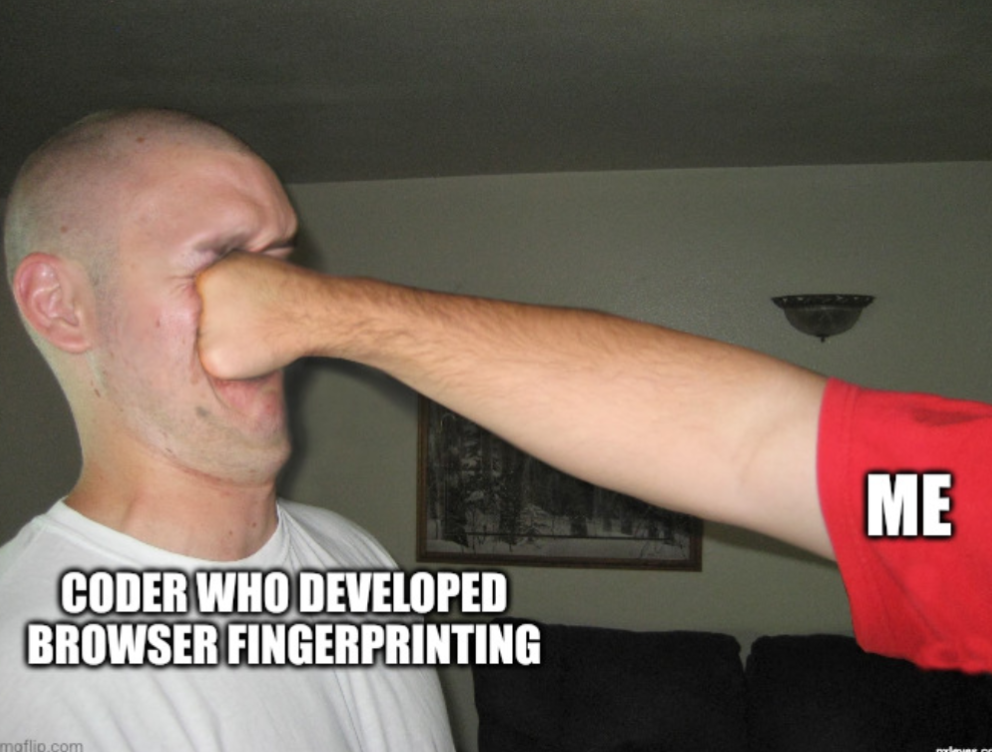
Why would you do this to us?
1. Be civil
No trolling, bigotry or other insulting / annoying behaviour
2. No politics
This is non-politics community. For political memes please go to !politicalmemes@lemmy.world
3. No recent reposts
Check for reposts when posting a meme, you can only repost after 1 month
4. No bots
No bots without the express approval of the mods or the admins
5. No Spam/Ads/AI Slop
No advertisements or spam. This is an instance rule and the only way to live. We also consider AI slop to be spam in this community and is subject to removal.
A collection of some classic Lemmy memes for your enjoyment
Why would you do this to us?
Is it possible for URL to request the one that i want? I feel like i remember different language versions of webpages from before browser fingerprinting - though I guess I don't know long ago it started.
Even so, it seems like it only needs to know my request as a one of 500 group. An individualised fingerprint of 1 in 10bn seems like overkill to me. Assuming that's what fingerprint means in this context.
Be requesting the specific language site you are giving them the information anyway.
I'm ok to give them 1 in 500 resolution (or whatever rough order of magnitude) to tell them i want to read the EN version. That's a lot less precise than 1 in 10 billion or whatever the fingerprint is.
Some browsers literally have a 'spoof is language to english' option to anti fingerprint. To hide in the horde.
And I'd rather DL 500 languages of actual content than 1mb of page and 2GB of ad shit.
Thing is, while it wasn't called "browser fingerprinting" immediately, it basically started as soon as JS was around. And feature-detection / media-queries actually make for better compatibility than just User-Agent strings (and other headers).
Content negotiation never really caught on, as best as I can tell. There's a number of headers that the client can send so that the server can select a version by language, content-type, and a few other things, but in all the web deployments I've ever done content-negotiation was never a consideration.
Almost any information can be abused.