this post was submitted on 20 Jun 2026
1252 points (99.1% liked)
Work Reform
17799 readers
969 users here now
A place to discuss positive changes that can make work more equitable, and to vent about current practices. We are NOT against work; we just want the fruits of our labor to be recognized better.
Our Philosophies:
- All workers must be paid a living wage for their labor.
- Income inequality is the main cause of lower living standards.
- Workers must join together and fight back for what is rightfully theirs.
- We must not be divided and conquered. Workers gain the most when they focus on unifying issues.
Our Goals
- Higher wages for underpaid workers.
- Better worker representation, including but not limited to unions.
- Better and fewer working hours.
- Stimulating a massive wave of worker organizing in the United States and beyond.
- Organizing and supporting political causes and campaigns that put workers first.
founded 3 years ago
MODERATORS
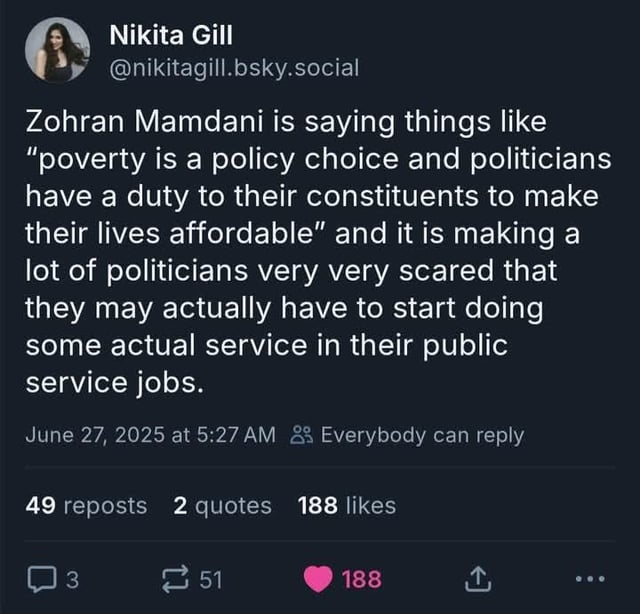
It seems to me that affordability starts with housing, because it is usually a household's single largest monthly expense. And it seems to me the best way to make housing more affordable is to make it non-profit. That doesn't necessarily mean city owned or other public housing, nor does it mean tax payer funded or subsidized housing, but having apartment buildings owned by a non-profit organization that charges tenants only enough rent to cover the organization's expenses without any extra going to an owner as profit. And the thing is, non-profit housing isn't only theoretical. It exists right now, but it's relatively rare. The reason is for-profit landlords don't want it because they can't compete.
Let's say you have two identical apartment buildings, but one is owned by a non-profit housing cooperative and the other is owned by a private landlord. The non-profit housing cooperative is going to have the same ongoing expenses (property management, maintenance, etc) as the private landlord, because the apartments are identical, but rent will be lower at the non-profit housing because they charge only enough rent to cover expenses whereas the private landlord charges rent to cover expenses plus some for his own personal profit.
yeah, in germany a few weeks ago the news made the headline that for-profit rent-out company vonovia makes 30c profit for every 1€ revenue. that's extreme. that means they're charging almost 50% more than they had to to operate at-cost.
also in vienna there's a lot of city-owned apartments and rents here are really affordable. sincerely, written from my 550€/month apartment (roughly $600/month)
also a huge roadblock to lower construction costs is unnecessary complex building codes, zoning laws, and again zoning laws.
There is also the rent-to-own option, which nearly no one uses. After paying the rent for X years, it's your house now - a portion of the rent went toward buying the place. It should be transferable to another person or paid out if needed.
That's how you generate generational wealth, even in lower-income situations.