this post was submitted on 15 Jun 2026
66 points (95.8% liked)
Linux
66337 readers
347 users here now
From Wikipedia, the free encyclopedia
Linux is a family of open source Unix-like operating systems based on the Linux kernel, an operating system kernel first released on September 17, 1991 by Linus Torvalds. Linux is typically packaged in a Linux distribution (or distro for short).
Distributions include the Linux kernel and supporting system software and libraries, many of which are provided by the GNU Project. Many Linux distributions use the word "Linux" in their name, but the Free Software Foundation uses the name GNU/Linux to emphasize the importance of GNU software, causing some controversy.
Rules
- Posts must be relevant to operating systems running the Linux kernel. GNU/Linux or otherwise.
- No misinformation
- No NSFW content
- No hate speech, bigotry, etc
Related Communities
Community icon by Alpár-Etele Méder, licensed under CC BY 3.0
founded 7 years ago
MODERATORS
you are viewing a single comment's thread
view the rest of the comments
view the rest of the comments
If we ignore the deeply disturbing political views of the Creator the entire project is meant to be a statement. There's a conspiracy theory that there was a grand plot to kill x11 by red hat and xlibre is built upon the idea that red hat was holding it back. This completely ignores the real issues that the codebase was pure spaghetti.
I heard that XLibre developers are working on cleaning the codebase. And I strongly believe we still need X11 at least until Wayland is polished enough, which still seems untrue even in 2026. The concerns about Red Hat are not conspiracy, a commercial corporation controlling important parts of Linux ecosystem is a serious threat, so having an alternative is never bad. Linux won't have a future if everyone just uses Red Hat approved solutions.
Two things, one as previously mentioned the codebase is a mess and even the best developers working on x11 tend to introduce regressions (the xlibre dev isn't so this is amplified). Second it absolutely is a conspiracy because red hat did everything in the power to save x11 until eventually they just kept using it (tbh it needed to be replaced two decades ago). As for your last point linux won't have a future if its aggressively held back by an army of enthusiasts who demand things never change and fragmented until software support is non-existent.
You know that "until Wayland is polished enough" is at least a year ago for the overwhelming majority of people, right?
A year ago I got a new PC, installed Ubuntu 24.04 which defaults to Wayland, and installed discord. Push to talk wouldn't work unless discord had mouse focus. I spent a few hours researching and trying different things before switching to X11 where it just immediately works.
Tell me more about how polished Wayland is.
That is a feature. Allowing arbitrary programs to read any key press is how you get keyloggers.
Wayland has a protocol to request reading keys out of focus (which will ask the user for permission, as opposed to just read it like on xorg).
If the program was running in xwayland (which it probably was) of course it won't use that protocol, and will just try to read it X11 style.
In some DEs (KDE) you can select if X11 apps are allowed to read keys.
"I switched to X11 and it immediately works". I'll give you another tip: if you run
chmod 777 -R /the file manager stops pestering about permissions and it immediately works.Yes, you clearly understand the problem, thank you. If there's a problem with filesystem permissions you can use tools like
chmod,chown, andsetfaclto fix them in a variety of ways.How do you fix a wayland session if your app doesn't properly support GlobalShortcuts? Where's the
chmod 777equivalent that lets the user say "I know this means this can spy on everything I do but I'd prefer this work today instead of waiting on a bug fix." Without something like this, the entire desktop ecosystem needs to mature before you can call Wayland "polished."If it's a Wayland application it will support global shortcuts.
For X11 apps. If you are on KDE there's this menu: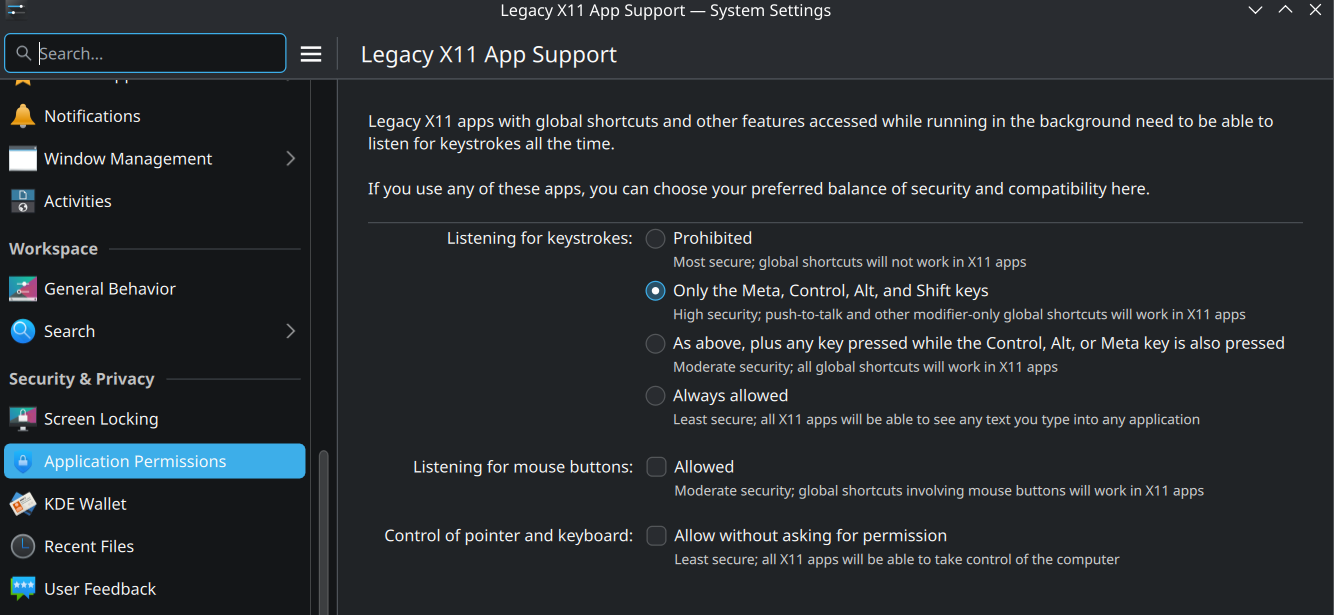
Other DEs have different ways to deal with this.
And if you are on Gnome, change DE. Gnome will always follow its own philosophy, because apparently it doesn't align with yours, you should use something else.
Btw, I gave the same answer in the previous comment.
Also, on the "how can you consider this polished"... Wayland supports global shortcuts, this is a fact. What it doesn't support is "global shortcuts for apps that use a protocol that is not Wayland". I think I made my point
Fam, if I may, I'll be a bit abrasive and blunt for the sake of brevity. So, without further ado.
(I'll assume this is on GNOME.) First of, in terms of Wayland development, that build is from the Bronze Age. The associated issue tracker has been closed since last year, even if you don't like the solution GNOME has come up with. Which, gets us to the second point; please don't blame the Wayland ecosystem as a whole whenever you find a fault within a Wayland compositor. If, instead, you would have been on KDE Plasma back then, you'd have found that PTT was supported. Even if it was basically a hack for the sake of UX. Thankfully, KDE Plasma has recently merged a proper implementation that's slated for its 6.7 release.
I'll grant you that the Wayland ecosystem hasn't fully matured yet. But it's undeniable that it already provides a better experience than its predecessor for the vast majority of users.
Fair points all around. I wasn't thinking about version locks for the LTS releases when I posted, and it looks like I wouldn't have had an issue on GNOME 48.
I think the maturity of the ecosystem has a larger impact on user experience than you're giving it credit for. I understand wayland and the rest of the desktop ecosystem will someday (maybe today for those living on the bleeding edge) provide meaningful benefits over X11 without drawbacks. I'll welcome it when it does, but in the meantime I don't want to deal with troubleshooting my discord keybinds, or figuring out why Spotify has a weird window border. I want my desktop environment to Just Work™. It's immaterial if the fault lies with wayland, GNOME, or Canonical for shipping wayland as a default while GNOME support still needed improvements. The end result is that as a user the only way to easily fix my problem is to use an X11 session instead of wayland, which makes wayland look like the problem.
https://github.com/X11Libre/xserver/pull/56
Here is the x11libre dev not understanding what the
^operand does in C. Would you trust running this person's code as a display server?Sure. No one expects anyone to know everything from the start, and people improve with time. But this was metux's understanding of C when he forked off xorg thinking he could do better than freedesktop.
He might have confused it with shell script
The Linux ecosystem would whither and die without the likes of Red Hat.