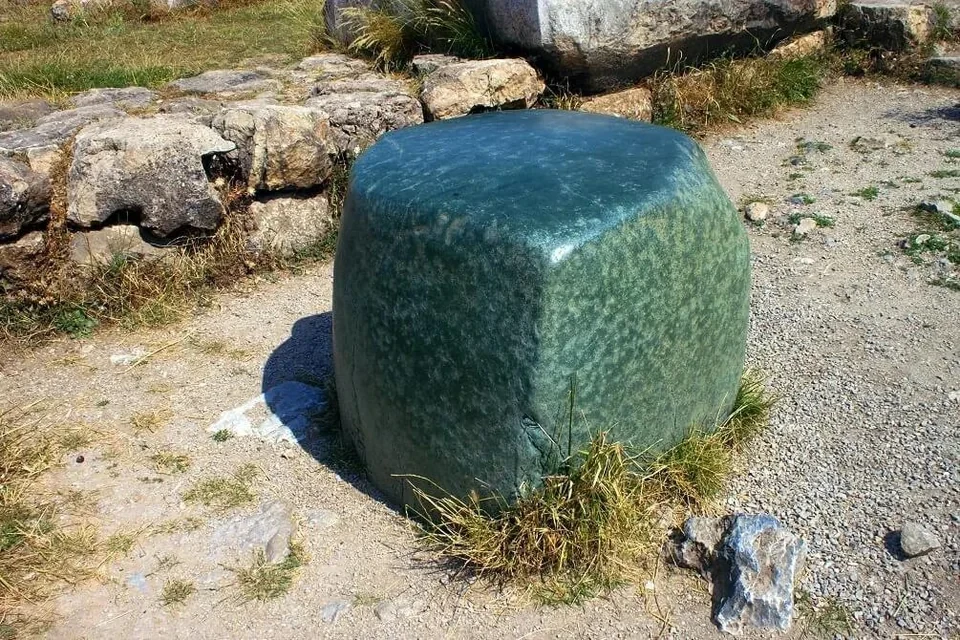
The Hattusa Green Stone is a roughly cubic block of what is believed to be nephrite standing in the remains of the Great Temple at Hattusa, capital of the Hittites in the late Bronze Age. Now on the hill above Boğazkale, in the Turkish Province of Çorum, Hattusa is a World Heritage Site.
The original purpose is unknown, but serves as a tourist attraction today.
The stone measures 69cm (27in) per side, and weighs about 1,000 kilograms (2,200lb). It is supposed by some to have had a religious use or purpose, but what that may have been is unknown. The suggestion has been made that it may have been merely the base of a statue, however the stone is the only one of its kind found at Hattusa. --WP, with some JE edits
So, not quite the Voynich Manuscript, but an interesting object nonetheless. And quite a bit heavier(!)
In the Lebanese city of Tyre, I visited the ancient ruins & saw an identical stone --u/Msqueefmaker
I'm just a layperson here, but wouldn't those normally be more upright-shaped?
I'm no expert either I just vaguely remember it from a class years ago. There are multiple translations of Ḫuwaši it can be refering to the ritual object and the place of ritual. As far as I can tell the only extant examples are the Huwasi temples and not the objects. While Huwasi has been translated as 'standing stone' there is no criteria for their size or shape, with portable stones also being attested. They aren't always stone either.