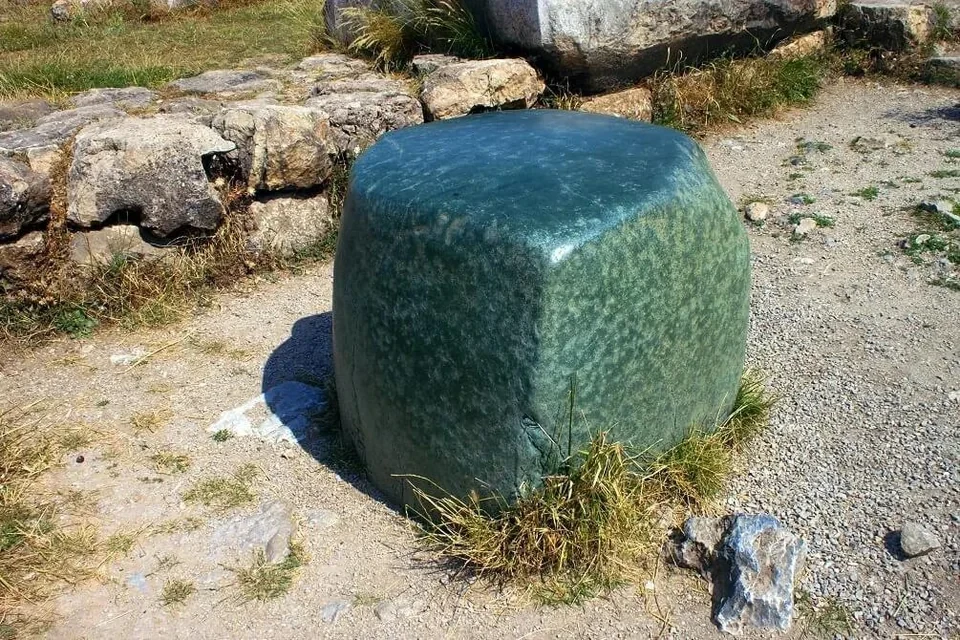
The Hattusa Green Stone is a roughly cubic block of what is believed to be nephrite standing in the remains of the Great Temple at Hattusa, capital of the Hittites in the late Bronze Age. Now on the hill above Boğazkale, in the Turkish Province of Çorum, Hattusa is a World Heritage Site.
The original purpose is unknown, but serves as a tourist attraction today.
The stone measures 69cm (27in) per side, and weighs about 1,000 kilograms (2,200lb). It is supposed by some to have had a religious use or purpose, but what that may have been is unknown. The suggestion has been made that it may have been merely the base of a statue, however the stone is the only one of its kind found at Hattusa. --WP, with some JE edits
So, not quite the Voynich Manuscript, but an interesting object nonetheless. And quite a bit heavier(!)
In the Lebanese city of Tyre, I visited the ancient ruins & saw an identical stone --u/Msqueefmaker
Interesting thought, but such a measure didn't get invented until well over two millennia later, by the English. Not that it couldn't have been a weight measure of some sort of another.
What do you mean "by the English"?
The English peoples. Via the word "tun." Which was something like ~240 wine gallons.
My source was WP on that.
WordPress?
Wikipedia
Oh phew. 😋
Fun fact: speaking of wine cargo terms, "buttload" is real. 🤣
Are you certifiably insane? You would be my first one. This is very exciting..
Dude...
Is this your first time on the internet, or something?
You asked me literally:
As if there was some great, cosmic mystery about all that.
However, I answered your Q, and then you proceeded to get upset, for whatever reason(s). The fuck is up with you, matey?
I'm going to assume that you are some kind of AI thing I'm too tired to figure out a proper name for your perversity.
Ancient cultures get underestimated all the time because we have smartphones and computers now which makes us cool and advanced.
Edit: The old way of measuring 1 kg was 1 Liter of water. You would get something like that i guess since its not precise.
The litter, kilo, meter all come from the metric system, which didn't exist in the time of the Hittites. It's not about underestimating them, they had other units of measurement, but that obviously wasn't metric.
The Egyptian "Elle" was 50 cm, so 1/2 a meter. So they could have measured 125 Liter using 1x1x1 "Elle".
I dont know the density of the material, that would be interesting to know. The cube looks like it was important to them. Maybe it was to measure big shipments of wares. Since they probably used scales back in that time.
Long story short: Seems like quite the coincidence, even more so if you consider the work that had to be put into carving the stone.
But well, maybe it was a doorstopper?