this post was submitted on 30 Mar 2026
73 points (100.0% liked)
HistoryPhotos
1294 readers
452 users here now
HistoryPhotos is for photographs (or, if it can be found, film) of the past, recent or distant! Give us a little snapshot of history!
Rules
- Be respectful and inclusive.
- No harassment, hate speech, or trolling.
- Foster a continuous learning environment.
- No genocide or atrocity denialism.
- Photos MUST be at LEAST 10 years old, and ideally over 20. We appreciate that we are living through events which will become history, but this is ultimately not a comm for news or current affairs, but events which have occurred some time in the past.
Related Communities:
- !militaryporn@lemmy.world
- !forgottenweapons@lemmy.world
- !historymusic@quokk.au
- !historygallery@quokk.au
- !historymemes@piefed.social
- !historyruins@piefed.social
- !historyart@piefed.social
- !historyartifacts@piefed.social
founded 8 months ago
MODERATORS

you are viewing a single comment's thread
view the rest of the comments
view the rest of the comments
In normal operation, this machine has proper working electro-mechanical interlocks to prevent errors.
It is quite interesting to read about how railway systems worked in the past.
One of the first safety systems created to prevent train crashes was super simple, it was a token system, and worked just as you imagine, to be allowed to enter a stretch of track between two stations, the driver had to be carrying a token, there was only one token for that part, and it was handed in at the next station.
This meant that as long as the rules were followed there could only be one train on that piece of track, and traffic could only alternate.
Simple and safe, but inefficient.
Control of track switches are critical to keeping a railway line safe, depending on the setting of the switch, it will not only risk a head on collision, but also a derailment and other issues.
Most switches on a train line these days are remote controlled from an operations center, but there are switches that are controlled by mechanical keys, usually at a remote rail yard that only sees quite limited traffic.
These systems can be quite fun, the driver is issued a key to the first switch, he gets to the switch on the line, stops the train, gets out, unlocks the switch with his key and sets it to the new direction, that unlocks two more keys in the switch which he turns and removes, this locks the first switch.
These keys unlocks further switches in the train yard in a similar manner.
Once he has got his train to it's position, he uncouple the locomotive and goes back the way he came, resetting the keys and switches.
Once he has thrown the last switch and got the key out, he can be certain that everything is properly locked up, and can radio the control center that he is done and everything is safe again.
In fact, at least in the older technology, there are two aspects to the safety system.
The one is the safety between stations. The token you describe was one of the earlier systems (which is still used in some places around the world). That was eventually superseded by a "line block". Only one signal leading to that line can be set to green at a time, and once that signal has been set to green, no further green signal can point towards that line until the whole process is reset. After the train has passed the signal, the signal can be reset to red, and station A's rail traffic controller (RTC) then sends an electric signal to station C, which marks the line between the two, or the block, as occupied. When the train has arrived in station C, that station's RTC sends a signal back to station A, which marks the block as free. Only then is the process reset and another signal can send a train onto that line. Essentially, the token was turned into an electric signal, and a mechanical system to ensure that token was respected was added. Eventually, they needed to increase the density of the trains on the line, so they added signals on the line, controlled by signal towers. Instead of the electric signal going from station A to station C, it went to signal tower B. As soon as the train fully passes signal tower B and is protected by its signal, the signal tower agent marks the block to station A as free, and the next train can be sent on its way before the first train has arrived at station C. The first such systems actually had small generators to create that signal which were hand cranked by the RTC or the signal tower agent.
The other aspect is more the focus of this picture - the safety within stations. It essentially ensures three things: that the route is set correctly, that that route is protected from other rolling stock movements, and that the signal shows the correct speed information (i.e. it doesn't tell the driver to go full speed over a diverging switch). A later addition was to ensure that the route is free of any rolling stock, which would come a number of years after this picture had been taken. While the train is on the route, it ensures that no switches are set underneath the train, and that the train is protected from any trains that might be behind it (through stop signals). The worked with a set of keys, similar to the way you described, except the RTC would run out with the keys to the switches, set those switches, run back with the keys they got from those switches in their new positions, stick those keys into the interlocking system, unlock the key to the signal, and run out to set that signal. Later systems had the switches controlled more centrally by levers attached to either rods or wire and pulley systems, and the ability to use those levers were/are controlled by somewhat complex systems, which can often be
 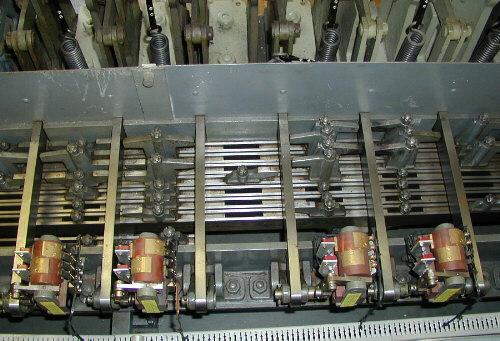 (this is a more simple example, there are much more complex examples in larger stations). So if as a RTC you're not sure why a switch won't set, for instance, you can just look at that interlocking system, follow the rod to the path it controls, and now you know why your switch won't set. Mind you, this should only happen when you're learning that interlocking, it should not be necessary for experienced controllers, unless there's a problem. (Fun fact: in Germany, there's always a sheet of glass protecting it, and if that glass breaks, the speed is restricted to 50 km/h since the interlocking system cannot be relied on/can be tampered with. It's a running gag among RTC's as to why the glass covering the interlocking, which is at about the height of the surface of a bench, broke...)
And the thing is, for the most part, even the most modern interlocking technology is based on these principles. In fact, when you learn to become an RTC, often you will train on the older systems (which, to be honest, is a hell of a lot of fun), and most indicators will be some equivalent of some function in the old interlocking systems, which really helps to visualize what's going on when the system has some kind of a problem.
Thank you for the detailed write up, I am not educated in rail, I am an IT guy, but my dad spent his career selling railroad signal systems, and plenty of (scattered) knowledge has entered my mind over the years.
It is always nice to find someone else knowing more than I do to fill in the blanks.
Have a lovely evening!
That's rather fascinating. Thank you for taking the time to write it all up. 🙂
It also reminds just a tiny bit of the Apollo moon missions, which I often listen to the audio of. They made a special point of training astronauts to think externally, not the natural process of doing so internally. That involved lots of verbal checklists, communicating extensively with each other and Mission Control over whether something had been attended to. Even stuff that they barely had any real interaction with, such as the Cosmic Ray Detector panels.
In fact, in Japan, they have what they call "point and tell". Essentially, every signal drivers see, they point at it and say what it tells them, for instance, "proceed at max 50 km/h". It does quite a bit to increase safety, because it forces you to consciously acknowledge safety relevant points.