this post was submitted on 18 Mar 2026
216 points (100.0% liked)
History Memes
2207 readers
358 users here now
A place to share history memes!
Rules:
-
No sexism, racism, homophobia, transphobia, assorted bigotry, etc.
-
No fascism (including tankies/red fash), atrocity denial or apologia, etc.
-
Tag NSFW pics as NSFW.
-
Follow all Piefed.social rules.
-
History referenced must be 20+ years old.
Banner courtesy of @setsneedtofeed@lemmy.world
OTHER COMMS IN THE HISTORYVERSE:
- !historymusic@quokk.au
- !historygallery@quokk.au
- !historyruins@piefed.social
- !historyart@piefed.social
- !historyartifacts@piefed.social
- !historyphotos@piefed.social
founded 10 months ago
MODERATORS
you are viewing a single comment's thread
view the rest of the comments
view the rest of the comments
The fact that it's named after a Maple Leaf badge still doesn't fully explain it though, because why should the fact that it's named after a badge change expected "leaves" to "leafs"?
One potential explanation for this phenomenon comes to us from morphology, the branch of linguistics dealing with the internal structure of words and how they are created. As we'll see, you're exactly right that it's because "maple leaf" refers to a badge instead of a leaf, but why will require a little bit of theory.
First we have to introduce the idea of a "compound" and prove that "maple leaf" is actually a single noun compound even though it looks like two words. A compound is any single word that contains (at least) two roots, that is, two "basic meaning-chunks" (that's not a perfect definition, but it serves our purposes here). There are three usual dimensions of tests to show whether something is two words or a compound:
Phonological. In English specifically, compounds often get initial stress. For example, I can build my house with a black BOARD, but I write on a BLACKboard. (Note that this is not exceptionless, even in English, so this test should only be used to support the next two tests).
Semantic. A second test is "semantic distance", that is, once a compound has formed, the meaning of the compound may drift from the meanings of the original components. For "blackboard", many of us have seen blackboards that were green, not black, passing the semantic distance test. This test is also not foolproof, however, since not all compounds show significant semantic distance yet, so you can use this test to show that something is a compound, but not that something isn't a compound.
Syntactic. The best test is "modification". The "head" of a compound (the part of the compound that tells you what kind of word it is and how it behaves) is the only part that can be targeted for modification (by adverbs, adjectives, etc.). So, for "blackboard", you can't say *"That's a very blackboard" to mean "That blackboard is very black". That is, once "black" has become part of the compound, it can't be modified.
So, putting all of this together, the string "maple leaf", as in "There's a maple leaf on that tree" a) has initial stress, so it passes the compound stress test, b) hasn't changed meaning, so it fails the semantic distance test, but c) can't be modified ("That's a big maple leaf" can't mean "That's a leaf from a big maple"), so it passes the modification test.
Our interim conclusion is that, whether we write it with a space between it or not (which doesn't matter at all as far as language is concerned), "maple leaf" is a single compound noun in English.
Ok, so where do we go from here?
Well, the next useful categorization is the distinction between "endocentric" and "exocentric" compounds. Endocentric compounds have the head inside the compound, which is just a fancy way of saying that the compound is a type of that thing. For example, a "doghouse" is a type of house, and a "maple leaf" is a type of leaf.
Exocentric compounds, as you might expect, are compounds that have their head outside the compound, which, again, is just a fancy way of saying that the compound is not a type of that thing. For example, "bigfoot" is not a foot, it's a creature with a big foot. "Blackbeard" is not a beard, but a person possessing a black beard. A "Toronto Maple Leaf" is not a leaf, but a person (or a badge, as I just learned today!) associated with a leaf. In short, this type of compound refers to something else. That's the "outside" part.
As it turns out, this "inside"/"outside" distinction is a useful theoretical construct that finally helps us explain "Maple Leafs".
What differences do you note in the compound pairs below?
bigfoot : *bigfeet : bigfoots
saber tooth : *saber teeth : saber tooths (when referring to the animal)
field mouse : field mice : *field mouses
salesman : salesmen : *salesmans
We get the expected irregular plurals when we have endocentric compounds, but unexpected regular plurals when we have exocentric compounds.
This is where the "outside" comes in handy theoretically. Many morphologists think that the "external" referential head on exocentric compounds takes up extra space in the structure of the word (even though we don't actually pronounce it) and consequently blocks plural morphology from reaching the irregular root due to the intervening external head, resulting in default, regular plural morphology instead (seen in the default ("productive") English -s plural endings above).
So, [[field mouse] + PLURAL] straightforwardly gives "field mice", but [[[big foot] + (of animal)] + PLURAL] gives "Bigfoots" due to "PLURAL" not being able to directly reach "foot" to produce the irregular plural "feet".
At last we can explain "maple leaves" vs. "Maple Leafs". Because a maple leaf is an endocentric compound that refers to a type of leaf, the construction looks like this: [[maple leaf] + PLURAL], which simply gives "maple leaves", with the irregular "v". (This "v" is called a "morphophonemic alternation", by the way. Let me know if you're interested in hearing more about them!)
For "Maple Leafs", on the other hand, we have [[[maple leaf] + (of person, or of badge)] + PLURAL], which gives "Maple Leafs", with default "-s" plural because the PLURAL feature can't see the normally irregular root "leaf" due to the added referential structure of the intervening external head.
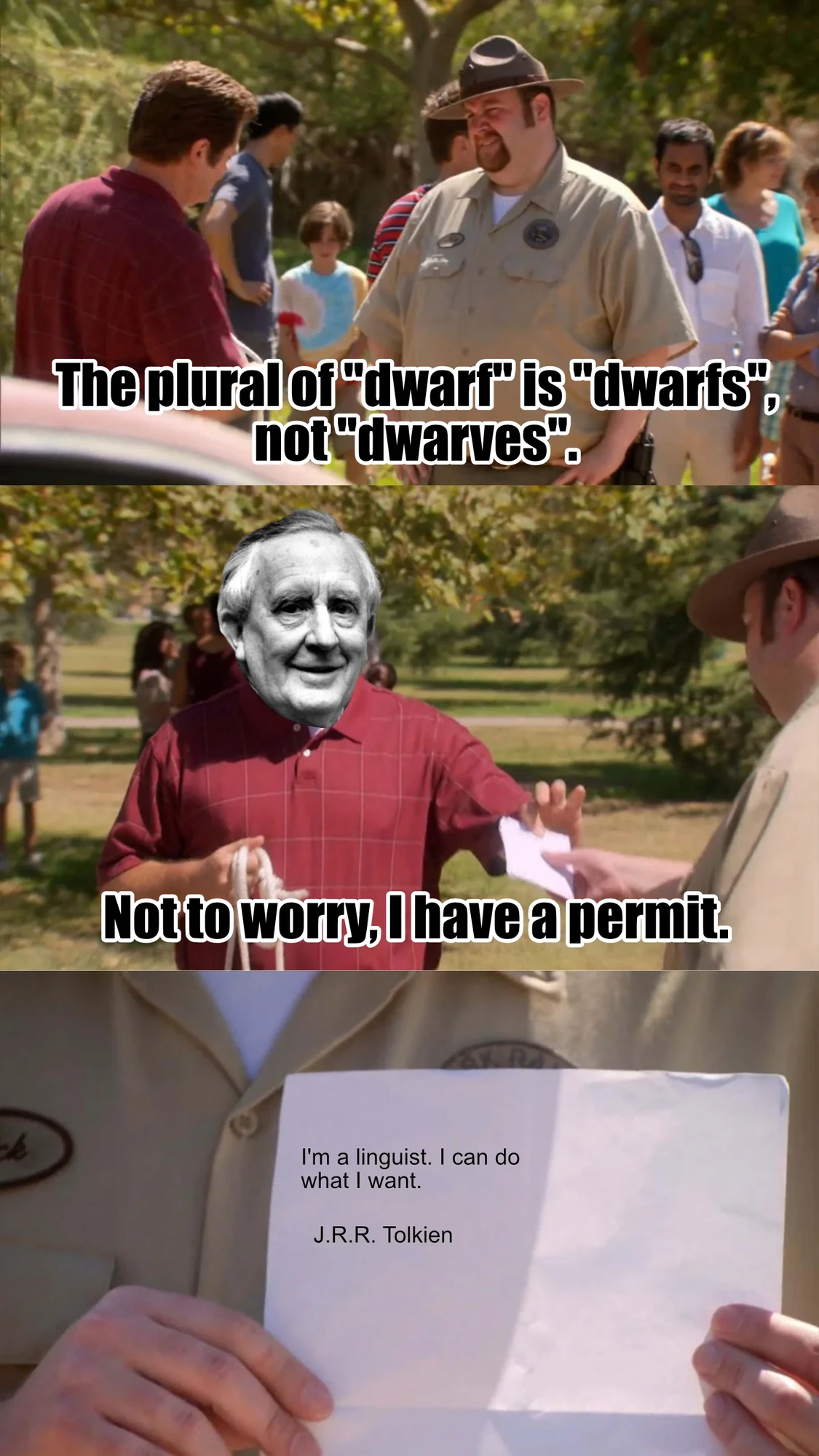
Edit: Also, Tolkien is like 50% of why I became a linguist.
That was an excellent writeup. If this were Reddit, I would have given you Reddit Gold.
I can't find any Lemmy Gold, so here's a Gold Lemmy.