Title text:
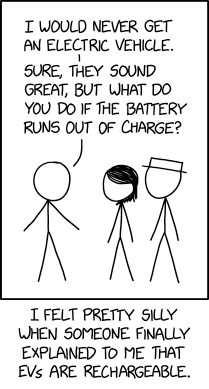
Now that I've finally gotten an electric vehicle, I'm never going back to an acoustic one.
Transcript:
Transcript will show once it’s been added to explainxkcd.com
Source: https://xkcd.com/3214/
A community for a webcomic of romance, sarcasm, math, and language.
Title text:
Now that I've finally gotten an electric vehicle, I'm never going back to an acoustic one.
Transcript:
Transcript will show once it’s been added to explainxkcd.com
Source: https://xkcd.com/3214/
Real world studies are showing they last about an average of 12-15 years on average, and every manufacturer has a warranty for at least 8 years, with many up to 10.
The typical passenger gas station pump flows at 7.9 gallons per minute. For most passenger cars and trucks, with tanks between 15 and 35 gallons, that's about 2-5 minutes of pumping.
A typical level 3 charger will take a battery from 10% to 80% in about 25 minutes. And chargers can be in places where gasoline pumps can't be, like ordinary parking lots and garages. So the dual purpose parking where you can charge the car while you shop at the grocery store or work out at the gym or sleep overnight at home is just a completely different paradigm from what we're used to.
The average car lasts about 12 years, by the way. EVs last basically as long as ICE vehicles. Which also makes sense, because it doesn't have to mix the fluids that lubricate and cool with combustion residue and foul up the engine that way.
So your data is out of date, and those fears that were commonly cited in 2015 have pretty much proven to be false for the technology that was around in 2015. Now, in 2026, there's been even more advances in managing battery/charging health and chemistry, with more of an infrastructure for maintenance, repair, and charging.
And that's a problem for ppl who buy 20 year old cars.
Yes, you are right, I take back my "converting gas pumps into EV chargers", that situation can be solved by having more charge points in other places, unfortunately, as things are know, I know from an EV drive himself that it's almost impossible to find a free charger at least where I live.
I guess that greatly depends on where you live, since you said "gallons" before I'm assuming US, at least here few people I know can afford a 12 years old car.
that's the average, some will last longer than that
So if you're in a country where it's economically feasible to continue maintaining cars beyond 15 years, why wouldn't you think that the much cheaper electric cars wouldn't dominate the market even more?
Compared to the U.S.'s low adoption rates, EVs sell at higher rates in certain rich countries like Norway and Denmark, middle income countries like China and Turkiye, and poor countries like Estonia and Nepal. The cheapest EVs, globally, are cheaper than the cheapest ICE vehicles.
The cost of maintaining a car to last 20 years can be applied to EVs and ICE cars alike. I suspect that EVs will be easier to maintain to those ages. In the U.S., that doesn't really happen in large part because our labor and parts network is expensive enough that buying new is comparably cheaper than repairing, past the 15 year mark, for most vehicles. EVs don't actually change the equation any.