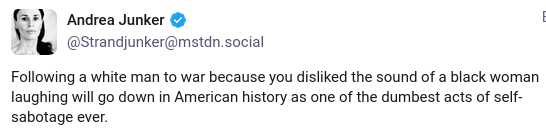
this post was submitted on 28 Feb 2026
343 points (100.0% liked)
People Mastodon
420 readers
1 users here now
People tooting stuff. We allow toots from anyone and are platform agnostic (Mastodon, BlueSky, Twitter, Tumblr, FaceBook, Whatever)
founded 6 months ago
MODERATORS
you are viewing a single comment's thread
view the rest of the comments
view the rest of the comments
This is just factually false, and it's as simple as looking at the vote results to acknowledge. You can want to present it as a binary, but in reality, voters have many options beyond vote R or vote D.
I don't really know how else to address this for you. Maybe you saw or heard some NPR or wall street journal clip about strategic voting and that was formative for your understanding of how elections work. Regardless, it was wrong because in the real world, when we run real elections, not hypothetical ones, voters choose to do or not do a wide range of different things.
That's not wishful thinking. That's looking at results from real elections. You aren't addressing reality, you are moralizing about how you wish things were, but aren't.
The point is that your moralizing and insistence doesn't have any bearing on how voters actually behave. You have to base your strategy on how things actually are, in the real world, backed up with receipts from real elections.
Strategic voting as strategy is irrelevant if voters don't actually behave that way. You might claim then that American voters are stupid voters who vote against their own their own interests because they don't abide by your approach. Ok fine. Then they are that way. But then you also must acknowledge that your outline if how to win an election is flawed because American voters don't behave that way.
You want voters to vote better but they don't. You want voters to be smarter but they aren't. If you are advocating a strategy that requires voters to be both smarter and better than they are, what's the likelihood of it succeeding?
You can't "fix" voter behavior. You can only adapt the strategies you rely on to accommodate real voters. Advocating strategic voting doesn't do this and lives in the realm of puritanical moralizing.
That's it. It's all that matters. There was one path to winning the election and it was to get the candidate to change their policy in the most important issue of the election. There was no other path to victory for the Dems.
We agree that voters don't meet your moral standard. But if you are advocating for strategies that depend on voters being different than they are, its your fault when those strategies fail.
Are you Kamala Harris? If you are, Mamala, if I can call you Mamala, why didn't you change your stance on Gaza so that you could win the election?
I apologize for interpretating the word "you" to mean the word "you". If you mean to speak of "they", you can use language like "voters", or the "electorate", or the "unwashed masses", whatever you prefer. But when you use the word "you" in response to something I say, there is no other way for me to interpret that other than by assuming you are directing the statement at me.
If that was all that mattered, people would have voted for less genocide, rather than refusing to vote so they could say they didn't vote for genocide, when in fact they said they were fine with whatever the rest of the voting public went with, which was inevitably some degree of genocide. Certainly, voting for Trump in protest wasn't a vote against genocide.
I'm sorry that your grasp of the English language is lacking. In that case, you, which is always syntactically plural, was used to refer to a singular individual.