this post was submitted on 27 Feb 2026
485 points (99.2% liked)
ShermanPosting
243 readers
529 users here now
Where we meme (joking in tone and detail, serious in sentiment) about General Sherman, the Civil War, and how the secesh traitors had it coming.
RULES
-
No bigotry. The Union, or at least the part of the Union WE support, fought AGAINST that shite. We are anti-racist, anti-sexist, anti-homophobic, anti-transphobic, and in general anti-bigot here, even if not all the lads in Union blue uniforms were.
-
No Confederate sympathizing. Anti-democratic racist slaver traitors don't deserve shit.
-
Follow all Piefed.social rules
founded 7 months ago
MODERATORS
you are viewing a single comment's thread
view the rest of the comments
view the rest of the comments
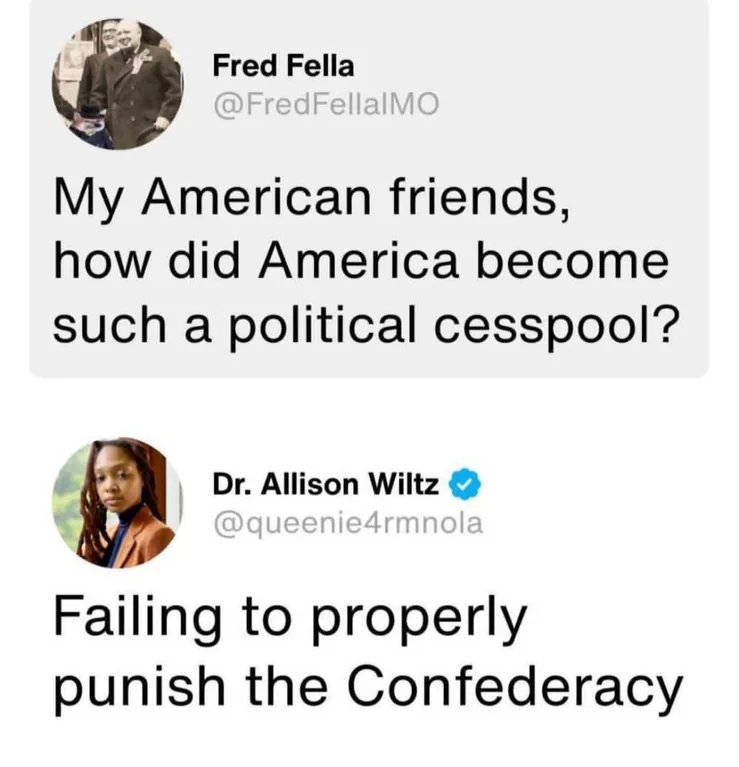
I hear this often, but I'm not really sure how to confidently square that assertion against Versailles, Morgenthau's memorandum and JCS 1067. I'm not saying it's wrong... only that if there is one thing history ISN'T lacking, it's conflict. I wish people would be specific and use historical templates, at least as a starting frame of reference. Some conflicts become cyclical, as every resolution merely sets the stage for the next. Some brutal conflicts are one-and-done.
What other historical resolutions does the end of the civil war most resemble? Which other historical resolutions are most similar to what people feel should have been applied to the south?
Versailles fell into the trap Machiavelli warned against - to injure an enemy, but not so greatly that you do not need to fear harm from him in the future.
The Morgenthau plan was morally unacceptable as it was effectively a sanctioned genocide, and rightly rejected.
The failure is in several parts, though all of which fed into each other:
The old elite of the Confederacy remained, and leveraged their social connections to restore their position of supremacy in the post-Reconstruction South.
The South was allowed to cultivate a post-Reconstruction cultural mythos glorifying slavery and the slaver cause amongst the common people.
The populations which were most resilient to the whole diseased regime, Black folk (on account of, well, knowing goddamn well they were the regime's scapegoat and underclass), were abandoned to the violence of white supremacist dominated state governments after Reconstruction.
The economic system of the US South did not fundamentally change, in part because of #1, remaining an aggressively agrarian society based on the leveraging of the grotesquely undervalued labor of tenant farmers for plantation owners, by the lack of alternatives available for said labor.
The solution is simple, but requires great political will.
Hang or expel the elite. Seize their property. Redistribute it. Eliminate ideologues from participation in public life. Reconstruct (ha) the economy according to the standards of the North and Midwest.
In pre-information age societies, the elite are the primary perpetuators of such cultural mythos. With their absence, the 'Lost Cause' is greatly weakened - not to mention they don't get to spend a century shitting up academia. With the seizure of their property, their kin lack recourse to regain the status of elites. By redistribution of the land, friendly demographics are given firmer economic grounding and influence in their communities. By eliminating prior ideologues of the old regime from participation in public life, a major transmission vector for thinly-cloaked revanchism is extinguished. By the reconstruction of the economy, the essential material conditions which enabled the pseudo-aristocracy is eliminated.
If I'm reading this right, there wasn't an analogue to Nuremberg or the Argentinian exodus? (Or, as I think about it, the anti-nazi-symbols laws?)
Partly - many Confederates fled the country for Brazil. However, this wasn't so much predicated on the punishments the US government was willing to hand out so much as a mixture of spite/prejudice and a desire to keep their 'movable property' (read: slaves). Brazil still allowed slavery at that time.
The US never seriously considered mass hangings, forced exile, or land seizures from the elites. Even the most famous (and sadly aborted by that traitor Andrew Johnson) redistribution plan, '40 acres and a mule', was predicated on seizures performed during wartime and as with the justification of a failure to pay taxes. There was no stomach to simply dispossess the mass of post-war Southern elites of their land, neither in the Northern elite nor the Northern farming class. The only punishment that was decisively levied, the elimination of former Confederate involvement from civic life (barred from office and barred from voting), was also lifted by that traitor, Andrew Johnson.
Even the highest ghouls, including Jefferson Davis, the literal president of the CSA, were never convicted for their crimes, much less punished.